
Why are your collectors still spending hours manually dialing accounts that just need a quick due-date reminder? When customer records and billing data live in separate silos, manual outreach inevitably leads to missed payments, higher delinquency, and costly charge-offs. Dealerships operate one business but are often forced to manage it through disconnected systems. Implementing modern automatic payment notifications tied directly to live loan records can bridge this gap, replacing phone tag with timely digital touchpoints that prompt fast borrower action.
You already know that keeping portfolios current shouldn’t require expanding staff headcount or burning out your team on routine calls. In this guide, discover how automated payment notifications streamline auto loan collections, help minimize delinquency, and unify borrower communication within one connected platform. We will explore how unified loan data can eliminate manual collection tasks, strengthen cash flow predictability, and provide borrowers with convenient digital payment options.
Key Takeaways
- Discover how automatic payment notifications shift auto lenders from reactive collection calls to proactive, multi-channel touchpoints across the entire vehicle loan lifecycle.
- See why real-time data synchronization between your DMS and LMS prevents awkward payment reminders from being sent to already settled accounts.
- Examine operational strategies for managing outreach frequency and borrower preferences to help reduce communication risk and improve borrower responsiveness.
- Evaluate the hidden operational overhead of bolting standalone messaging plug-ins onto legacy systems versus running a connected operating architecture.
- Learn how controlled AI agents can support servicing teams by automating routine payment reminders, task scheduling, and account status alerts.
Understanding Automatic Payment Notifications in Auto Finance
Automobile retail servicing requires precision timing. In auto lending, automatic payment notifications represent programmatic, event-based alerts sent across multiple digital channels to guide borrowers through their installment obligations. Unlike standard enterprise software that simply delivers a digital receipt after funds clear, collateralized retail auto finance requires continuous engagement across the entire loan lifecycle. Dealerships operate one business but are often forced to manage it through disconnected systems. When your collection tools do not talk to your servicing records, team members resort to manual telephone calls. This creates friction, drains staff hours, and stalls portfolio cash flow.
Transitioning from manual calls to structured digital alerts gives Buy-Here-Pay-Here (BHPH) operators and finance teams better control over portfolio performance. Proactive outreach meets borrowers where they are, replacing adversarial debt calls with routine, self-service digital prompts.
The Core Mechanics of Automated Payment Messaging
Modern loan engines rely on clear operational triggers rather than static calendar reminders. Automated messaging workflows typically activate around three critical milestones:
- Pre-Due Date Reminders: Dispatched three to five days before payment maturity, giving borrowers notice to verify available account funds.
- Transaction Processing Updates: Instant confirmation sent when a recurring charge or pre-authorized debit (PAD) completes successfully.
- Grace Period and Past-Due Alerts: Escalated prompts triggered the day after a missed due date, containing direct links to cure delinquency immediately.
Direct communication via SMS text and transactional email ensures high open rates. When these touchpoints draw real-time balance calculations directly from connected auto finance software, borrowers always see their exact balance due, including any applicable late fees.
Why Traditional Collection Call Workflows Fall Short
Dialing past-due accounts by hand is expensive and inefficient. Borrowers routinely ignore calls from unfamiliar numbers, forcing servicing personnel to leave repeated voicemails that rarely yield return payments.
Disconnected architecture worsens the issue. When an independent DMS or standalone messaging plug-in fails to sync instantly with the loan management system (LMS), staff end up calling borrowers who already settled their accounts hours earlier. These disjointed interactions damage customer trust and waste collector bandwidth. Proactive, automated notification channels help eliminate administrative overhead, giving servicing teams clear visibility while offering borrowers frictionless, convenient payment options.
Essential Components of High-Performing Notification Systems
A reliable notification engine requires deep architectural integration across your entire lending workflow. Effective automatic payment notifications do not function as standalone text blasts. Instead, they synchronize loan balances, payment gateways, and accounting ledgers in real time. Organizations seeking a unified omni-channel platform to accept payments across mobile, web, and in-person channels can discover Strictly to enhance their transaction processing. When these systems connect directly, dealerships eliminate redundant data entry across distinct platforms while maintaining accurate transaction histories across every account.
Dynamic Data Merge and Channel Orchestration
Generic payment notices are easily ignored. High-performing notifications pull live variables straight from the LMS to provide clear account visibility. Merging specific details, such as vehicle make and model, exact balance amounts, and scheduled due dates, builds trust and clarifies the request.
Timing and channel selection are equally critical. SMS messages often generate immediate engagement, making them practical for time-sensitive alerts, while transactional emails provide reliable records for loan documentation. Structuring your schedule into a predictable cadence allows the dealership to guide borrower behavior effectively:
- Five Days Prior: A friendly notification reminding the customer of their upcoming installment date.
- Due Date Morning: A direct prompt confirming payment execution or requesting payment submission.
- Grace Period Follow-Up: A polite reminder designed to resolve late payments before contractual delinquency triggers.
Embedded Frictionless Payment Capabilities
Every additional step in the payment process increases the risk of borrower abandonment. High-performing notification engines use secure, tokenized deep links that direct borrowers straight to a mobile checkout page without requiring complex portal logins. Offering versatile payment methods, such as ACH bank transfers, debit cards, and credit cards, helps reduce collection delays.
Under federal lending guidelines, the precise timing of crediting a payment as of the date received is critical for portfolio accuracy. Integrated payment processing ensures that once a borrower completes a transaction, the general ledger updates immediately, closing out the notification workflow without manual reconciliation.
Deploying mobile-responsive interfaces and self-service touchpoints supported by advanced AI platform capabilities can help lenders handle routine servicing automatically. If disjointed tools are slowing down your collection workflows, you can connect with our team to see how unified data simplifies payment operations.
Mitigating Portfolio Risk and Maintaining Regulatory Oversight
Automating borrower contact brings efficiency, but uncoordinated messaging introduces real operational exposure. Sending payment alerts without strict controls can trigger consumer disputes, carrier filtering, and expensive regulatory scrutiny. Federal guidelines under CFPB Regulation F restrict communication frequency, while Telephone Consumer Protection Act (TCPA) penalties range from $500 up to $1,500 per willful violation. Major mobile carriers also block unregistered commercial traffic under mandatory A2P 10DLC rules. Establishing controlled automatic payment notifications backed by unified data allows the dealership to manage these operational risks while keeping collection outreach steady.
Siloed communication tools often fail because they track consent separately from the main loan record. Auto finance compliance management requires an operating architecture where messaging rules, customer profiles, and loan statuses remain continuously aligned.
Consent Tracking and Opt-Out Management
Proactive messaging depends entirely on verifiable consent. Auto finance software should capture and document express written consent during loan origination before any automated servicing alerts go out. When a borrower replies with standard opt-out keywords like STOP, the system must process that revocation immediately across every channel.
Relying on collectors to manually update phone numbers across separate platforms invites human error. Controlled automation is designed to enforce contact parameters automatically, honoring borrower channel preferences, time-of-day restrictions, and frequency limits without impeding your team’s daily collection workflow.
Audit-Ready Logging and Data Protection
Auditors and regulators evaluate process traceability. If a borrower disputes receiving a payment alert or questions a late fee, lenders need immediate access to time-stamped communication records. A connected platform logs every outgoing text, email, and borrower interaction against the master loan ledger.
Data security is just as essential when transmitting financial records and embedded payment links. Verifacto maintains a SOC II certified data security architecture to safeguard sensitive consumer information across the servicing cycle. Centralizing loan records and communication histories into a unified operating structure provides greater visibility into portfolio health while helping protect your dealership from preventable operational risk.
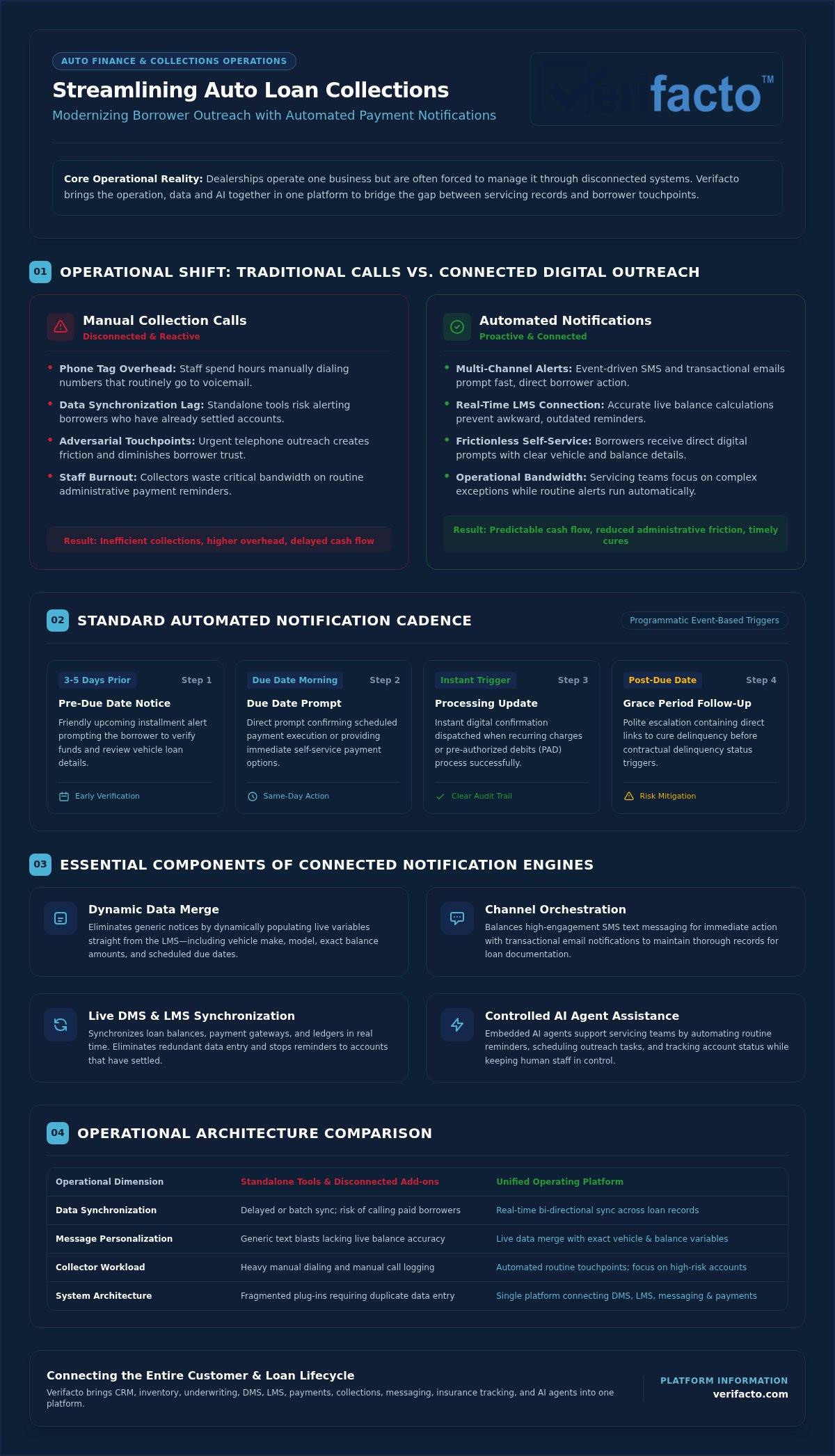
Comparing Standalone Tools Against Unified Operating Platforms
Dealerships operate one business but are often forced to manage it through disconnected systems. Verifacto brings the operation, data and AI together in one platform to eliminate these operational silos. When lenders bolt third-party texting utilities onto isolated DMS applications, communication breakdowns quickly follow. Asynchronous data synchronization creates costly delays between when a borrower submits funds and when external tools register that transaction. Deploying automatic payment notifications through fragmented add-ons often results in embarrassing collection mistakes that erode customer goodwill and drain team resources.
The Inefficiencies of Fragmented Notification Plugins
Managing standalone communication plug-ins forces staff into repetitive administrative cycles. Servicing teams lose hours each week manually exporting customer spreadsheets from the DMS, uploading them into third-party portals, and reconciling payment statuses by hand.
Latency between siloed applications creates severe customer friction. If a borrower makes an in-store or online payment at 9:00 AM, but the batch sync doesn’t run until noon, a disconnected messaging plugin might fire an aggressive past-due alert at 10:00 AM. Sending payment demands to already settled accounts frustrates borrowers, triggers preventable inbound dispute calls, and piles on unnecessary per-message carrier fees.
The Strategic Advantage of Unified DMS and LMS Platforms
Operating from a connected dealer and loan management architecture changes the dynamic entirely. When your payment gateway, LMS, and messaging tools share a live data foundation, transaction events instantly resolve balances across the entire customer record. The moment a transaction clears, automated collection sequences pause immediately, preventing awkward reminders.
Delivering automatic payment notifications from an integrated platform allows the dealership to maintain clean financial records through seamless accounting synchronization with QuickBooks. Servicing teams gain complete visibility into portfolio health without toggling between disconnected software. To see how unified data brings clarity to your servicing workflows, book a demonstration to explore how the platform fits your business.
Transforming Collections With Intelligent Operational Automation
Dealerships operate one business but are often forced to manage it through disconnected systems. Verifacto brings the operation, data and AI together in one platform, replacing fragmented servicing tactics with coordinated operational intelligence. Instead of requiring collectors to review spreadsheets and manually queue text blasts, controlled AI models access connected servicing data to trigger timely touchpoints. Implementing intelligent automatic payment notifications allows the dealership to resolve routine payment delays early while freeing staff to concentrate on complex, high-risk accounts.
Automated Lifecycle Engagement and Risk Escalation
Servicing risk rarely happens in isolation. A missed auto installment frequently correlates with lapses in vehicle insurance coverage, exposing dealerships to unmitigated collateral loss. Verifacto uses purpose-built operational agents to connect these data points in real time. The AI Operational Assistant is designed to monitor account activity, automatically scheduling customized reminders and assigning specific follow-up tasks to staff when accounts show early distress.
Controlled automation coordinates payment schedules with collateral protection insurance (CPI) tracking. When an account defaults or insurance drops, the system triggers coordinated alerts across borrower channels. These unified workflows also connect front-end deal structuring to servicing, where modules like the AI sales agent ensure borrower communication preferences and contact details are captured accurately from day one. Servicing teams retain full supervisory authority, while AI agents handle routine administrative execution.
Deploying Modern Notification Workflows in Your Operation
Modernizing your loan servicing model does not require an operational overhaul overnight. Dealerships and finance companies can establish reliable notification workflows by taking a structured approach:
- Audit Existing Touchpoints: Review current communication channels, manual collector outreach hours, and payment processing friction points to identify where revenue leakage occurs.
- Map Notification Cadences: Establish rule-based schedules for pre-due alerts, payment execution receipts, and grace-period reminders aligned with borrower pay schedules.
- Unify Core Infrastructure: Connect your DMS, LMS, payment processing, and collections data into a single operating architecture to eliminate data discrepancies and manual sync errors.
- Activate Controlled Automation: Deploy AI agents to execute automatic payment notifications, flag collateral risks, and support human decision-making.
Ready to modernize your loan lifecycle and streamline collections? Book a demonstration to explore how the platform fits your business.
Modernize Your Auto Loan Collections Architecture
Replacing manual collection phone tag with connected automatic payment notifications transforms loan servicing from a reactive scramble into a predictable operation. When alerts link directly to live loan records, your team doesn’t waste time sending awkward reminders to accounts that have already settled. Proactive, multi-channel touchpoints provide borrowers with the convenient digital options they expect while helping reduce delinquency risk across your portfolio.
Verifacto brings your entire servicing lifecycle into balance. Built on a SOC II certified data security architecture with a 99.99% system uptime guarantee, the AI-driven operating platform unifies DMS, LMS, payments, and insurance tracking under one roof. Controlled automation is designed to support your staff’s judgment, eliminating administrative friction so collectors can focus on accounts that truly require personal attention. Book a demonstration to explore how the platform fits your business.
Frequently Asked Questions
What are automatic payment notifications in auto loan servicing?
Automatic payment notifications are event-driven digital alerts delivered via SMS text or email to guide borrowers through their installment schedules. Rather than relying on staff to dial accounts manually, these system-generated touchpoints trigger before due dates, confirm recurring debits, and alert customers to past-due balances. When tied to live portfolio data, they provide borrowers with direct links to review balances and submit payments quickly.
How do automated SMS notifications help reduce auto loan delinquency?
Automated SMS messages can help reduce delinquency by delivering timely, convenient touchpoints straight to a borrower’s mobile device. Most consumers ignore unexpected phone calls, but text messages yield high read rates. Embedding secure payment links into these alerts allows borrowers to cure balances immediately via debit card or bank transfer, resolving late accounts before they progress into costly default or repossession workflows.
Can automatic payment notifications integrate directly with my dealership management system?
Yes, modern solutions connect messaging directly with your core operations. In Verifacto’s unified operating platform, dealership management tools, loan servicing software, and payment processing share a single data engine. This architecture ensures that automatic payment notifications instantly reflect balance changes, payoff amounts, or schedule adjustments without requiring manual spreadsheet exports or batch uploads across disparate third-party applications.
Are automated text and email payment reminders compliant with lending regulations?
Automated reminders can support operational alignment with rules like the TCPA and CFPB Regulation F when configured properly. The system is designed to record express written consent during origination, enforce contact frequency parameters, and immediately process opt-out keywords like STOP. Centralized audit logging tracks every outgoing transmission with immutable timestamps, though lenders should always review specific outreach procedures with their own legal counsel.
What happens when a customer makes a payment after receiving an automated reminder?
When a borrower completes a transaction, a connected operating platform logs the payment in real time. The general ledger updates instantly, which automatically stops subsequent collection notifications and cancels scheduled staff follow-up tasks. This real-time synchronization prevents sending awkward past-due notices to accounts that are already current, protecting customer trust while keeping financial records synchronized with your accounting software.
How do automated notifications handle lapsed borrower auto insurance or CPI requirements?
A connected platform monitors active insurance coverage alongside installment payment schedules. If borrower coverage lapses, the system can trigger automated alerts prompting the customer to upload updated policy details. If verification fails, the platform supports the placement of Collateral Protection Insurance (CPI) and adjusts the monthly billing balance accordingly, alerting the borrower to the updated installment amount through their preferred communication channel.