
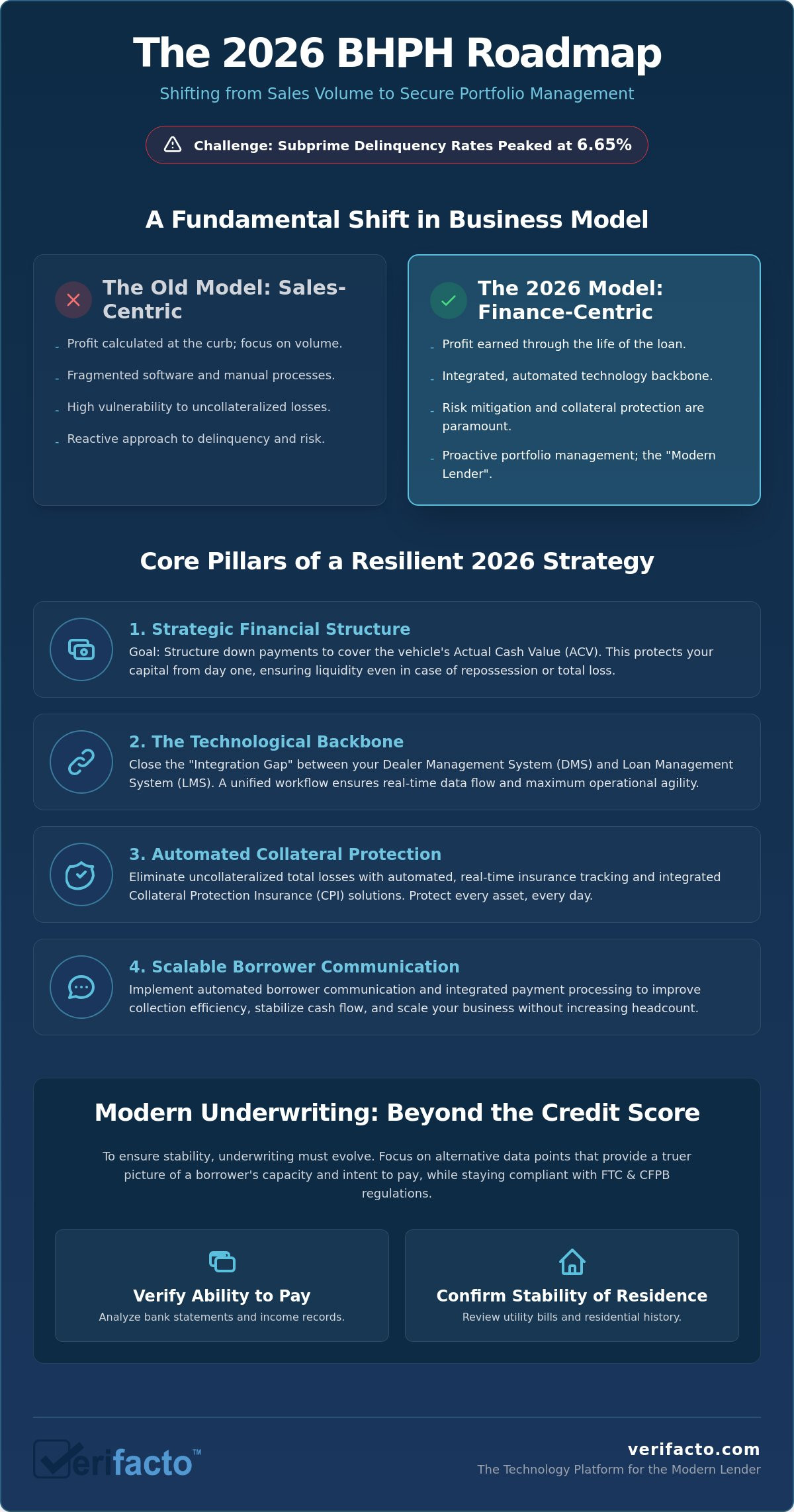
With subprime delinquency rates peaking at 6.65% recently, the margin for error in independent auto finance has vanished. You likely feel the daily pressure of managing fragmented software systems while manually chasing insurance renewals just to keep your collateral protected. It’s an exhausting cycle that limits your ability to scale and leaves your assets vulnerable. Your buy here pay here business plan 2026 must move beyond simple vehicle sales and pivot toward a disciplined, technology-driven portfolio management strategy.
We understand the professional anxiety that comes with record-high delinquencies and tightening regulatory scrutiny. This roadmap promises to replace those manual hurdles with a streamlined, automated approach to profitability. You’ll learn how to integrate your DMS and LMS for a unified workflow, implement real-time insurance tracking, and use automated borrower communication to stabilize your cash flow. We will show you how to master the 2026 landscape by focusing on risk mitigation and collateral protection, giving you the tools to grow your business with absolute confidence and security.
Key Takeaways
- Shift your operational focus from volume-based vehicle sales to a risk-first portfolio management model to survive 2026’s economic volatility.
- Discover how to structure down payments to cover the vehicle’s Actual Cash Value (ACV) to protect your capital from the moment the contract is signed.
- Modernize your operations by closing the “Integration Gap” between your DMS and LMS to ensure real-time data flow and operational agility.
- Build a buy here pay here business plan 2026 that prioritizes automated insurance tracking and CPI solutions to eliminate uncollateralized total losses.
- Implement automated borrower communication and integrated payment processing to improve collection efficiency and scale your business without increasing headcount.
The 2026 BHPH Landscape: Shifting from Sales to Portfolio Management
The 2026 market demands a fundamental shift in how you view your dealership. For decades, profit was calculated at the curb; today, profit is earned through the life of the loan. A successful buy here pay here business plan 2026 treats every vehicle sale as the beginning of a financial relationship rather than the end of a transaction. With 60-day subprime delinquency rates reaching a high of 6.65% recently, the traditional volume-based model is no longer sustainable. If your strategy relies on simply moving inventory without a rigorous focus on loan performance, you’re essentially gambling with your capital.
The “Modern Lender” persona is the new standard for independent dealers. This persona prioritizes data over intuition and automation over manual effort. Instead of chasing sales targets, successful operators now focus on collection efficiency and collateral protection. They recognize that they’re financial institutions that happen to sell cars. This mindset shift is the only way to navigate a market defined by high interest rates and increased regulatory oversight from bodies like the FTC and CFPB. You need a plan that protects your assets while providing the flexibility your borrowers require.
Why Your 2026 Plan Must Be Finance-Centric
The core of the Buy Here Pay Here business model has always been in-house financing, but 2026 requires a deeper commitment to loan servicing. Rising vehicle acquisition costs have squeezed margins. You can’t afford to lose a single unit to uncollateralized losses. A “Loan Servicing” mindset focuses on maximizing the long-term value of the portfolio rather than the quick gross profit of an individual sale. It requires implementing strict underwriting that accounts for the 25% average interest rates common in subprime lending. High-yield portfolio management is the only path to maintaining healthy cash flow when inventory costs remain elevated.
Economic Pressures and Borrower Vulnerability
Inflation and volatile fuel costs continue to strain the repayment capacity of the subprime demographic. Your buy here pay here business plan 2026 must account for the fact that your borrowers are more vulnerable than ever. “Deep Subprime” risks, often seen in borrowers with credit scores below 580, require a more proactive communication strategy. When a borrower faces a financial crunch, your automated systems must ensure your payment remains their top priority. Stability in your portfolio doesn’t happen by accident; it’s the result of identifying these vulnerabilities early and using technology to mitigate the risk of default before it becomes a repossession.
Core Pillars of a Successful BHPH Financial Strategy
Your financial foundation determines whether your dealership thrives or merely survives in a high-risk environment. A robust buy here pay here business plan 2026 must prioritize liquidity and capital recovery over raw sales volume. In a market where average interest rates for subprime borrowers hover around 25%, your ability to manage the cost of capital is paramount. You aren’t just selling a vehicle; you’re managing a high-yield, high-risk loan portfolio that requires constant monitoring and precise financial engineering.
One of the most critical metrics in your 2026 strategy is the “Cash-in-Deal” ratio. To maintain a healthy cash flow, your goal should be to structure down payments that cover the vehicle’s Actual Cash Value (ACV). When you collect the cost of the car upfront, you’re only risking your profit margin, not your operating capital. This approach ensures that even in the event of a total loss or repossession, your business remains liquid and capable of “recycling” that capital into new inventory. Setting realistic charge-off targets is also essential. Given the recent 6.65% delinquency rates, your plan should account for a higher-than-average loss provision to avoid unexpected cash crunches.
Underwriting for Stability, Not Just Approval
Modern underwriting has evolved past basic credit scores. Since traditional scores often fail to capture the full picture of a subprime borrower, your 2026 plan should incorporate alternative data points. Focus on “Ability to Pay” by verifying bank statements and “Stability of Residence” through utility bill histories. It’s also vital to stay compliant with evolving FTC regulations for auto dealers, which now place a heavier emphasis on pricing transparency and data protection. Implementing tiered interest rates allows you to reward lower-risk borrowers while protecting your margins against higher-risk profiles.
Cash Flow Management and Capital Recovery
Effective management of your receivables is what keeps the lights on. You can find proven strategies for improving BHPH cash flow management by automating your payment reminders and diversifying your collection methods. In a high-interest rate environment, the speed of capital recovery is just as important as the interest earned. If your capital is tied up in non-performing assets, you can’t take advantage of market opportunities. By refining your collection process, you ensure that every dollar works harder for your bottom line. To see how these strategies look in practice, you might consider how integrated payment processing can reduce manual errors and accelerate your daily deposits.
Integrating Modern DMS and LMS: The Technological Backbone
Your financial strategy is only as strong as the tools you use to execute it. In the past, dealers could get by with spreadsheets and standalone programs, but that approach is a liability in 2026. The “Integration Gap” between your sales software and your servicing software is a primary source of uncollateralized losses. When your Dealer Management System (DMS) doesn’t communicate with your Loan Management System (LMS), critical data like insurance status or payment history falls through the cracks. A modern buy here pay here business plan 2026 must eliminate these silos to ensure every department operates from a single source of truth.
Eliminating manual entry is the first step toward operational security. By integrating your systems, you ensure that data flows seamlessly from the initial sale to the final payment. This reduces the risk of human error and provides a clear, real-time view of your portfolio’s health. You need to know exactly how your assets are performing at any given moment, not weeks after a payment was missed.
The Synergy of Integrated DMS and LMS
Integration means that as soon as a deal is finalized in the DMS, the borrower’s record is automatically populated in the LMS. This seamless data transfer eliminates the need for double entry, which is where most expensive errors occur. By centralizing borrower records, you simplify the auditing process and ensure you’re always prepared for regulatory reviews. It’s not just about convenience; it’s about reducing overhead by cutting redundant software subscriptions and freeing up your staff to focus on high-value tasks like collections and risk management.
Implementing a specialized auto loan management software is no longer optional for modern lenders. It provides the real-time visibility you need to conduct proactive portfolio health checks. Instead of waiting for a payment to be 30 days late, you can identify patterns of delinquency early and intervene. This proactive approach is the cornerstone of a risk-first model, allowing you to protect your liquidity and keep your capital recycling efficiently.
Cloud-Based Scalability for Independent Dealers
Cloud-based systems offer the agility required to manage a portfolio in a volatile market. The 2026 “Mobile Dealer” model allows you to monitor your business from any device, ensuring you’re never disconnected from your assets. These platforms handle automated updates, which is critical for staying current with auto finance compliance management. As regulations change, your software adapts automatically, shielding you from the risk of non-compliance.
Cloud storage also provides superior data security and disaster recovery compared to on-site servers. It keeps your sensitive borrower data protected and ensures your buy here pay here business plan 2026 remains operational regardless of local hardware failures or office disruptions. Reliability is the foundation of borrower trust and business stability.
Collateral Protection: Real-Time Insurance Tracking and CPI
Uninsured total losses represent the single greatest threat to your dealership’s liquidity. When a borrower lets their coverage lapse and the vehicle is totaled, you’re left with a worthless asset and a defaulted loan. A modern buy here pay here business plan 2026 must treat insurance as a dynamic variable that requires constant oversight, not a one-time check at the point of sale. Relying on paper binders or manual phone calls creates a dangerous vulnerability that your portfolio simply can’t afford.
Automating insurance verification for car loans involves three critical steps. First, integrate your system with live carrier data to confirm active coverage before the keys are handed over. Second, establish a 24/7 monitoring protocol that alerts you the moment a policy is canceled or changed. Third, use automated notifications to remind borrowers of their obligation to maintain insurance. This proactive approach ensures your collateral remains protected without requiring your staff to spend hours on the phone with insurance agents. It shifts the burden of proof from your team to the technology.
The High Cost of Manual Insurance Monitoring
Manual monitoring is a 20th-century bottleneck that drains your resources. When your team has to call agents manually, they’re only catching lapses after they happen. This creates a “Coverage Gap” where your asset is completely unprotected for days or even weeks. In 2026, real-time tracking is essential because it eliminates this window of risk. By automating the follow-up process, you reduce staff hours and allow your team to focus on resolving actual delinquencies rather than administrative data entry.
CPI as a Risk Mitigation Powerhouse
When a borrower fails to provide proof of insurance, Collateral Protection Insurance (CPI) serves as your financial safety net. CPI allows you to place coverage on the vehicle to protect your interest as the lienholder. This isn’t just about security; it’s about maintaining the integrity of your portfolio. Your system should automatically trigger “Force-Placed” protocols when a lapse is detected, following state-specific CPI regulations to ensure compliance. This automation removes the guesswork and ensures that every vehicle in your fleet is covered, regardless of the borrower’s actions.
To secure your assets against uncollateralized losses, you can explore how Verifacto’s insurance tracking solutions integrate directly into your 2026 operational strategy.
Executing Your Plan with Verifacto: Automation and Profitability
A strategic roadmap is only as effective as the tools used to implement it. Verifacto serves as the central engine for your buy here pay here business plan 2026, providing a single pane of glass to manage every operational hurdle. By consolidating your DMS and LMS into a unified platform, you gain total mastery over your portfolio. You can stop reacting to crises and start managing for growth with the confidence that your assets are protected and your workflows are optimized for maximum profitability. This isn’t just about software; it’s about giving you the control needed to navigate a high-risk environment with absolute precision.
Achieving operational excellence requires a move away from manual, time-consuming tasks that invite human error. Verifacto automates the heavy lifting of loan servicing, from insurance tracking to payment processing. This automation ensures that your business remains scalable and resilient, regardless of market shifts. By leaning on a sophisticated system designed for the practical realities of 2026, you protect your margins and secure your professional peace of mind.
Automated Communication: The Modern Collection Tool
Frictionless communication is the heartbeat of a healthy loan portfolio. With Verifacto, you can improve collection efficiency by using automated text and email triggers. These aren’t just simple reminders; they’re strategic touchpoints designed to prevent delinquencies before they occur. You can personalize outreach at scale, ensuring every borrower feels supported without adding a single person to your headcount. Every interaction is automatically documented, creating a bulletproof audit trail that satisfies regulatory compliance requirements and protects your dealership from legal vulnerabilities.
Built-in Payments: Removing the Barrier to Recovery
Payments should be the easiest part of the borrower’s experience. Verifacto’s built-in payment processing removes the typical barriers to recovery by offering borrowers multiple ways to pay, including online portals, ACH, and mobile options. When you provide real-time digital choices, you effectively eliminate the classic “check is in the mail” excuse. These integrated payments provide instant ledger updates, so your data is always current. This level of speed and transparency is essential for maintaining liquidity and ensures your buy here pay here business plan 2026 stays on track for long-term success. By reducing the friction of the payment process, you maximize your recovery rates and stabilize your monthly cash flow.
Future-Proof Your Dealership for 2026 and Beyond
Success in the coming years requires more than just moving inventory; it demands a total commitment to automated risk management and operational precision. By shifting your focus from short-term sales to long-term portfolio health, you ensure your capital remains recycled and protected. Integrating your DMS and LMS eliminates the dangerous data gaps that lead to uncollateralized losses, while real-time insurance tracking provides a constant safety net for your most valuable assets. Implementing a robust buy here pay here business plan 2026 allows you to scale with confidence, knowing your collections are efficient and your compliance is secure.
Verifacto provides the mastery you need over these complex challenges through a single, integrated platform. You can leverage real-time insurance tracking, automated CPI solutions, and proactive borrower communication tools to boost your profitability without increasing your workload. It’s time to move past manual bottlenecks and embrace a technology-driven strategy that prioritizes security and growth. Automate your 2026 BHPH business plan with Verifacto today and take the first step toward a more stable, profitable future. You have the tools to thrive; now is the time to use them.
Frequently Asked Questions
What is the most important part of a BHPH business plan in 2026?
The most important part of a buy here pay here business plan 2026 is a risk-first portfolio management strategy. In a high-delinquency market, you must prioritize collection efficiency and collateral protection over raw sales volume. Your plan should focus on high-yield returns and capital recycling to ensure you maintain liquidity. By treating your dealership as a financial institution first, you can navigate economic volatility with greater stability and control.
How much capital do I need to start a BHPH dealership in today’s market?
Starting a dealership in today’s market requires enough capital to cover vehicle acquisition costs, operating expenses, and the “cash-in-deal” for your initial loans. While specific amounts vary by location and scale, you should have enough liquid capital to sustain your portfolio through the first several months of collections. Rising inventory costs mean your initial investment must be more robust than in previous years to ensure you can cover the actual cash value of your units.
Is BHPH still profitable with 6% delinquency rates?
Profitability is still achievable with delinquency rates at 6.65% if you implement strict underwriting and high-yield interest structures. Many successful dealers charge an average interest rate of approximately 25% to offset the risks associated with subprime lending. The key is to minimize loss severity through automated collateral protection and efficient recovery processes. When you protect your assets effectively, your high-performing loans more than compensate for the industry-standard delinquency levels.
Can I manage a BHPH portfolio without specialized software?
Managing a modern portfolio without specialized software is nearly impossible and exposes your business to significant operational risk. Manual tracking leads to errors in payment ledgers and insurance verification, which can result in uncollateralized losses. Specialized tools like an integrated DMS and LMS provide the real-time data needed to make informed decisions and stay compliant. Without these systems, you won’t have the agility required to survive in a technology-driven market.
How does automated insurance tracking reduce my charge-off rate?
Automated insurance tracking reduces your charge-off rate by eliminating the “coverage gap” between policy cancellation and your discovery of the lapse. It provides 24/7 monitoring that alerts you the moment a borrower loses coverage, allowing you to intervene before a total loss occurs. By ensuring every vehicle is continuously insured, you prevent catastrophic financial hits that typically lead to loan charge-offs. This proactive protection is essential for maintaining a healthy bottom line.
What are the biggest compliance risks for BHPH dealers in 2026?
The biggest compliance risks in 2026 involve FTC enforcement on pricing transparency and CFPB rules regarding consumer financial data access. You must ensure your “all-in pricing” is accurate and that your data sharing practices align with Section 1033 requirements. Additionally, staying within state-specific interest rate caps, such as those set by the Texas Office of Consumer Credit Commissioner, is vital. Failure to automate your compliance management can lead to severe legal penalties and reputational damage.
How do I handle a borrower who lets their insurance lapse?
When a borrower lets their insurance lapse, you should immediately trigger your “force-placed” insurance protocols. This involves notifying the borrower of the lapse and placing Collateral Protection Insurance (CPI) on the vehicle to safeguard your interest as the lienholder. Automation makes this process seamless by placing the coverage and adding the premium to the loan balance without manual staff intervention. It ensures your collateral is never left vulnerable to uninsured accidents or theft.
Why is an integrated DMS/LMS better than using two separate systems?
An integrated DMS/LMS is superior because it eliminates the “Integration Gap” where data often gets lost between sales and servicing. It ensures that borrower records move seamlessly from the point of sale to the payment ledger without redundant manual entry. This single source of truth provides real-time visibility into your portfolio health and reduces software overhead costs. By unifying your systems, you improve operational efficiency and ensure that your collections team always has the most current data.