
Your dealership’s growth isn’t limited by your sales team’s talent or market demand. It’s often restricted by a data ceiling created by legacy software that was never built for the operational complexity of 2026. When your staff spends more time re-keying lead information into disconnected systems than they do closing deals, you aren’t just losing time. You’re experiencing the primary signs you have outgrown your DMS. This fragmentation leads to invisible revenue leakage, particularly when insurance lapses or delinquency rates climb because your tools don’t talk to each other in real-time.
We understand that switching systems feels like a high-stakes risk, but staying on a plateau is more expensive. You deserve a clear view of your entire loan lifecycle without the friction of vendor lock-in or manual compliance logs. This article identifies seven critical operational bottlenecks and revenue leakage points that signal your current system is failing you. We will also explore how moving to an AI-powered operating platform can unify your data, automate routine follow-ups, and provide the visibility needed to scale your business with confidence.
Key Takeaways
- Identify the specific operational friction and “plateau effect” that serve as primary signs you have outgrown your DMS.
- Learn how to spot hidden revenue leakage caused by disconnected vendor silos and redundant data entry across multiple logins.
- Discover how real-time insurance tracking and CPI solutions can help close the gap on collateral risk and prevent losses from policy lapses.
- Explore how AI agents for sales and collections can automate routine workflows to support human judgment and improve follow-up consistency.
- Understand the strategic value of moving to a unified operating platform that prioritizes data portability and eliminates vendor lock-in.
The Invisible Ceiling: Why Your Current DMS Feels Like a Bottleneck
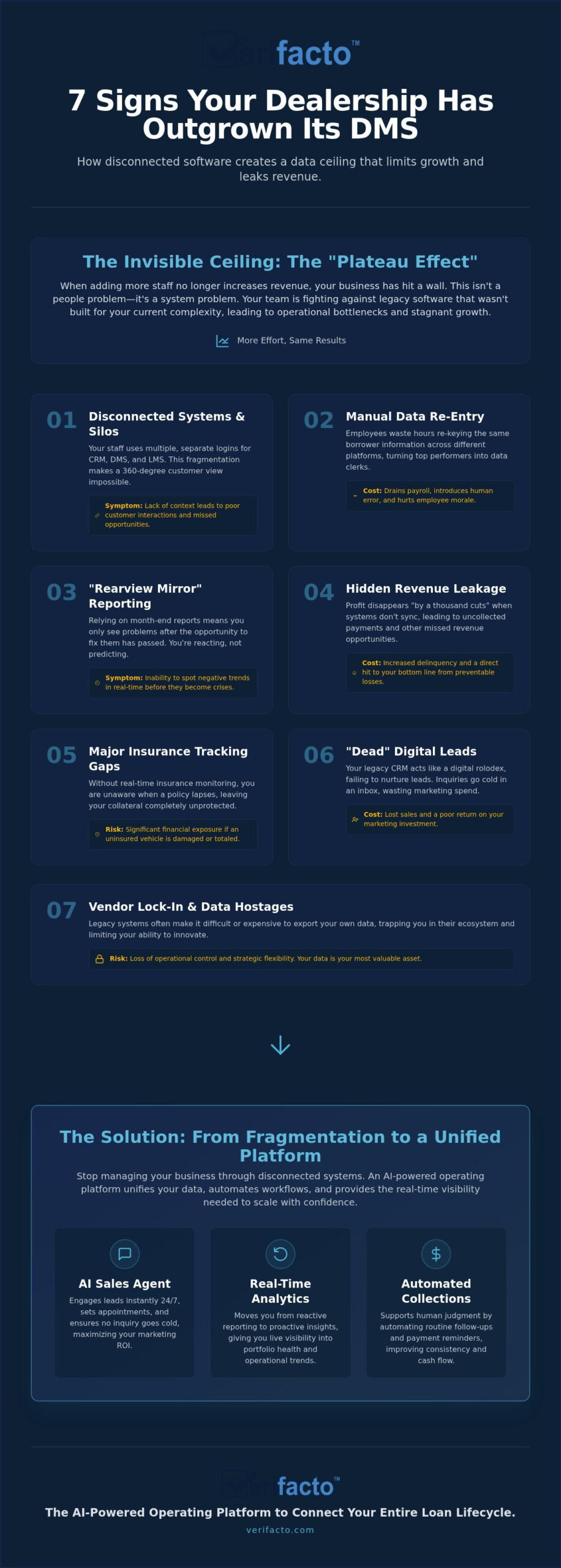
Growth in the automotive industry often hits a hard wall that no amount of hiring can break. This is the “Plateau Effect.” You might notice that adding more sales staff or collection agents no longer results in a proportional increase in revenue. Instead, it only seems to increase the volume of paperwork and the frequency of errors. This stagnation is one of the most telling signs you have outgrown your DMS. Your team is likely fighting against a system designed for a smaller, simpler version of your business.
Most dealerships operate as one cohesive business but are forced to manage it through three or four disconnected logins. When your CRM, DMS, and LMS don’t talk to each other, your data becomes a liability rather than an asset. While a foundational Document Management System (DMS) is essential for basic record-keeping, a growing dealership requires more than just storage. You are no longer just managing inventory; you are managing a high-stakes financial portfolio. Sticking with “good enough” software creates invisible revenue leakage that compounds every month.
The High Cost of Manual Data Entry and Duplicate Tasks
Calculate the hours your team loses to re-keying borrower information across different platforms. If a single application requires manual entry into the CRM, the deal-folder, and the servicing software, you are wasting valuable time. This duplicate work doesn’t just drain payroll; it introduces human error. A single typo during origination can lead to compliance risks, funding delays, and significant legal exposure. Beyond the financial cost, repetitive administrative work kills employee morale. Your top performers want to engage with customers and close deals, not act as data entry clerks for a system that should be automated.
When Reporting Becomes a Rearview Mirror Instead of a GPS
Relying on month-end reports is like trying to drive a car by only looking in the rearview mirror. By the time you see the data, the opportunity to fix a problem has already passed. Legacy systems fail to provide the real-time visibility needed for high-velocity decision-making. You cannot effectively manage risk if you only find out about insurance lapses or collection dips weeks after they occur. To scale, you must move toward predictive insights. Transitioning to an AI-driven operating platform provides the real-time data flow necessary to spot trends before they become crises. Recognizing these signs you have outgrown your DMS is the first step toward reclaiming control over your operations and your data.
Revenue Leakage from Disconnected Vendor Silos
Dealerships often suffer from profit by a thousand cuts. Revenue disappears when your systems don’t sync. If you are logging into five different platforms to check a single customer’s status, you are experiencing one of the definitive signs you have outgrown your DMS. This fragmentation makes it impossible to maintain a 360-degree view of your borrowers, leading to uncollected payments and untracked insurance lapses. When the sales team, the finance office, and the collections department use siloed tools, the borrower experience suffers, and your bottom line pays the price.
Information trapped in data silos prevents your staff from having the context needed to make smart decisions. A collector might call a borrower about a late payment, unaware that the sales team just spoke to them about an upgrade or that their insurance has already expired. This fragmented communication increases delinquency rates because it creates a lack of accountability. Borrowers are more likely to miss payments when they perceive that the dealership’s internal systems are disorganized or out of sync.
The Lead Management Gap in Legacy Systems
Legacy CRMs are often little more than digital rolodexes. They fail to nurture modern digital leads, leaving potential sales to die in an inbox while your staff is busy. An AI Sales Agent bridges this gap by engaging leads instantly and setting appointments. This ensures no inquiry goes cold due to system limitations. Eliminating these “dead leads” is a fast way to stop revenue leakage and ensure your marketing spend actually converts into showroom traffic.
Payment Processing Friction and Cash Flow Stagnation
Manual payment posting is a major red flag for any growing operation. If your team still takes cards over the phone and manually updates a ledger, your system is holding you back. Modern platforms offer built-in payment processing for ACH and cards that updates the ledger instantly. By using the LoanApp, borrowers receive automated reminders and can pay directly from their mobile devices. This accessibility is designed to improve liquidity and reduce the “time-to-payment” across your entire portfolio. You can explore how a unified platform removes these friction points to keep your cash flow moving.
Risk Exposure and the Insurance Tracking Gap
Manual insurance verification is the primary risk for Buy Here Pay Here (BHPH) and independent lenders. If your team still “checks boxes” by calling agents one by one, your operation is vulnerable. This inefficiency is among the most dangerous signs you have outgrown your DMS. The “Lapse Trap” occurs when a borrower provides proof of insurance at the time of sale but cancels the policy shortly after driving off the lot. Without real-time monitoring, you might not discover a lapse until the vehicle is totaled, leaving you with uncollateralized debt and a total loss of asset value.
Many dealerships struggle with dispersed data and inconsistent manual processes. A Forrester Total Economic Impact™ study highlights how legacy systems prevent real-time access to critical information, creating significant barriers to growth. Moving to a platform that unifies insurance data with your loan servicing ledger shifts your team from reactive damage control to proactive risk mitigation. This transition is designed to provide greater visibility into the actual health of your portfolio.
Automating Collateral Protection Insurance (CPI)
Modern operating platforms detect insurance lapses the moment they occur by connecting directly to insurance data feeds. When a policy is canceled, the system triggers an automated workflow to notify the borrower through the LoanApp. If the borrower does not provide new coverage, the platform can help facilitate automated CPI placement to protect your portfolio without manual intervention. For deeper context on this strategy, refer to our guide on What is Collateral Protection Insurance (CPI)?.
Maintaining Audit-Ready Compliance Logs
Legacy systems often fail during state audits because they lack chronological, immutable logs of borrower interactions. If you cannot prove when a lapse was detected or how you attempted to contact the borrower, you face significant legal exposure. Systems that rely on manual updates are clear signs you have outgrown your DMS and are ready for a more secure infrastructure. An integrated platform ensures your auto finance compliance management is embedded into the daily workflow. Every notification and response is automatically logged, ensuring you stay prepared for audits without the need for manual record-keeping.
From Data Entry to AI-Driven Decision Making
Breaking the data ceiling requires a fundamental shift in how your dealership processes information. One of the clearest signs you have outgrown your DMS is when your most talented employees are stuck performing manual data entry instead of generating revenue. Dealerships operate one business but are often forced to manage it through disconnected systems. Verifacto brings the operation, data and AI together in one platform to transform your workflow from reactive to proactive.
Modernizing your operation follows a logical four-step sequence:
- Step 1: Unify your data sources into a single cloud-hosted interface to eliminate redundant logins.
- Step 2: Deploy an AI Sales Agent to handle routine lead engagement and appointment setting.
- Step 3: Use predictive analytics to identify high-risk accounts before they reach the point of default.
- Step 4: Shift human staff from administrative roles to high-value relationship management and complex problem-solving.
AI Agents as an Operational Assistant
AI is an embedded tool that supports human judgment. It’s not a replacement for your team. An AI Operational Agent automates task scheduling and sends personalized email or SMS notifications based on real-time borrower behavior. For example, the system can initiate repossession workflows based on predefined data triggers, such as a confirmed insurance lapse combined with a missed payment. This ensures that actions are taken based on objective data rather than emotional reactions or inconsistent manual checks. It’s the difference between simple automation and true AI-supported judgment.
Predictive Analytics for Portfolio Health
Static spreadsheets can’t keep pace with a high-velocity lending environment. By using an AI-powered operating platform, you gain access to real-time dashboards that highlight patterns human eyes might miss. An Analytics Agent can spot subtle shifts in delinquency across a large portfolio, allowing you to intervene early. This data-driven approach is essential for improving collection efficiency for auto loans. Instead of calling every past-due account, your team can prioritize their efforts where they will have the most significant impact on your cash flow. Book a demonstration to explore how the platform fits your business and see how unified data can drive better decisions.
Modernizing Your Operation with a Unified AI Platform
Reliability is non-negotiable in a high-stakes environment. Our platform provides the security of SOC II compliance and a 99.99% uptime guarantee. This means your data is protected and your operation remains online, whether you’re closing a deal on the showroom floor or managing collections from a remote office. Transitioning to a unified platform can help you scale without the operational downtime typically associated with legacy software migrations. We focus on a no-nonsense approach to daily operations that prioritizes speed and modernization.
Unifying the Entire Lending Lifecycle
The platform connects every stage of the customer journey, from the first digital lead to the final payment. The LoanApp plays a critical role here by maintaining a direct, automated line of communication with the borrower. This visibility helps reduce delinquency by keeping the borrower engaged throughout the life of the loan. To further streamline the back office, our accounting integration with QuickBooks eliminates end-of-month reconciliation headaches. Your financial data flows directly into your ledger, which ensures accuracy and saves your staff from hours of manual audit work.
Next Steps for Dealership Growth
Evaluating your current tech debt is essential for long-term survival. The cost of inaction, such as revenue leakage, manual errors, and missed leads, often far outweighs the investment in modernization. Legacy systems lack the scalability required to handle the complexities of a modern automotive market. If your current software prevents you from using AI to automate workflows or see real-time portfolio health, these are definitive signs you have outgrown your DMS. It’s time to move toward a system that grows with you rather than one that holds you back. Book a demonstration to explore how the Verifacto platform fits your business.
Secure Your Growth with a Unified Operating Platform
Recognizing the signs you have outgrown your DMS is the first step toward reclaiming your dealership’s efficiency. Legacy software that forces your team into manual data entry and disconnected vendor silos creates a data ceiling that limits your revenue potential. By unifying your entire lending lifecycle, you can eliminate the risk of insurance lapses and turn fragmented data into actionable, predictive insights that protect your portfolio.
Verifacto provides the stability of SOC II compliance and a 99.99% uptime guarantee, ensuring your data remains secure and accessible around the clock. With embedded AI agents for sales, analytics, and collections, you can automate routine workflows while keeping your staff focused on high-value borrower relationships. It’s time to move beyond the technical debt of traditional software and build a modern foundation for scalable growth.
See how Verifacto connects your operation from the first lead to the final payment to explore how our platform fits your specific business needs. We’re ready to help you modernize your operation and scale your portfolio with confidence.
Frequently Asked Questions
What are the first signs that my DMS is failing my dealership?
The most common signs you have outgrown your DMS include a plateau in operational efficiency despite hiring more staff and the need for duplicate data entry across systems. If your team spends hours re-keying lead info into separate CRM and LMS tools, your current software is a bottleneck. You might also notice invisible revenue leakage from untracked insurance lapses or uncollected payments that your system doesn’t flag in real-time.
How does a unified AI platform differ from a traditional DMS?
A traditional DMS acts as a static system of record for inventory and basic deals, while a unified AI platform connects the entire customer lifecycle. Verifacto integrates sales, insurance tracking, and loan servicing into one cloud-based interface. Instead of just storing data, the platform uses AI agents to automate workflows and provide predictive insights. This shift moves your operation from manual data entry to data-supported judgment.
Is switching from a legacy DMS like Frazer to a cloud platform difficult?
Transitioning to a modern platform is designed to be a streamlined process that minimizes disruption to your daily operations. Unlike older systems that lock your data away, Verifacto emphasizes dealer control and easy data export. This reduces vendor lock-in and allows for a smoother migration of your existing portfolio. Modern cloud platforms provide the scalability and accessibility that legacy on-premise software simply cannot match as your business grows.
Can an AI-powered system really help reduce delinquency?
An AI-powered platform is designed to provide greater visibility into borrower behavior, which can help your team intervene before a default occurs. By using automated borrower communication through the LoanApp, you maintain a consistent touchpoint for reminders and follow-ups. This automation supports your collections team by prioritizing high-risk accounts based on real-time data triggers, such as missed payments or insurance lapses, rather than manual spreadsheets.
How does real-time insurance tracking protect my car loan portfolio?
Real-time tracking protects your collateral by detecting insurance policy cancellations the moment they happen. Traditional systems rely on manual checks that often miss the lapse trap occurring shortly after the sale. Verifacto connects directly to insurance data feeds to trigger automated notifications. If a borrower fails to provide coverage, the system can help facilitate CPI solutions to ensure your portfolio remains protected against total loss and uncollateralized debt.
What is the benefit of having a DMS and LMS in the same system?
Having your DMS and LMS in one platform eliminates the data silos that cause operational friction and revenue leakage. It provides a single source of truth from the first lead to the final payment. This unification removes the need for multiple logins and manual reconciliation between sales and servicing. It also allows for seamless accounting integration with tools like QuickBooks, which simplifies end-of-month reporting and improves overall accuracy.
How do AI agents work with my existing dealership staff?
AI agents act as embedded operational assistants that handle routine, repetitive tasks to support your human staff. For example, the Sales Agent can engage digital leads and set appointments, while the Collections Agent automates follow-ups. This allows your team to shift from administrative roles to high-value relationship management. The AI provides the data and triggers, but your staff retains the final judgment for complex business decisions and customer interactions.
Is my data secure in a cloud-based dealer management system?
Yes, modern cloud platforms often provide higher security standards than on-premise servers. Verifacto ensures your data is protected with bank-level encryption and maintains SOC II compliance to meet rigorous industry standards. We also provide a 99.99% uptime guarantee, ensuring that your operational data is always available when you need it. This infrastructure is designed to alleviate professional anxieties regarding data loss, system stability, and unauthorized access.