
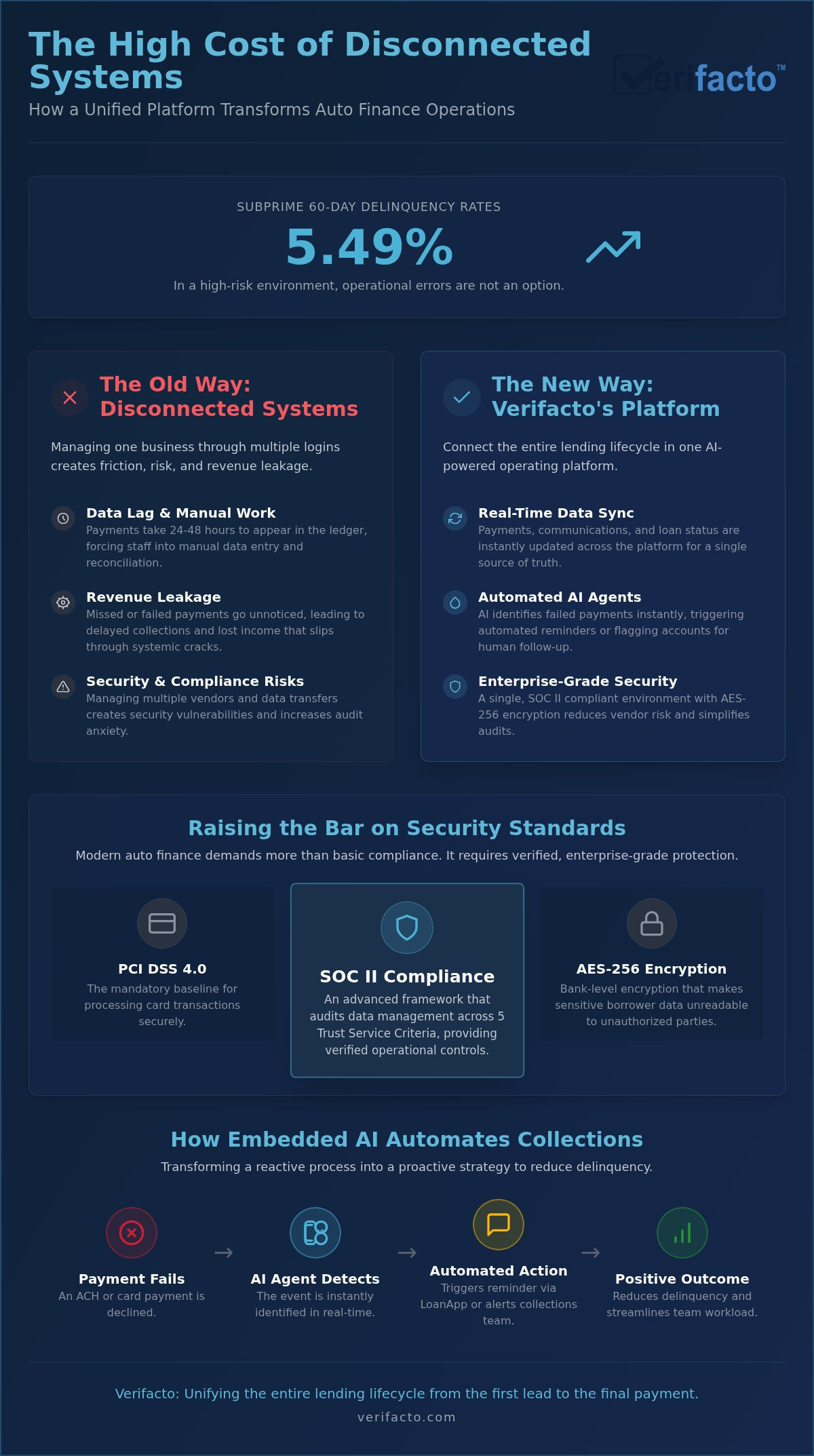
With subprime 60-day delinquency rates reaching 5.49% in May 2026, your team can’t afford to lose money to manual data entry errors or disconnected vendor systems. It’s a common struggle to manage one business through multiple logins while worrying if your current setup meets the mandatory PCI DSS 4.0 standards. You’ve likely felt the anxiety of a looming compliance audit or the sting of revenue leakage when a payment isn’t properly recorded in your ledger.
Implementing a robust, secure payment gateway for auto finance is no longer just a technical requirement; it’s a strategic move to unify your entire lending lifecycle. This article explains how an integrated platform eliminates the high cost of disconnected systems and connects everything from the initial lead to the final payment. You’ll discover how to leverage embedded AI agents and the LoanApp to automate reminders, reduce delinquency, and maintain enterprise-grade security without the usual operational complexity.
Key Takeaways
- Identify how manual data reconciliation between disconnected systems causes revenue leakage and operational friction.
- Learn why a secure payment gateway for auto finance must now go beyond simple PCI DSS to include enterprise-grade SOC II compliance.
- Understand how embedded AI agents use real-time payment data to automate borrower communication and proactively manage delinquency.
- Evaluate the financial benefits of a unified operating platform that syncs directly with QuickBooks to provide total visibility.
The Hidden Cost of Disconnected Payment Systems in Auto Finance
Dealerships operate one business but are often forced to manage it through disconnected systems. When your payment processor doesn’t talk to your loan management records, your staff spends hours on manual reconciliation. This friction isn’t just an administrative headache; it’s a financial risk. A standalone secure payment gateway for auto finance might process the card successfully, but if that data doesn’t instantly update your ledger, you lose the ability to act on real-time information. You’re left managing your portfolio through a rearview mirror.
Many Payment service providers offer basic gateways that handle the transaction but fail to bridge the gap to your dealership’s operational core. This separation creates a lag where payments are made but not recognized by your collection tools for 24 to 48 hours. In that window, your team might waste time calling a borrower who has already paid, or worse, miss a failed transaction that should have triggered an immediate follow-up. Modern lenders are moving away from these siloed tools in favor of unified platforms that treat payments as a core part of the loan lifecycle.
Recognizing Revenue Leakage in Your Operation
Revenue leakage occurs when your system fails to identify a missed payment the moment it happens. In a siloed environment, a failed ACH might sit in a portal for days before a manager notices. By then, the borrower is much harder to reach. Disconnected systems obscure the true performance of your portfolio because your data is scattered across different logins. You can’t see the “why” behind the numbers when the payment history and the borrower’s communication logs live in different worlds.
A unified platform provides greater visibility by connecting every transaction to the borrower’s profile. When a payment fails, embedded AI agents can immediately flag the account for your team or trigger an automated reminder. This eliminates the gap between payment processing and loan servicing, ensuring no revenue slips through the cracks of a manual process.
The Burden of Multi-Vendor Management
Maintaining multiple vendors means paying multiple subscription fees and managing complex API connections that can break without warning. Every time data moves between a separate DMS and a payment vendor, you create a security vulnerability and increase the risk of duplicate data entry. These manual entries often lead to compliance errors that surface during audits, creating unnecessary professional anxiety.
While many legacy software providers claim to be “integrated,” they’re usually just bolting on third-party tools. This isn’t true unification. A native secure payment gateway for auto finance reduces vendor lock-in and gives you total control over your data. It streamlines your operation by:
- Eliminating the need for manual data imports and exports.
- Reducing the cost of maintaining multiple disconnected systems.
- Providing a single, secure environment for all sensitive financial data.
- Ensuring your records are always audit-ready with a clear, automated trail.
Defining a Secure Payment Gateway: Essential Standards for 2026
A secure payment gateway for auto finance is a system that encrypts sensitive data and unifies it with loan management records. In 2026, this definition has expanded beyond the simple ability to process a transaction. It now represents the secure bridge between a borrower’s financial account and your dealership’s operating ledger. For high-volume lenders, security isn’t just about avoiding a breach; it’s about maintaining a transparent, audit-ready environment that protects the integrity of the entire portfolio.
While basic compliance with Payment Card Industry (PCI) Security Standards is mandatory, the industry has shifted toward more comprehensive frameworks. Following the full implementation of PCI DSS 4.0 in early 2025, lenders now require higher levels of technical scrutiny. Bank-level encryption is the non-negotiable baseline. By using AES-256 encryption, you ensure that sensitive borrower information is unreadable to unauthorized parties, reducing your liability and protecting the professional reputation you’ve built with your customers.
SOC II Compliance and Data Protection
SOC II compliance represents a significant step up from standard payment processing certificates. It provides a framework that audits how a platform manages data across five “trust service criteria”: security, availability, processing integrity, confidentiality, and privacy. For your dealership’s risk profile, using a SOC II-compliant platform means you have verified controls in place to prevent unauthorized access. This level of protection is essential for passing state and federal regulatory audits, where you must prove that borrower data is handled with consistent, documented care.
To see how these security layers integrate into a daily workflow, book a demonstration to explore how the platform fits your business.
Uptime and Reliability: The Backbone of Collections
Operational continuity depends on a 99.99% uptime guarantee. If your gateway goes down during a peak payment window, such as a Friday afternoon when subprime borrowers receive their paychecks, the financial impact is immediate. Downtime doesn’t just delay revenue; it breaks the borrower’s habit of timely payment and increases the workload for your collection team. When a system is unavailable, borrower trust erodes quickly, making future outreach more difficult.
Modern lenders favor cloud-hosted architecture because it provides “anytime, anywhere” access without the burden of on-premise hardware. This setup allows your staff to manage payments and monitor performance from any device while ensuring the system remains resilient against local outages. By removing the complexity of physical servers, you gain a more stable environment that supports high-volume transaction processing without the risk of system crashes during critical business hours.
How AI-Driven Automation Transforms Payment Processing
Most dealerships operate in a reactive state, waiting for a payment to fail before taking action. This delay is a primary driver of delinquency. By embedding AI directly into your secure payment gateway for auto finance, you move from chasing debt to managing relationships. AI agents aren’t a standalone novelty; they’re functional tools that use your connected business data to automate high-volume tasks. This shift allows your team to focus their human judgment on complex cases while the system handles the routine heavy lifting.
Automation also addresses the persistent problem of human error in payment scheduling. When your staff must manually set up recurring ACH or card payments in a separate portal, mistakes are inevitable. A unified platform eliminates this risk by automating the scheduling process during the loan origination phase. Because the payment processing is built-in, every successful transaction or failed attempt is recorded instantly, ensuring your ledger is always an accurate reflection of your portfolio’s health.
The AI Collections Agent in Action
The Collections Agent acts as a tireless assistant that monitors every account’s real-time status. Instead of waiting for a manager to run a delinquency report, the system identifies a missed payment the moment it occurs. It then uses automated borrower communication to send immediate, professional reminders via SMS or email. This proactive approach keeps the obligation top-of-mind for the borrower and often resolves the issue before it requires a manual phone call.
This automation doesn’t replace your team; it empowers them. By handling the initial outreach and routine follow-ups, the Collections Agent clears the path for your staff to engage in more meaningful, high-value conversations with borrowers who need personalized attention. You maintain total control over the messaging and frequency, ensuring the technology supports your specific dealership’s culture and communication style.
Predictive Insights with the AI Analytics Agent
Visualizing your operation’s cash flow trends becomes effortless with integrated AI tools. The Analytics Agent provides real-time dashboards that combine payment history with loan origination data. This allows you to see beyond simple balances and identify “at-risk” loans before a payment is even missed. For instance, if the AI detects a pattern of late payments across a specific vehicle type or credit tier, it flags these trends so you can adjust your lending criteria accordingly.
Custom reporting through the Analytics Agent helps you understand the “why” behind your portfolio’s performance. You can easily export this data for deeper analysis, reducing vendor lock-in and ensuring you always have a clear view of your financial trajectory. This level of visibility is only possible when your secure payment gateway for auto finance is part of a unified platform that sees the entire customer lifecycle, from the first lead to the final payment.
Evaluating Integrated Payment Solutions: A Buyer’s Framework
When selecting a secure payment gateway for auto finance, the most critical distinction to make is between integrated and unified systems. Many vendors claim to be integrated, but this often means they’ve simply built a shaky bridge between two different software platforms using an API. In a unified system, the payment processing, loan management, and communication tools are part of a single, cohesive architecture. This eliminates the “data lag” that occurs when information has to travel between separate databases.
A truly unified framework also addresses the intersection of payments and compliance. For example, your system should be able to verify active insurance coverage the moment a payment is processed. If a borrower makes a payment but their insurance has lapsed, a unified platform flags this immediately. This level of oversight protects your collateral while ensuring you remain audit-ready at all times. You should also prioritize data control; a provider that makes it difficult to export your own data for external analysis is creating vendor lock-in that can hinder your long-term growth.
The Importance of Accounting Integration
Manual reconciliation is a hidden tax on your staff’s time. If your team spends the first week of every month trying to match bank statements to your ledger, you have a systemic efficiency problem. High-performing integrated payment solutions for dealers solve this by offering a direct, real-time sync with QuickBooks and other major accounting software. This ensures that every transaction processed through your secure payment gateway for auto finance is reflected in your financial records without human intervention.
This automated synchronization does more than just save time; it reduces accounting overhead and minimizes the risk of errors that can trigger red flags during a tax audit. When your payment data and your ledger are perfectly aligned, you gain a clear, real-time view of your dealership’s financial health, allowing you to make faster, more informed decisions about your portfolio.
Enhancing the Borrower Experience via LoanApp
Borrowers in 2026 expect the same convenience from their auto lender that they get from their primary bank. Providing a transparent, easy-to-use interface through the LoanApp gives your customers the flexibility they need to stay current. Whether they prefer ACH, credit cards, or setting up recurring payments, the LoanApp serves as a self-service portal that empowers the borrower and reduces the administrative burden on your call center staff.
There is a significant psychological benefit to this transparency. When a borrower can easily see their payment history, remaining balance, and upcoming due dates in one place, they feel more in control of their financial obligation. This transparency builds trust and reduces the friction that often leads to missed payments. By making it easy for them to pay, you make it easier for your dealership to maintain a healthy cash flow.
Beyond automotive lending, many service-based businesses use consumer financing for small business to offer customers similar flexibility and transparency in their payment options.
If you’re ready to move beyond disconnected tools, see how Verifacto connects your operation from the first lead to the final payment.
Verifacto: Unifying the Entire Lending Lifecycle
Dealerships operate one business but are often forced to manage it through disconnected systems. Verifacto brings the operation, data and AI together in one platform. Our secure payment gateway for auto finance isn’t just a tool for processing transactions; it’s the engine that powers a unified lending lifecycle. By integrating payment processing directly with your DMS and LMS, you eliminate the gaps where revenue leakage typically occurs and gain a clear view of your portfolio’s health.
From Lead to Final Payment: A Unified Workflow
The efficiency of a unified platform starts at the very beginning of the customer relationship. The AI Sales Agent captures and validates borrower data, which then flows seamlessly into the loan management system. When it’s time to process the first payment, the system is already prepared. This handoff removes the risk of duplicate data entry and ensures that the secure payment gateway for auto finance has the accurate information needed to execute recurring ACH or card transactions without friction.
This connectivity is vital for maintaining collateral security. The platform is designed to provide real-time synergy between payment status and collateral protection insurance (CPI). If the system detects a missed payment alongside an insurance lapse, it can automatically trigger task management for your collections team. This proactive automation ensures that repossession workflows or insurance placements are handled based on live data, protecting your portfolio from unmitigated risk.
Modernizing Your Operation with Confidence
Modernizing your dealership shouldn’t feel like a burden. Verifacto provides enterprise-grade security and reliability without the typical operational complexity. With SOC II compliance and a 99.99% uptime guarantee, you can process payments with the confidence that your data is protected and your system is always available. This stability is designed to help reduce operational hours by automating routine financial tasks, allowing your team to focus on high-value decision-making.
We believe in dealer control. Our platform is designed to provide the visibility you need without the vendor lock-in that restricts your growth. You can easily access and export your data for analytics, ensuring you always have a clear view of your financial performance. Book a demonstration to explore how the platform fits your business and see how Verifacto connects your operation from the first lead to the final payment.
Modernizing Your Lending Lifecycle for 2026
Dealerships operate one business but are often forced to manage it through disconnected systems. We’ve seen how a unified approach eliminates the friction of manual reconciliation and protects your portfolio from the hidden costs of revenue leakage. Implementing a secure payment gateway for auto finance that’s embedded within a SOC II compliant platform gives you more than just transaction processing. It provides a reliable framework that connects your data, AI agents, and borrower communication into a single, high-performance environment.
With a 99.99% uptime guarantee and bank-level encryption, your operation stays stable and audit-ready. This isn’t about replacing your team; it’s about giving them the tools to work with mastery and precision. You can transform your daily operations from a series of manual hurdles into a streamlined, automated success story.
See how Verifacto connects your operation from the first lead to the final payment
We’re ready to help you take control of your financial performance with a platform built for the realities of modern lending.
Frequently Asked Questions
What makes a payment gateway ‘secure’ for auto finance specifically?
Security in this sector requires combining bank-level encryption with industry-specific compliance standards. For 2026, this means mandatory PCI DSS 4.0 compliance and enterprise-grade SOC II certification to protect sensitive borrower financial data. A secure payment gateway for auto finance also ensures that data is unified with loan records, preventing the security gaps often created by manual data transfers between disconnected systems.
How does a built-in payment gateway improve collection efficiency?
Collection efficiency improves when payment data is available in real-time to trigger automated workflows. When a payment is processed through a built-in gateway, the ledger updates instantly, allowing the Collections Agent to send immediate reminders for failed transactions. This eliminates the 24 to 48-hour lag common in siloed systems, ensuring your team only spends time on accounts that actually require manual intervention.
Can an integrated payment system help with insurance compliance?
A unified platform provides greater visibility by linking payment status directly to insurance tracking. For example, the system can flag accounts where a payment was made but the borrower’s insurance has lapsed. This allows you to manage CPI placement and insurance follow-ups in the same workflow as loan servicing, protecting your collateral without the need for manual cross-referencing between different vendor portals.
Does Verifacto’s payment gateway sync with QuickBooks?
Verifacto’s platform is designed to provide a direct, real-time sync with QuickBooks. This feature eliminates the end-of-month reconciliation headache by automatically matching every transaction processed through the gateway to your accounting ledger. It ensures that your financial records are always accurate and audit-ready without requiring manual data entry or tedious file exports from your staff.
What payment methods can I accept through an integrated gateway?
You can accept a wide range of modern payment methods, including ACH transfers, credit cards, and debit cards. The system also supports recurring payments, which can be scheduled during the loan origination process. By offering these flexible options through a single secure payment gateway for auto finance, you make it easier for borrowers to stay current while reducing the administrative burden of managing multiple payment vendors.
Is AI really necessary for auto finance payment processing?
AI acts as an embedded tool that automates high-volume tasks and supports human judgment using connected business data. While you can process payments without it, AI agents like the Analytics Agent help you identify at-risk loans before payments are missed. It transforms payment processing from a reactive transaction into a proactive strategy that helps reduce delinquency and improves overall portfolio performance through predictive insights.
How does the LoanApp help with borrower payments?
The LoanApp serves as a self-service mobile portal that gives borrowers the transparency they expect. It allows customers to view their payment history, check balances, and make one-time or recurring payments directly from their phones. This convenience reduces the volume of inbound calls to your office and empowers borrowers to manage their financial obligations on their own schedule, which can help improve payment consistency.