
How many repossessed units are currently sitting in a storage lot, unaccounted for in your primary ledger, while their market value drops every single day? For many auto finance executives, the answer is often “too many.” You likely agree that managing a recovery portfolio through disconnected spreadsheets and fragmented vendor portals is a recipe for revenue leakage. This is why choosing the right software to track repossessed inventory is no longer just an IT decision; it’s a critical financial strategy to protect your bottom line and maintain operational control.
This article explores how an AI-powered operating platform eliminates the chaos of manual tracking to manage assets from the initial default to the final resale. You’ll discover how to implement automated workflows that provide real-time visibility into every unit, ensuring that no vehicle is ever “lost” or forgotten in the recovery cycle again. We will break down how a unified system connects your data, agents, and accounting to streamline the entire asset recovery process for 2026. By the end, you’ll understand how to turn a fragmented recovery process into a high-speed, transparent pipeline that maximizes asset recovery value.
Key Takeaways
- Stop revenue leakage by replacing disconnected spreadsheets with a unified system that prevents repossessed units from sitting idle or being forgotten.
- Discover how modern software to track repossessed inventory provides real-time visibility from the initial repo assignment through the final resale.
- Leverage AI agents to flag high-risk accounts and automate workflows, ensuring your team focuses on the assets that need the most attention.
- Streamline your operations by connecting recovery data directly to your LMS, which eliminates duplicate data entry and improves accounting accuracy.
- Learn how a unified platform protects your business by managing the entire loan lifecycle, from the first lead to the final payment.
The Hidden Cost of Disconnected Repossession Tracking
Dealerships operate one business but are often forced to manage it through disconnected systems. When an account moves into default, the data usually splits. One piece stays in your LMS, while another moves to a repo agent’s portal or a manual spreadsheet. This fragmentation is where assets disappear. Effective software to track repossessed inventory is designed to bridge this gap, ensuring that a vehicle’s status is visible to every department in real time. Without this connection, you are essentially flying blind during the most volatile stage of the loan lifecycle.
Repossessed inventory management is more than a list of VINs. It is a high-stakes timeline. If your data lives in silos, you face delayed resales and accelerated depreciation. According to 2026 industry data from Statista, vehicle depreciation remains one of the largest financial losses for lending portfolios. Every day a recovered unit sits in “repo-limbo” without being processed for resale, your potential recovery amount shrinks. The consequences of these silos include:
- Increased storage fees due to delayed transport orders.
- Duplicate data entry that leads to clerical errors in loan balances.
- Missed opportunities to send “Right to Cure” notices promptly.
- Inability to provide accurate payoff quotes to borrowers during the redemption period.
Revenue Leakage in the Repo Lifecycle
Asset “disappearance” isn’t always literal; it’s often operational. When a vehicle is recovered but not checked into inventory, it generates daily holding costs while its market value declines. This risk is compounded by missing insurance data. Without verified coverage, you’re exposed to total loss during transport or storage. Utilizing collateral protection insurance (CPI) provides a necessary safety net, but only if your platform can track which units are covered during the Repossession process. Disconnected systems often fail to trigger CPI claims, leading to thousands of dollars in unrecovered losses.
The Compliance Trap of Manual Logs
Maintaining audit-ready logs is nearly impossible with manual entry. As of 2026, regulatory scrutiny is at an all-time high. A recent DOJ settlement involving SCRA violations resulted in over $137,000 in penalties for a dealership that failed to follow court order requirements. Manual logs often lead to missed state-mandated notices or incorrect timelines. Modern software to track repossessed inventory provides greater visibility into these legal windows. By using an AI-powered platform, you can manage the entire legal timeline from a single source of truth rather than a stack of papers, reducing the anxiety of a surprise audit.
Core Features of Modern Software to Track Repossessed Inventory
Most lenders lose track of their assets because they rely on the recovery agent’s portal as their primary source of information. This creates a dangerous data gap. While the agent knows where the truck is, your internal team is often left guessing about the exact status of the collateral. Modern software to track repossessed inventory is designed to close this gap by providing a centralized dashboard that reflects real-time status updates. Whether a unit is “Assigned,” “On Lot,” or “Sold,” the data should live within your primary operating platform, not just a third-party application.
Integration with your LMS and DMS is the most critical feature for maintaining financial integrity. When an asset is recovered, the system should automatically update the loan balance and trigger the necessary accounting adjustments. This level of synchronization is vital because the IRS guidelines on the tax treatment of… repossessions require precise reporting of canceled debt and fair market value. Using a unified platform ensures your records are accurate for both internal audits and federal reporting requirements without the need for manual data reconciliation.
Field verification is another area where traditional systems fail. Through the LoanApp mobile application, your team can verify inventory status directly from the lot. This mobile accessibility allows for instant photo uploads and condition reports that sync immediately with the master file. By keeping the paper trail digital and intact, you eliminate the risk of lost documents and ensure that borrower communications, such as redemption notices, are sent based on verified data rather than assumptions.
Real-Time Tracking and GPS Integration
Modern software must interface with existing tracking data without forcing you into proprietary hardware contracts. The focus should be on data visibility, not selling you more equipment. Effective auto loan management software centralizes location data to provide geofencing alerts. When a repossessed vehicle enters your designated storage lot, the system should automatically check it into inventory. This automation reduces the time a vehicle spends in “limbo” and accelerates the timeline for resale.
Automated Task Initiation for Recovery
Efficiency is built on triggers, not manual oversight. Instead of a collector manually moving a file to a recovery specialist, the system should initiate the workflow based on pre-defined delinquency thresholds. This move from a “late payment” flag to “repo initiated” happens seamlessly within the platform. By automating the handoff between internal collectors and external recovery teams, you maintain momentum. You can explore how AI agents help manage these transitions by supporting human judgment with real-time risk analytics.
This structured approach ensures that every stakeholder has the information they need to act quickly. When your software to track repossessed inventory is part of a unified lending platform, you stop managing through disconnected lenses and start operating with a single, reliable source of truth.
Manual Logs vs. AI-Powered Inventory Management
Relying on manual logs or the “tribal knowledge” of a seasoned recovery manager is a significant operational risk. While experience is valuable, it doesn’t scale and it can’t prevent data from falling through the cracks. In a high-volume lending environment, you need automated syncs to maintain data integrity. If your team is manually cross-referencing repo agent portals with your internal ledger, you’re already behind. Modern software to track repossessed inventory replaces these fragmented habits with a single, automated source of truth that updates as fast as the recovery happens.
Security is another area where manual systems and legacy software fail. Most repossession tools overlook the necessity of SOC II compliance and bank-level encryption. Protecting sensitive borrower data is a legal mandate, not a luxury. When you manage recovery through spreadsheets, you’re one misplaced file away from a massive compliance breach. A unified platform provides the security infrastructure required to meet FTC rules on vehicle repossession while ensuring your data remains under your total control.
The Role of AI Agents in Asset Recovery
AI should be viewed as an embedded tool that supports human judgment, not a replacement for your team. An AI Operational Assistant can handle the heavy lifting of routine task scheduling, such as coordinating with transport companies once a vehicle is marked as “On Lot.” This automation allows your recovery specialists to focus on high-stakes decisions rather than administrative data entry.
The efficiency continues after the recovery. You can use an AI Sales Agent to identify potential buyers from your existing lead funnel and move repossessed units back into the “Sold” category faster. AI also provides predictive insights by analyzing historical data to identify which assets are at the highest risk of “going dark.” This allows you to initiate recovery actions before a vehicle becomes unrecoverable, directly protecting your portfolio’s value.
Eliminating Vendor Lock-In
Dealerships often find themselves held hostage by a single repo vendor or a software provider that makes it difficult to move data. You should always have total control over your inventory data. A modern platform ensures data portability, allowing you to export your inventory lists and recovery history whenever you need them for deeper analytics or audits.
Your software to track repossessed inventory must also play well with the rest of your business. This means direct integration with your accounting stack, such as a direct sync with QuickBooks. When a vehicle is sold at auction, the platform should automatically reconcile the sale price with the loan balance and update your accounting records. This seamless flow eliminates duplicate data entry and ensures your financial statements reflect the reality of your inventory in real time.
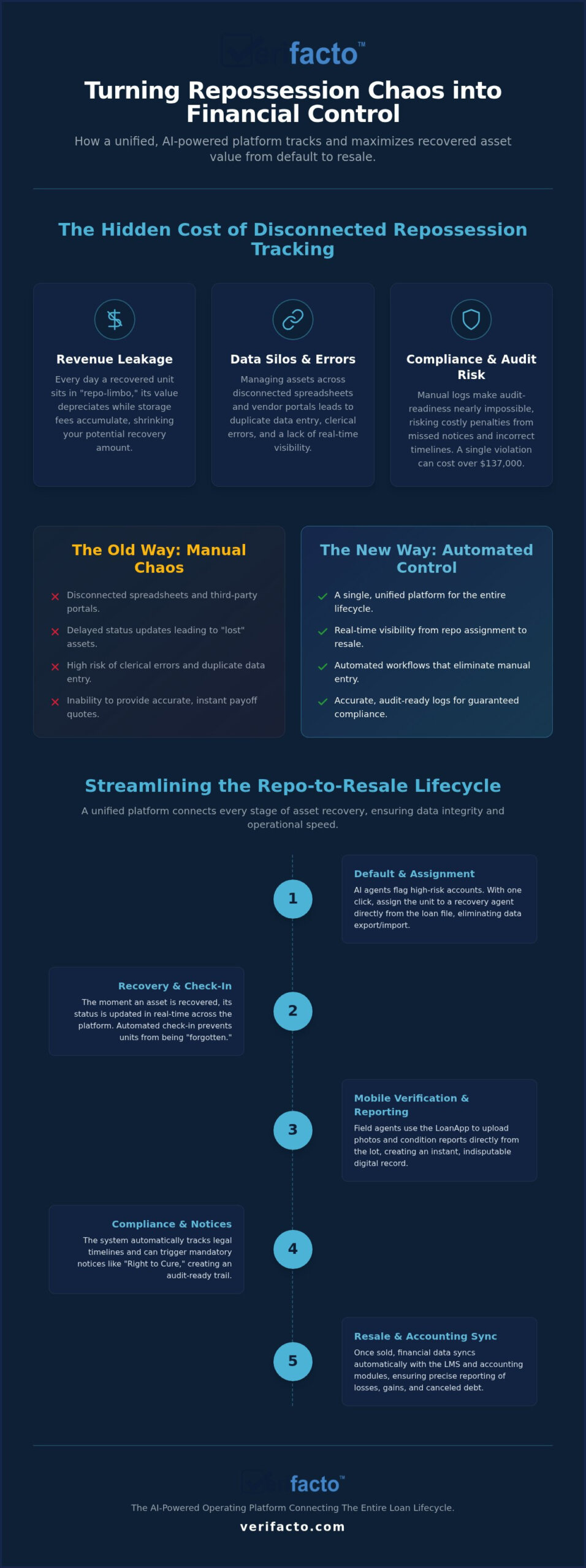
Streamlining the Repo-to-Resale Lifecycle in 2026
Operational efficiency often collapses the moment a vehicle is “on the hook.” Many lenders find that while their recovery agents are fast, their internal software to track repossessed inventory doesn’t handle the transition into the resale phase. This creates a bottleneck where assets sit in storage lots, losing value while staff manually update multiple systems. A unified platform eliminates this friction by treating the recovery as a single, continuous workflow.
The 2026 standard for asset recovery follows a strict, automated five-step sequence:
- Step 1: Automated Initiation. The system identifies accounts that hit pre-set delinquency thresholds in your LMS and moves them to “Repo Initiated” without manual data entry.
- Step 2: Verification and Check-in. As soon as the agent confirms recovery, the vehicle is automatically checked into your inventory with real-time status updates.
- Step 3: Post-Recovery Compliance. The platform generates required borrower notices, such as the “Notice of Intent to Sell,” based on state-specific legal timelines.
- Step 4: Valuation and Reconditioning. Your team tracks repair costs and auction floor prices within the same interface to maintain a clear view of the total investment.
- Step 5: Resale Integration. Once ready, the vehicle is pushed to marketplaces or your own retail lot directly from the DMS.
Maximizing Recovery Value
Profitability in the recovery cycle depends on the “days-to-resale” metric. Every day a unit sits idle, it accumulates storage fees and loses market value. By tracking reconditioning costs in real time, you gain full visibility into your break-even point for every asset. Of course, the most cost-effective recovery is the one that never happens. By improving collection efficiency through automated borrower communication, you can often resolve delinquencies before they escalate to a repossession order.
Integrated Payment and Accounting Sync
The final stage of the lifecycle is the most complex for accounting departments. When a vehicle is sold, the proceeds must be accurately applied to the borrower’s remaining balance, including any recovery or storage fees. A unified system provides a real-time sync with your accounting stack, ensuring your profit and loss statements are always current. Utilizing integrated payment solutions allows for seamless settlement of deficiency balances or redemption payments.
Ready to see how a unified platform can eliminate the chaos of disconnected systems? Book a demonstration to explore how Verifacto fits your business operations.
Verifacto: Unifying Your Lending Lifecycle and Asset Recovery
Dealerships operate one business but are often forced to manage it through disconnected systems. Verifacto brings the operation, data and AI together in one platform. This unified approach is essential for modern software to track repossessed inventory because it ensures that recovery data isn’t an island. It connects the entire customer and loan lifecycle, from the first lead to the final payment. By replacing fragmented DMS, LMS, and CRM tools, you gain a single source of truth for your entire portfolio.
The AI Operational Assistant is at the core of this efficiency. It manages high-stakes repossession tasks by automating workflows using connected business data. Instead of waiting for a staff member to notice that a delinquency threshold has been met, the AI-powered operating platform triggers the necessary actions. This automation supports human judgment by providing the data needed to make informed recovery decisions quickly. It reduces the time spent on administrative data entry and focuses your team’s energy on high-value operations.
Security and reliability are non-negotiable when handling sensitive borrower information. Verifacto provides bank-level encryption and is SOC II compliant, ensuring your critical inventory data remains protected. With a 99.99% uptime guarantee, your team has access to real-time asset status whenever they need it. This stability allows you to scale your repossessed portfolio without the fear of system downtime or data breaches.
A Modern Alternative to Fragmented Systems
Independent dealers are moving away from legacy, disconnected software that creates dangerous data silos. Legacy tools often fail to provide the visibility required for effective software to track repossessed inventory. The “One Platform” advantage means your operational data and AI live in one secure cloud interface. This eliminates the need to jump between vendor portals or manage conflicting spreadsheets. See how Verifacto connects your operation from the first lead to the final payment by bringing every department into the same digital environment.
Next Steps for Your Dealership
Moving your current repo logs into a unified AI-powered system is a straightforward process designed to reduce vendor lock-in. You retain total control over your data, with the ability to export it for analytics or accounting at any time. The first step toward operational efficiency is seeing the technology in action. You can request a demonstration to observe how the AI Operational Assistant handles complex recovery workflows. Book a demonstration to explore how the platform fits your business and discover how to eliminate the chaos of disconnected systems today.
Take Control of Your Asset Recovery Pipeline
Effective asset recovery in 2026 requires moving beyond the limitations of manual logs and disconnected vendor portals. By implementing unified software to track repossessed inventory, you eliminate the operational gaps that lead to revenue leakage and compliance risks. You have explored how a single platform automates the journey from default to resale, ensuring every vehicle is accounted for and every legal notice is sent on time.
Verifacto provides the security and reliability high-stakes lending environments demand. With SOC II compliance and a 99.99% uptime guarantee, your data stays protected and accessible. AI-powered operational efficiency supports your team by automating routine tasks and providing real-time visibility across your entire portfolio. This isn’t just about tracking cars; it’s about protecting your bottom line through total operational control.
Don’t let disconnected systems dictate your financial performance. See how Verifacto connects your operation from the first lead to the final payment and start maximizing the value of your recovered assets today. You have the tools to turn operational chaos into a streamlined, profitable recovery pipeline.
Frequently Asked Questions
What is the best software to track repossessed inventory for BHPH dealers?
Verifacto’s unified operating platform is designed to be the best software to track repossessed inventory for BHPH dealers. It connects the entire loan lifecycle from the first lead to the final payment. This integration ensures that repossessed inventory is tracked in real-time within the same system used for loan management. It eliminates the need for disconnected spreadsheets and ensures total data consistency across your entire operation.
Can AI really help with the repossession process?
AI acts as an embedded tool that supports human judgment and automates complex workflows. The AI Operational Assistant is designed to flag high-risk accounts based on delinquency data and initiate recovery tasks automatically. This proactive approach helps identify units at risk of going dark before they become unrecoverable. AI agents also streamline communication with recovery teams, ensuring the handoff from collections to repossession is seamless and data-driven.
How does integrated inventory tracking reduce financial risk?
Integrated tracking reduces financial risk by eliminating revenue leakage caused by lost repossessed units. When your software to track repossessed inventory is unified with your LMS, every status update reflects in your accounting records immediately. This provides greater visibility into depreciation costs and storage fees. It ensures sale proceeds are accurately applied to borrower balances, protecting your profit margins and maintaining total financial integrity.
Is my data secure when using a cloud-based repo tracking system?
Security is a core component of the Verifacto platform. We maintain SOC II compliance and utilize bank-level encryption to protect sensitive borrower and operational data. Our cloud infrastructure provides a 99.99% uptime guarantee, ensuring that your inventory information is always accessible when you need it. This level of security is designed to alleviate professional anxieties regarding data breaches and system reliability in high-stakes environments.
Does Verifacto provide GPS hardware for tracking cars?
Verifacto doesn’t sell GPS tracking hardware. Instead, our platform is designed to interface with your existing tracking data from various providers. This approach prevents vendor lock-in and allows you to use the hardware that fits your business needs. We focus on the data layer, providing a centralized dashboard where you can monitor all repossessed assets regardless of the tracking device used.
How does repossession software help with state compliance?
Modern software is designed to automate the generation of state-mandated notices based on specific legal timelines. This provides greater visibility into the required windows for a Right to Cure or a Notice of Intent to Sell. By using a unified system, you can maintain audit-ready logs that document every step of the recovery process. This automation helps reduce compliance anxiety by ensuring that critical deadlines are tracked and met consistently.
Can I export my repossessed inventory data for external audits?
You maintain total control over your data and can easily export it for analytics or external audits at any time. Our platform is built on the principle of data portability to ensure you aren’t held hostage by a single vendor. Whether you need to sync with QuickBooks or provide reports for a regulatory review, the system allows for seamless data extraction in professional, industry-standard formats.
What happens to the loan balance once a car is repossessed and sold?
The system is designed to automatically apply sale proceeds to the borrower’s remaining balance once the vehicle is sold. This includes reconciling the sale price against any recovery fees, storage costs, and reconditioning expenses. Because the platform connects your DMS and LMS, these accounting updates happen in real time. This provides a clear view of the final deficiency or surplus for every repossessed asset in your inventory.