
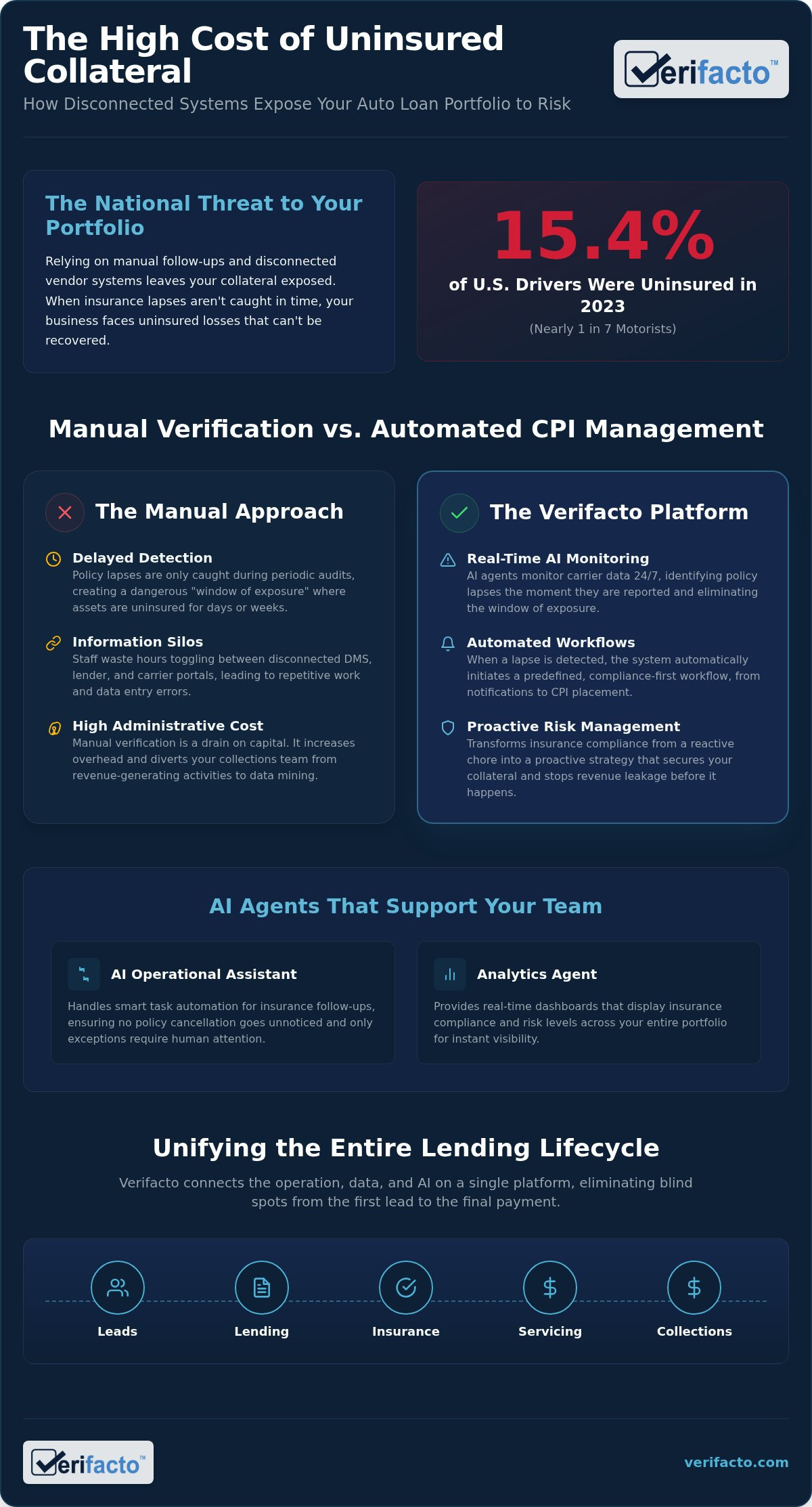
According to the Insurance Research Council, 15.4% of U.S. drivers were uninsured in 2023, which means nearly one in seven motorists on the road lacks basic coverage. For auto lenders, this statistic isn’t just a national trend; it’s a direct threat to your portfolio’s stability. Relying on manual follow-ups for canceled policies or toggling between disconnected vendor systems leaves your collateral exposed to significant risk. When lapses aren’t caught in time, your business faces uninsured losses that can’t be recovered. Implementing modern lender-placed insurance software is no longer a luxury; it’s a necessity for protecting your bottom line.
You likely agree that managing insurance compliance is one of the most time-consuming and frustrating parts of loan servicing. We’ll show you how to transform this reactive chore into a proactive risk management strategy that secures your collateral and stops revenue leakage. This article explores how Verifacto unifies your operation, using AI agents to provide real-time visibility and automated CPI placement. You’ll learn how to reduce the administrative burden on your collection teams while ensuring your portfolio remains protected through every stage of the loan lifecycle, from the first lead to the final payment.
Key Takeaways
- Identify how fragmented systems create revenue leakage through uninsured losses and why unifying your data is the first step toward security.
- Discover how lender-placed insurance software utilizes AI agents to monitor coverage 24/7, catching policy lapses the moment they occur.
- Compare the hidden costs of manual verification against automated CPI management to see how your team can scale without increasing overhead.
- Learn how to build a compliance-first workflow that maintains audit-ready logs while adhering to state-specific notification requirements.
- See how connecting insurance tracking to your entire lending lifecycle provides the real-time visibility needed to protect every asset in your portfolio.
The Financial Risk of Disconnected Insurance Tracking
Dealerships operate one business but are often forced to manage it through disconnected systems. This fragmentation creates a dangerous gap between your loan management data and your collateral’s insurance status. When your DMS doesn’t communicate with your insurance tracking tools in real time, you’re operating with blind spots that lead directly to revenue leakage. Uninsured losses aren’t just an occasional cost of doing business; they’re a preventable drain on your capital that occurs when lapses aren’t caught before an accident happens.
Manual verification processes are inherently flawed because they rely on human memory and inconsistent schedules. If a policy cancels on a Tuesday but your team doesn’t check the carrier portal until Friday, that vehicle is unprotected for three full days. Utilizing advanced lender-placed insurance software is designed to close this window of exposure. Verifacto addresses this challenge by bringing the operation, data, and AI together in one platform, ensuring that your risk management keeps pace with your lending volume.
The High Cost of Information Silos
Information silos impose a heavy administrative tax on your staff. When employees must log into multiple vendor portals to verify a single loan, they’re wasting hours on repetitive tasks that don’t generate revenue. This manual workflow also increases the risk of data entry errors. A single mistyped VIN or a missed notification can delay Collateral protection insurance placement, leaving your dealership to shoulder the full cost of a totaled vehicle. These delays in notification are the primary drivers of preventable financial loss in auto finance today.
Moving Beyond Periodic Audits
Periodic portfolio audits are no longer sufficient for high-risk subprime or BHPH environments. A snapshot of your portfolio from two weeks ago tells you nothing about which borrowers canceled their policies this morning. In 2026, the volatility of insurance premiums means borrowers are more likely to let coverage lapse to cover other expenses. You need real-time visibility to manage this risk effectively. Verifacto’s AI agents support human judgment by providing instant insights into portfolio risk, allowing your team to focus on collections rather than data mining. Transitioning to a unified lender-placed insurance software solution is the only way to achieve the operational efficiency required to protect your financial performance in a shifting market.
How Real-Time AI Tracking Secures Your Portfolio
Traditional insurance tracking is limited by business hours and human capacity. While your staff is focused on sales or collections, policies can lapse without warning, leaving your collateral unprotected. AI-powered lender-placed insurance software is designed to solve this by monitoring borrower coverage 24/7. It eliminates the need for manual routine checks by connecting directly to carrier data, identifying lapses the moment they are reported. This constant vigilance transforms insurance monitoring from a reactive task into a proactive safeguard for your bottom line.
The goal of this technology is to provide greater visibility into which loans are at risk of becoming uninsured liabilities. When a lapse is detected, the system doesn’t just record the error; it initiates a predefined workflow to address the risk. This ensures that Lender-placed insurance is only utilized when necessary, protecting the lender’s interest while maintaining a clear audit trail of all compliance efforts.
The Role of AI Agents in Insurance Verification
Verifacto utilizes specialized AI agents to manage the complexities of portfolio risk. The AI Operational Assistant handles smart task automation for insurance follow-ups, ensuring that no policy cancellation goes unnoticed. It works alongside the Analytics Agent, which provides real-time dashboards that display insurance compliance across your entire portfolio. These tools are built to support human judgment rather than replace it. By flagging only the exceptions that need professional attention, the system allows your team to focus their expertise on high-priority cases instead of digging through spreadsheets.
LoanApp: Connecting the Borrower to the Compliance Workflow
Operational efficiency improves when you remove the friction between the lender and the borrower. The LoanApp serves as a direct bridge, allowing borrowers to upload new insurance documents directly from their mobile devices. If the lender-placed insurance software detects an upcoming expiration, it can trigger automated notifications through the LoanApp to remind the borrower to renew. This seamless transition from detection to notification happens within a single platform, reducing the time a vehicle spends on the road without coverage. It’s a partner-like approach that encourages borrower compliance while securing your collateral.
By unifying these disconnected steps, you can stop revenue leakage and ensure your team stays productive. You might want to explore how the platform fits your business to see these AI agents in action.
Manual Verification vs. Automated CPI Management Software
Growing a portfolio requires more than just adding loans; it requires scaling your risk management. Manual tracking, which typically involves calling carriers or checking individual portals, is not scalable for growing portfolios. It creates a bottleneck that slows down your entire operation and limits your ability to respond to lapses. In contrast, automated lender-placed insurance software is designed to handle the entire lifecycle of a force-placed policy from detection to billing. By unifying these disconnected systems, you reduce the risk of uninsured losses and stop revenue leakage before it impacts your financial performance.
Comparing the two methods reveals significant differences in operational efficiency and risk mitigation. While manual work might seem manageable at a small scale, the cost of a single uninsured loss far outweighs the investment in a modern, unified platform. Verifacto brings the operation, data, and AI together in one place to eliminate the gaps that manual processes leave behind.
Efficiency Gains in Automated Workflows
Automated insurance tracking is a process that connects carrier data directly to the loan record without manual intervention. While a manual audit cycle often takes 30 days to identify a lapse, AI-driven detection can flag a cancellation the moment it’s reported by the carrier. This speed is critical for protecting your collateral and ensuring that your lender-placed insurance software can trigger notifications immediately. A unified platform also eliminates the need for duplicate data entry across your LMS and insurance modules. This operational efficiency allows your team to focus on high-value tasks instead of administrative busywork. According to the Lender-Placed Insurance guidelines from the NAIC, maintaining accurate, real-time records is essential for navigating the complex regulatory landscape and preventing “reverse competition” issues.
Accuracy and Data Integrity
Lenders using manual systems often struggle with stale data where a loan is flagged as insured despite a recent cancellation. This gap in visibility is where the highest risk of loss exists. Verifacto’s cloud-hosted architecture ensures that every team member sees the same, most recent insurance status in real time. This single source of truth is backed by SOC II compliance and bank-level encryption, protecting sensitive borrower insurance data from unauthorized access.
A unified platform also reduces vendor lock-in by keeping all your insurance data accessible and exportable. You maintain control of your business data, allowing for deeper insights through the AI Analytics Agent. This level of transparency is designed to help you make more informed decisions about your portfolio’s health. If you want to see how these tools can streamline your specific workflow, you can book a demonstration to explore how the platform fits your business.
Implementing a Compliance-First Insurance Tracking Workflow
Lenders operate in a complex environment where state-specific regulations dictate exactly how and when insurance can be placed on a borrower’s vehicle. A compliance-first approach requires automated detection of lapses combined with audit-ready logs that prove you followed every required step. Without a unified system, your team might miss a notification window or fail to document a required borrower warning, leading to legal exposure and potential fines. Modern lender-placed insurance software is designed to automate these guardrails, ensuring your operation stays within regulatory boundaries while protecting your collateral.
A unified platform can help ensure that all CPI placements are documented and justified for future audits. This transparency is essential for maintaining your reputation and financial stability. To see how this fits into your overall strategy, refer to our Auto Finance Compliance Management Checklist for broader regulatory alignment.
The Workflow of a Compliant CPI Placement
A streamlined workflow reduces the risk of human error during the sensitive transition from a lapsed policy to a force-placed one. Verifacto utilizes a four-step automated sequence to maintain compliance:
- Step 1: Real-time detection of insurance cancellation via integrated tracking agents that sync directly with carrier databases.
- Step 2: Automated notification sent immediately to the borrower through the LoanApp and SMS systems to encourage self-correction.
- Step 3: A mandatory verification period where the AI Operational Assistant monitors for new document uploads or insurance updates.
- Step 4: Automated placement of CPI and the subsequent adjustment of the loan balance within the integrated LMS once the grace period expires.
Maintaining Audit-Ready Documentation
Regulators often focus on the ‘paper trail’ during an audit. Manual systems often fail here because notes are scattered across spreadsheets or physical files. Cloud-based systems solve this by creating timestamped communication logs for every insurance-related interaction. Whether it’s an automated SMS or a document upload via the LoanApp, every action is recorded in a way that’s easy to export for state regulators or internal audits.
It’s also critical that loss payee and lienholder status is correctly maintained across all electronic records. Verifacto provides greater visibility into these statuses, ensuring that your financial interest is legally recognized at all times. By unifying your data, you reduce the administrative burden of compliance and eliminate the blind spots that lead to revenue leakage. If you’re ready to secure your portfolio, book a demonstration to see how our compliance workflows fit your business.
Unifying Your Lending Lifecycle with Verifacto
Dealerships operate one business but are often forced to manage it through disconnected systems. Verifacto brings the operation, data, and AI together in one platform. This unification is the ultimate solution to the revenue leakage and operational friction caused by fragmented vendor tools. By integrating lender-placed insurance software directly into your DMS and LMS, you eliminate the blind spots that traditionally leave collateral exposed. This isn’t just about insurance tracking; it’s about creating a self-protecting portfolio where every piece of data works in harmony to secure your financial performance.
Verifacto manages the entire lending lifecycle, from the first lead captured by our AI Sales Agent to the final payment received. This means your risk management strategy begins even before a loan is funded. Learn more about our AI Sales Agent to see how automation starts at the very beginning of the customer journey, ensuring that compliance and efficiency are baked into the process from day one.
The Business Value of Unification
Unified data leads to smarter decision-making and higher profitability. When your insurance status, payment history, and borrower communication live in one interface, your team gains a 360-degree view of portfolio health. We provide a reliability guarantee of 99.99% uptime for these critical risk-management tools, so your data is always there when you need it. This stability is designed to alleviate professional anxiety by providing a secure foundation for your daily operations. Additionally, the platform provides seamless accounting integration with tools like QuickBooks, which allows for unified financial reporting and eliminates the need for duplicate data entry across different departments.
Taking the Next Step Toward Automation
The shift from manual to AI-driven operations is the key to scaling an independent dealership or finance company. Verifacto provides the tools to help you manage growth without exponentially increasing headcount. Our platform is designed to replace fragmented vendor systems, reducing the complexity of managing a modern dealership. It’s time to move away from novelty AI and embrace embedded, practical automation that secures the portfolio and improves financial performance.
By leveraging lender-placed insurance software within a unified environment, you protect your assets while freeing your team to focus on high-priority collections and sales. Don’t let disconnected systems limit your potential for growth. Book a demonstration to explore how the platform fits your business and connects your operation from the first lead to the final payment.
Securing Your Portfolio Through Operational Unification
Managing an auto finance portfolio requires constant vigilance, yet relying on disconnected systems and manual audits creates unnecessary blind spots. You’ve seen how fragmented data leads to revenue leakage and how real-time monitoring can stop these preventable losses. By implementing advanced lender-placed insurance software, you move from a reactive stance to a proactive risk management strategy that secures your collateral automatically.
Verifacto provides the stability you need with a 99.99% uptime guarantee and bank-level data protection through SOC II compliance. Our embedded AI agents for sales, analytics, and operations are designed to support your team’s judgment rather than replace it. This unified approach ensures that your data remains accessible, exportable, and fully protected throughout the entire loan lifecycle, from the first lead to the final payment.
Book a demonstration to explore how the Verifacto platform fits your business and see how unification can transform your daily operations. It’s time to eliminate the administrative burden of insurance tracking and focus on the growth and performance of your dealership.
Frequently Asked Questions
What is collateral protection insurance tracking?
Collateral protection insurance tracking is the continuous process of verifying that borrowers maintain the insurance coverage required by their loan agreements. This tracking identifies lapses in real time to protect the lender’s financial interest in the vehicle. By using dedicated lender-placed insurance software, companies can automate the verification of policy status across thousands of loans simultaneously. This prevents the collateral from being exposed to risk without the lender’s knowledge.
How does real-time insurance tracking differ from traditional audits?
Real-time tracking provides instant notification of policy cancellations, whereas traditional audits often rely on 30-day or 60-day cycles. Traditional methods leave a significant window where the collateral is unprotected on the road. Real-time systems connect directly to carrier data streams, allowing the platform to flag a lapse the moment it occurs. This immediate visibility enables lenders to take action before an uninsured loss impacts their bottom line.
Can I integrate CPI tracking with my existing dealer management system?
Yes, Verifacto is designed to unify disconnected systems by integrating insurance tracking directly into your existing DMS or LMS. This eliminates the need to toggle between different vendor portals or perform duplicate data entry. By bringing the operation, data, and AI together in one platform, you gain a single source of truth for every loan. This integration ensures that insurance status is always synced with your borrower records.
Is automated insurance tracking compliant with state regulations?
Automated systems are built to support compliance by following predefined notification timelines and maintaining audit-ready logs. While regulations vary by state, the software is designed to automate the required borrower warnings and grace periods before a policy is placed. This systematic approach reduces the risk of human error during the placement process. It provides a timestamped record of every communication, which is essential for surviving regulatory audits.
How does the LoanApp help with insurance verification?
The LoanApp serves as a direct communication channel between the lender and the borrower for insurance updates. Borrowers can use their mobile devices to photograph and upload new insurance documents instantly. Once uploaded, the system’s AI agents can help verify the data, reducing the administrative burden on your staff. This self-service feature encourages faster compliance and ensures that your records are always updated with the most recent borrower information.
What happens if a borrower provides new insurance after CPI is placed?
If a borrower provides proof of coverage that overlaps with the CPI term, the software is designed to facilitate a premium refund for the overlapping period. The system tracks the effective dates of the new policy and adjusts the loan balance accordingly. This process ensures that the borrower is only charged for the days they were actually uninsured. Automation handles these calculations, maintaining accuracy and transparency for both the lender and the borrower.
Does Verifacto offer real-time visibility into my entire loan portfolio?
Yes, the platform provides a centralized dashboard that displays the insurance status of every asset in your portfolio. You can see which loans are compliant, which are in a grace period, and which have active CPI placements. This visibility is powered by the Analytics Agent, which organizes complex data into actionable insights. Having this real-time overview allows managers to identify high-risk trends and allocate resources to the most critical collection tasks.
What are the benefits of using AI for insurance monitoring?
AI-powered lender-placed insurance software automates routine verification tasks that would otherwise require hundreds of manual man-hours. The AI Operational Assistant monitors carrier notifications and flags exceptions that require human judgment. This allows your team to focus on resolving issues rather than searching for them. By embedding AI into the workflow, you can scale your portfolio without exponentially increasing your headcount, improving overall operational efficiency and financial performance.