
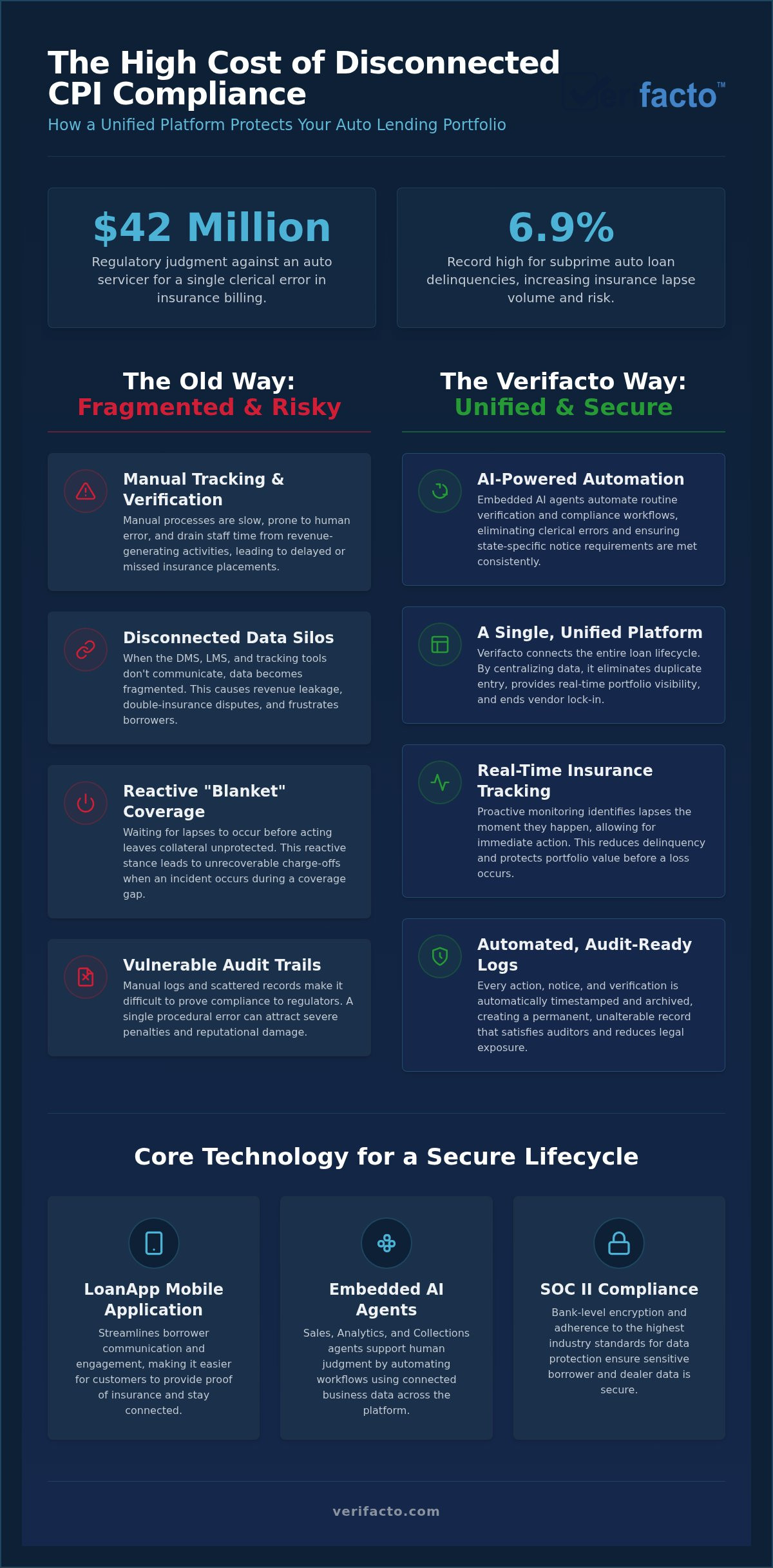
Is a single clerical error worth a $42 million regulatory judgment? In January 2025, the CFPB secured exactly that against an auto servicer for improper insurance billing, proving that manual oversight is a massive liability for CPI compliance for auto lenders. With subprime auto loan delinquencies hitting a record 6.9% in early 2026, the volume of insurance lapses is rising, and so is the pressure on your compliance department.
You’ve likely dealt with the fallout: manual verification that moves too slowly, frustrated borrowers complaining about being double-insured, and the headache of trying to assemble audit-ready logs for state regulators. It’s a high-stakes balancing act where a single mistake can lead to significant financial and reputational damage. We understand that managing these risks while maintaining operational speed feels like an impossible task when your data is scattered across disconnected systems.
This article explains how to eliminate these risks by unifying your tracking and placement workflows through a single AI-powered platform. You’ll learn how to replace fragmented processes with real-time visibility and automated compliance logs that satisfy auditors. We’ll show you how to leverage tools like LoanApp to improve borrower communication and turn a disconnected operation into a secure, high-performance lifecycle that protects your portfolio and your reputation.
Key Takeaways
- Stop revenue leakage caused by disconnected data and manual tracking errors. Unifying your workflows helps eliminate the “double-insurance” disputes that frustrate borrowers and trigger regulatory scrutiny.
- Navigate the evolving regulatory landscape by automating state-specific notice requirements and maintaining audit-ready logs. This proactive approach ensures you meet your legal duty to track without slowing down operations.
- Move beyond reactive “blanket” coverage to real-time insurance tracking. Proactive monitoring is designed to reduce delinquency and borrower churn by identifying lapses before they become financial liabilities.
- Leverage embedded AI agents and the LoanApp mobile application to streamline borrower engagement. This technology supports human judgment by automating routine insurance verification tasks using connected business data.
- Strengthen your CPI compliance for auto lenders by centralizing the entire lending lifecycle on a single, SOC II-compliant operating platform.
The High Cost of Disconnected CPI Compliance in Auto Lending
Dealerships operate one business but are often forced to manage it through disconnected systems. This fragmentation is the primary driver of risk in CPI compliance for auto lenders. When your insurance tracking lives in a different silo than your loan management, revenue leakage becomes inevitable. You miss lapses, fail to place coverage in time, and lose collateral to unrecoverable charge-offs because the data didn’t move fast enough between your DMS and LMS.
Disconnected data also triggers double-insurance disputes. If a borrower provides proof of coverage but your systems don’t sync in real-time, you might improperly charge them for Collateral Protection Insurance. These friction points don’t just frustrate customers; they create audit vulnerabilities. Regulators are increasingly focused on procedural errors, and fragmented systems are the leading cause of the data entry mistakes that attract their attention.
Operational Friction: The Enemy of Compliance
Manual insurance verification is a massive time-drain for dealership staff. It forces employees to step away from revenue-generating activities to chase down paper trails and verify policy details over the phone. Many legacy systems rely on vendor lock-in, where your data is trapped in a proprietary format, preventing the real-time risk visibility needed to protect portfolio margins. Every day of delay in insurance placement represents a gap in your security that can lead to significant financial loss.
Verifacto’s Unified Approach to Risk
Verifacto brings the operation, data, and AI together in one platform. Instead of managing risk through disconnected tools, you gain a single operating platform that connects the entire customer lifecycle. This unified approach is designed to eliminate duplicate data entry and ensure that insurance status is always current across your entire portfolio. By centralizing this data, you gain the control necessary to manage compliance without increasing the administrative burden on your team.
Centralized data allows for automated workflows, such as those managed by the AI Sales Agent, which can help verify coverage during the initial lead phase. By moving from reactive placement to real-time tracking, you protect your bottom line and ensure your operation remains audit-ready. This provides greater visibility into your portfolio, allowing you to identify risks before they turn into losses.
Navigating the Regulatory Landscape of Lender-Placed Insurance
Lenders face a complex web of state and federal mandates that define the “duty to track” collateral insurance. Navigating the legal landscape of CPI compliance for auto lenders requires more than just a spreadsheet. If you fail to provide timely, accurate notices before initiating force-placed insurance, you risk significant regulatory penalties. Between early 2024 and September 2025, state bodies enacted 119 regulatory changes impacting motor vehicle lending and add-on products. This fragmentation makes manual tracking nearly impossible for growing portfolios.
Verifacto’s AI is designed to help you stay ahead of these shifts by embedding compliance logic directly into your workflow. By automating the placement process based on state-specific rules, the platform provides greater visibility into your regulatory standing. Security is equally critical. Verifacto maintains SOC II compliance and utilizes bank-level encryption to safeguard sensitive borrower and dealer data, ensuring your operation meets the highest industry standards for data protection.
Maintaining Audit-Ready Logs
State regulators don’t just want to see that you followed the rules; they want proof. Every insurance notice sent, every policy verified, and every premium placed must be timestamped and archived. Verifacto’s platform automates this audit trail, creating a permanent, unalterable log of every action taken within the system. This transparent record-keeping reduces legal exposure and ensures you are always prepared for a surprise audit. When your logs are automated, you eliminate the risk of human error or missing documentation that often leads to compliance failures.
The Borrower Experience and Fair Lending
Compliance is not just about rules; it is about communication. Unexpected CPI charges are a leading cause of borrower friction and delinquency. Utilizing the LoanApp allows you to provide borrowers with real-time visibility into their insurance status. This transparency helps prevent force-placement surprises by giving customers a clear path to submit their own proof of coverage.
Automated reminders sent through the platform can help borrowers maintain their own insurance, which is the ideal outcome for both the lender and the customer. By fostering clear communication, you reduce the likelihood of disputes and build a more stable portfolio. You can see how Verifacto connects your operation from the first lead to the final payment while keeping your compliance workflows seamless.
Real-Time Tracking vs. Reactive Placement: A Strategic Audit
Lenders often choose between “blanket” coverage and tracked insurance programs, but the difference in financial outcomes is stark. Blanket policies offer a passive safety net that covers the entire portfolio, yet they lack the granularity needed to manage individual risk. Tracked CPI programs, however, provide the visibility required to verify that every specific asset is protected. For those managing subprime portfolios, where delinquencies reached 6.9% in January 2026, relying on blanket coverage is a gamble that often results in unrecoverable losses.
Reactive placement is a primary driver of borrower churn. When a lender places insurance weeks after a lapse is discovered, the sudden addition of a $2,000 to $3,000 premium can push a struggling borrower into default. CPI compliance for auto lenders isn’t just about following rules; it’s about timing. Real-time monitoring allows you to identify lapses early, providing a window to communicate with the borrower before expensive force-placement becomes the only option. Verifacto’s CIMS™ (Insurance Tracking) is designed to integrate this monitoring directly into the lending lifecycle, ensuring insurance status is a dynamic part of your data, not a static footnote.
The Pitfalls of Reactive Manual Tracking
Manual tracking creates a “gap” period. This is the dangerous stretch of time between when a borrower’s policy cancels and when your staff finally discovers the lapse through a manual audit. If an accident occurs during this gap, the collateral loss is often total. Human errors in this process also lead to wrongful placements, where borrowers are charged for insurance they already have. This doesn’t just cause reputational damage; it leads to “double-insurance” disputes that can trigger regulatory inquiries. The human capital cost of having employees chase insurance certificates is a form of revenue leakage that many lenders overlook until it impacts their bottom line.
The AI Advantage in Collateral Protection
Verifacto moves your operation from reactive discovery to automated detection. By connecting your business data directly to insurance carrier feeds, the platform identifies lapses as they happen. The AI Analytics Agent provides predictive risk insights, helping you see which accounts are most likely to lapse based on historical payment patterns and communication data. This isn’t a standalone novelty; it’s an embedded tool that supports your team’s judgment with hard data.
Operating with 99.99% uptime, Verifacto ensures continuous portfolio monitoring that never sleeps. This level of automation is designed to reduce the administrative burden on your staff while providing greater visibility into your risk exposure. Instead of reacting to crises, you can manage your portfolio with the confidence that your collateral is protected through a unified operating platform. See how Verifacto connects your operation from the first lead to the final payment by booking a demonstration to explore how the platform fits your business.
Implementing AI-Driven Compliance Workflows
Modernizing your operation requires a shift from manual checklists to a unified, automated sequence. Implementing a robust workflow for CPI compliance for auto lenders starts with removing the barriers between your data sets. Verifacto brings the operation, data, and AI together in one platform to replace the siloed approach that leads to errors. This process ensures that insurance status is tracked from the moment a lead enters your system until the final payment is made.
The transition to an AI-driven model follows five critical steps:
- Step 1: Unify inventory and origination data within the Verifacto DMS to create a single source of truth.
- Step 2: Automate initial borrower engagement using the AI Sales Agent to verify coverage requirements during the sales process.
- Step 3: Maintain real-time verification throughout the loan lifecycle by connecting directly to insurance carrier data.
- Step 4: Execute automated placement immediately when a lapse is detected, ensuring no “gap” periods exist in your collateral protection.
- Step 5: Manage the entire lifecycle, including collections and payment processing, through a single interface to prevent data fragmentation.
The Role of the Collections Agent
AI should be presented as an embedded tool that supports human judgment rather than a total replacement for employees. The Collections Agent automates notifications for insurance lapses, which drastically reduces the need for manual outreach by your staff. By identifying high-risk accounts early, the agent allows your team to focus their energy on complex cases that require a human touch. This proactive approach is designed to improve recovery rates and maintain portfolio stability without increasing your headcount.
Streamlining Borrower Communication
Friction in communication is often what leads to borrower disputes and delinquency. By utilizing automated SMS and email notifications, you keep the borrower informed of their insurance status without manual intervention. The LoanApp simplifies insurance verification for the borrower by allowing them to snap a photo of their policy and upload it directly to the system in seconds. This transparency reduces the “force-placement surprises” that often damage the lender-borrower relationship. You can explore how Verifacto’s AI agents automate your compliance workflow to protect your collateral more effectively.
Unifying the Lending Lifecycle with Verifacto
Dealerships operate one business but are often forced to manage it through disconnected systems. Verifacto brings the operation, data, and AI together in one platform to eliminate the friction caused by using separate tools for sales, servicing, and insurance tracking. While a traditional DMS or LMS handles specific tasks, an AI-powered operating platform connects the entire customer and loan lifecycle. This unified approach is designed to provide the consistency required for robust CPI compliance for auto lenders, ensuring that no data point is lost during handoffs between departments.
Security and reliability are foundational to this integration. Verifacto maintains SOC II compliance and utilizes bank-level encryption to protect sensitive borrower and dealer information. By moving your operation to a cloud-hosted environment, you eliminate the need for expensive on-premise hardware and the maintenance costs associated with local servers. This modernization provides a 99.99% uptime guarantee, ensuring your portfolio monitoring remains continuous and reliable.
Data control is a critical component of operational independence. Verifacto empowers lenders with full access to their business data, reducing vendor lock-in and allowing for easy export of records for deep analytics. Whether you’re preparing for a state audit or using the Analytics Agent to identify trends in portfolio performance, having centralized, exportable data gives you the strategic advantage needed to grow in a competitive market.
Improving Financial Performance Through Efficiency
Consolidating disconnected systems directly impacts your bottom line by reducing the redundancy of paying for multiple, overlapping software licenses. Automated workflows allow your team to focus on high-value tasks like sales and complex customer resolutions while embedded AI agents handle routine insurance verification and lapse notifications. This shift is designed to improve dealership profitability by minimizing the administrative overhead that typically scales with portfolio growth. When your software handles the repetitive “no-nonsense” requirements of daily operations, your staff can focus on the human judgment that drives your business forward.
Next Steps for Modern Lenders
The first step toward securing your portfolio is assessing your current compliance gaps and identifying where revenue leakage occurs in your workflow. If you’re still relying on manual audits or disconnected spreadsheets, your collateral is at risk. We recommend reviewing The 2026 Auto Finance Compliance Management Checklist to evaluate your current standing against industry standards.
Transitioning to a unified platform provides greater visibility and control over your entire operation. Book a demonstration to explore how the platform fits your business and see how Verifacto connects your operation from the first lead to the final payment. Strengthening your CPI compliance for auto lenders doesn’t have to be an operational burden when you have the right technology supporting your team.
Securing Your Portfolio with Integrated Intelligence
Dealerships operate one business but are often forced to manage it through disconnected systems. Verifacto brings the operation, data, and AI together in one platform to solve this fragmentation. By moving from reactive manual tracking to real-time monitoring, you can effectively manage CPI compliance for auto lenders while protecting your bottom line from regulatory penalties and collateral loss. This unified approach eliminates the data gaps that lead to double-insurance disputes and revenue leakage.
Our SOC II compliant, AI-powered operating platform provides the security and 99.99% uptime guarantee your portfolio requires. You’ve seen how automated workflows and the LoanApp can help reduce delinquency and improve operational efficiency by keeping borrowers informed and engaged. It’s time to replace fragmented tools with a unified solution that supports your human judgment and grows with your business. Modernizing your compliance strategy is the most direct path to long-term stability and growth in a complex market.
See how Verifacto connects your operation from the first lead to the final payment
Frequently Asked Questions
What is the difference between CPI and force-placed insurance?
CPI refers to the insurance policy itself that protects the lender’s interest in the collateral. Force-placed insurance is the administrative action of adding that policy to a loan when a borrower fails to maintain their own coverage. While the terms are often used interchangeably, CPI is the specific product used to mitigate risk in CPI compliance for auto lenders when a primary policy lapses. This distinction is vital for maintaining clear audit trails.
How does Verifacto ensure CPI compliance with state regulations?
Verifacto helps you stay aligned with state regulations by automating the timing and delivery of required borrower notices. The platform is designed to track fragmented state-level changes and maintain timestamped, audit-ready logs of all communications. This provides greater visibility into your compliance standing, ensuring that every placement follows the specific legal procedures required in your jurisdiction. It’s a proactive way to avoid the procedural errors that often lead to regulatory penalties.
Can automated insurance tracking really reduce charge-offs?
Automated insurance tracking is designed to reduce charge-offs by eliminating the dangerous “gap” period where collateral is unprotected. Manual audits often take weeks to discover a lapse, but real-time tracking identifies the issue immediately. This allows for faster placement or borrower outreach, ensuring the vehicle is covered before an accident occurs. It helps prevent total collateral loss and unrecoverable debt by ensuring you’re never flying blind on your portfolio’s coverage status.
Is the Verifacto platform SOC II compliant for data security?
Yes, Verifacto is SOC II compliant and utilizes bank-level encryption to secure all platform data. This commitment to enterprise-grade security ensures that sensitive borrower information and dealership financial records are safeguarded. By hosting your data in a secure cloud environment, you reduce the risks associated with local hardware failures while meeting the high security standards required by modern financial regulators. It’s a no-nonsense approach to data protection that allows you to focus on growth safely.
How do AI agents assist with CPI management without replacing staff?
AI agents function as embedded tools that handle high-volume, routine tasks like monitoring insurance feeds and sending automated reminders. The Sales Agent verifies coverage at origination, while the Collections Agent flags lapses for immediate attention. These tools support human judgment by providing accurate, real-time data to your team. This allows your staff to focus on complex borrower interactions and high-level strategy rather than getting bogged down in manual data entry and document chasing.
What happens if a borrower provides proof of insurance after CPI is placed?
If a borrower provides proof of coverage after CPI is placed, the system allows for a seamless premium adjustment or refund. This rapid reconciliation is designed to resolve double-insurance disputes quickly, which helps maintain a positive borrower relationship. By unifying your tracking and placement data, the platform ensures that the overlapping coverage period is handled accurately. It’s a transparent process that satisfies both the borrower’s concerns and the auditor’s requirement for precise record-keeping.
Does Verifacto integrate with my existing accounting software like QuickBooks?
Verifacto features a direct sync with QuickBooks to ensure your financial records remain accurate and unified. This integration eliminates the need for duplicate data entry between your operating platform and your accounting software. It ensures that CPI premiums, loan payments, and operational expenses are reflected in real-time across your books. You’ll have a clear and reliable view of your dealership’s financial performance without the administrative headache of manual reconciliation between disconnected systems.
How does the LoanApp help with insurance verification?
The LoanApp simplifies the verification process by allowing borrowers to upload policy documents directly from their mobile devices. This creates a direct line of communication that bypasses the delays of traditional mail or fax. By giving borrowers a convenient way to prove they’re insured, you improve the accuracy of your tracking. It’s an essential tool for maintaining CPI compliance for auto lenders because it ensures your data is based on the most current borrower information available.