
A missed insurance lapse rarely starts with one bad decision. It starts when loan data sits in one system, insurance records in another, and staff have to connect the dots manually. Auto loan compliance software can help address that gap when it connects the work behind the loan, not just one task.
Dealerships operate one business but are often forced to manage it through disconnected systems. When DMS and LMS records don’t align with insurance tracking, teams can overlook coverage changes, delay follow-up, or struggle to see what happened and when. The result is a less complete view of account activity and portfolio risk.
A connected, AI-powered platform can bring loan, insurance, payment, and communication data into a shared operating environment. Automated insurance tracking and CPI workflows, connected records, and embedded AI tools can help teams identify issues for review and organize follow-up. The goal is not to replace human judgment or guarantee compliance. It is to give your team clearer workflows and better visibility across the lending lifecycle.
Key Takeaways
- Disconnected DMS, LMS, and insurance records can make it harder to spot gaps and understand portfolio risk.
- Auto loan compliance software can connect lending workflows and help teams identify potential issues for review.
- Embedded AI agents and an Operational Assistant can support monitoring, task management, and workflow reminders.
- A practical transition starts by mapping data silos, assigning workflow ownership, and preparing records.
- Verifacto connects dealership operations, data, and AI in one platform, with bank-level encryption and a 99.99% uptime guarantee.
The Financial Risk of Managing Compliance Through Disconnected Systems
A dealership may use one system for inventory and sales, another for loan servicing, and a separate tool to track insurance. Each system has a purpose, but manual transfers and duplicate records make it easier for information to become outdated or inconsistent.
Auto loan compliance software connects operational information across the customer and loan lifecycle. Rather than treating insurance, payments, borrower communication, and loan records as separate activities, a unified platform can help teams review them in context. That visibility supports oversight, but it does not replace staff judgment or guarantee compliance.
Consider a borrower who updates an insurance policy. If the change is recorded in one system but not reflected in the loan file, the dealership’s portfolio view may not show the current coverage status. Staff then need to reconcile records before assessing the account and deciding on the appropriate next step. Background on disclosure requirements is available in the Truth in Lending Act (TILA). Operational software can organize information, but it is not legal advice.
Why Manual Insurance Verification Is a Portfolio Threat
A coverage lapse can leave collateral exposed. If a vehicle is damaged or lost during an uninsured period, the lender may face a loss that insurance could otherwise have helped cover. The level of exposure depends on the circumstances. Operationally, a lapse that goes unnoticed is harder to address promptly.
Periodic manual checks provide a snapshot, not a continuous view. Coverage can change between reviews, and staff may be working from records entered at different times. Real-time insurance tracking helps teams review current coverage information and identify potential gaps for follow-up. Insurance tracking and CPI workflows can organize that work, while dealership staff retain responsibility for reviewing records and deciding what action to take.
The Operational Cost of Reactive Compliance
An audit request or discovered lapse can turn into a scramble when records are spread across systems. Staff may have to locate documents, compare dates, correct account details, and determine which record is current. The problem is often the workflow: the information needed to answer a basic account question is scattered across tools and files.
Repeated reconciliation takes time away from portfolio work and can add operating effort without improving visibility. Connected workflows can help reduce duplicate entry and make account status easier to review before a documentation gap becomes urgent.
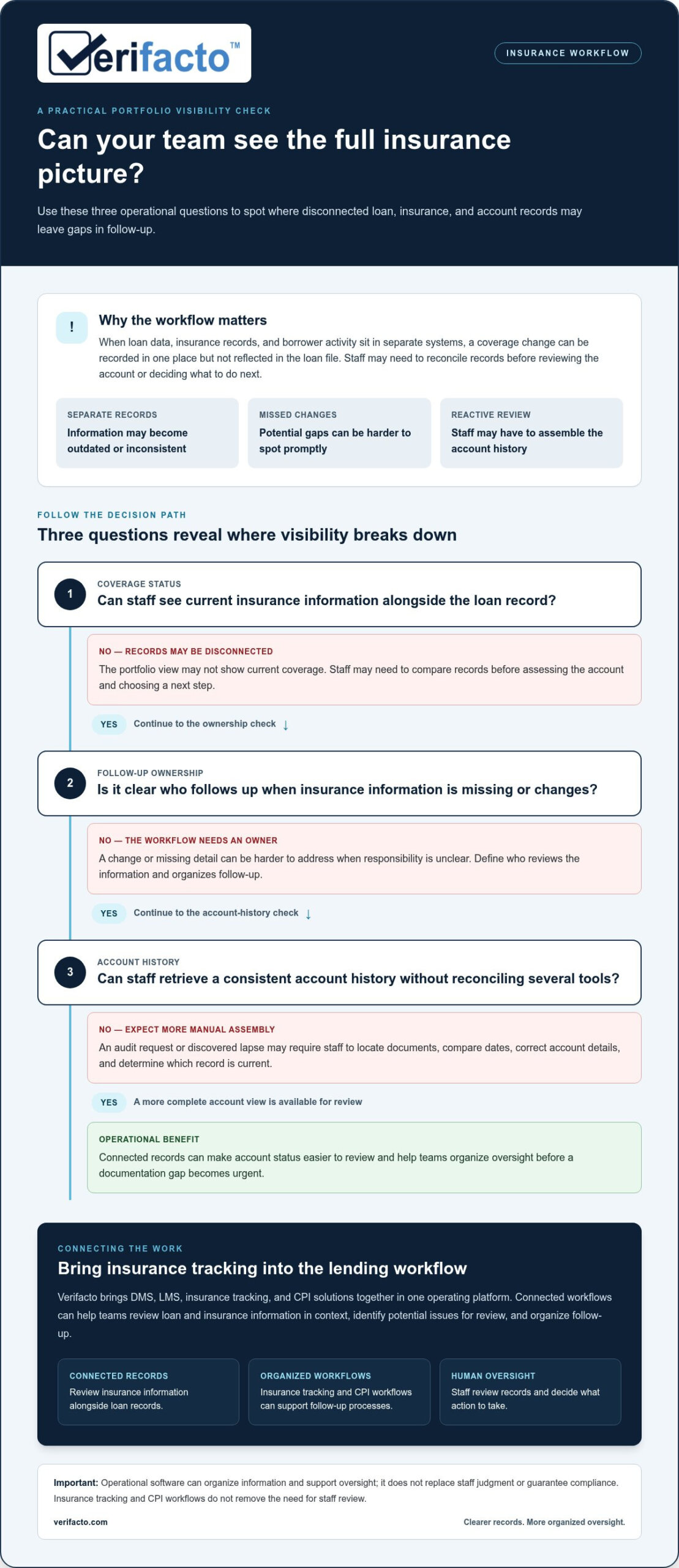
- Coverage status: Can staff see current insurance information alongside the loan record?
- Record ownership: Is it clear who follows up when information is missing or changes?
- Audit preparation: Can staff retrieve a consistent account history without reconciling several tools?
Verifacto brings DMS, LMS, insurance tracking, and CPI solutions together in one operating platform. Connecting these workflows can give dealership leaders a clearer view of portfolio exposure and help teams organize oversight instead of repeatedly assembling records after an issue arises.
Core Capabilities of an AI-Powered Compliance Framework
AI is most useful when it can work with connected operational data rather than isolated records. Account details, insurance status, payment activity, and borrower communications each provide context. When these records are available within one operating platform, embedded AI tools can provide insights and help staff focus attention on items that may need review. AI supports decisions; it should not make consequential lending or compliance decisions independently.
An AI Operational Assistant can support routine task management, reminders, and workflow guidance. For example, when a file needs follow-up, a task or reminder can help bring it to staff attention and clarify the next step. Automated borrower communication can also support follow-up, with the dealership retaining oversight of message content, timing, and handling.
Built-in payment processing can reduce the need to move payment information manually between separate tools. When payment activity is connected to account records, staff can review the account in context and make routine reconciliation more orderly. A connected history of borrower communications and account activity can also help staff understand what was sent, what was recorded, and what follow-up remains. Dealerships should define which events need to be documented and maintain records that fit their processes.
Automated Insurance Monitoring and CPI Placement
Insurance tracking can help identify a potential coverage lapse, while an integrated CPI workflow supports the next step in the dealership’s process. Verifacto provides insurance tracking and CPI solutions, including automated CPI placement with immediate coverage with no waiting period. These workflows can help teams manage insurance information and collateral risk, but they do not remove the need for staff oversight. For additional background, see the 2026 Lender’s Guide to CPI.
Connected records also matter when borrower or loan information affects reporting workflows. The Federal Register on Qualified Passenger Vehicle Loan Interest illustrates how auto-loan reporting topics can involve detailed requirements. Software can help organize operational data, but dealerships should use qualified guidance to interpret requirements that apply to their business.
Using Analytics to Focus Risk Reviews
An Analytics Agent can turn connected portfolio data into dashboards, reports, and insights that help teams review account status and potential exceptions. Rather than giving every account the same level of attention, staff can use available indicators to prioritize where a closer look may be useful. Predictive insights can help surface patterns for review, but they do not guarantee that an account will become delinquent or remain current.
Verifacto’s AI agents are designed to support human judgment with connected data and workflow assistance. Dealerships evaluating AI-powered operational tools can start with practical questions: Which signals merit review? Who owns follow-up? How will staff record the outcome?
Manual Auditing vs. Automated Compliance: A Performance Comparison
A manual audit provides a careful review of records at a point in time. It may not reveal what changed after the review. If an insurance lapse occurs between scheduled checks, staff may not identify it until the next review or another account event prompts investigation. Connected auto loan compliance software can help bring loan and insurance information into one operational view so teams can review relevant changes sooner. The result still depends on the information available and the dealership’s follow-up process.
The practical difference is not that automation replaces audits. It is that a connected workflow can make reviews more focused. Instead of comparing records across systems, staff can review an account with a more consistent picture of its history and status. Connected data can also give AI-powered operational workflows relevant context to surface items for human attention.
A unified platform can reduce the number of separate vendor relationships a dealership depends on, helping limit operational friction and vendor lock-in. Consolidation alone does not guarantee data portability or eliminate dependency. Leaders should understand how they can access and retain business data and how workflows would be affected if systems or vendors change.
Reducing Revenue Leakage Through Integration
Consider a borrower journey that begins in a dealership CRM. At origination, the team records insurance information alongside the loan file. As the account moves into servicing, connected DMS and LMS workflows can help keep those records associated instead of relying on repeated manual transfers. If a detail is missing or changes, staff have a clearer path to review the account and decide on follow-up.
This connected process can reduce the chance that information gets lost between stages, though it does not eliminate the need to verify records. Built-in payment processing keeps payment activity within the broader operating workflow, giving staff a more connected account view. Together, connected records and payment workflows can support more organized reviews without promising that errors or losses will never occur.
Scalability, Security, and Control
As an active portfolio grows, more accounts may need attention. Manual checks and reconciliation can become harder to manage consistently, especially when staff repeat the same steps across separate tools. Automated workflows can help a dealership handle routine monitoring and follow-up more systematically. The goal is to reduce repetitive work, not to assume that business growth requires a matching increase in administrative staff.
Cloud hosting and on-premise hardware each require sound security practices. Hosting model alone does not determine which is safer. Verifacto reports SOC II compliance and bank-level encryption. These are relevant considerations when evaluating a platform, and dealerships should also assess how its controls fit their own security responsibilities and processes.
For independent auto finance businesses, connected software can provide a stronger operating foundation by improving visibility and reducing repetitive tasks. Compare workflows, data access, and oversight needs before consolidating systems. Choose an approach that keeps staff in control of account decisions.
Checklist: Transitioning to an Automated Compliance Framework
A successful transition starts with clear ownership of data and workflows. Use this checklist to map the current process, prepare records, and introduce automation in a structured way. Auto loan compliance software can help connect routine work, while your team remains responsible for reviewing exceptions and deciding what action to take.
- Map your data silos. List the systems holding customer, contract, payment, and insurance information. Note where staff re-enter data, pass files between tools, or maintain separate spreadsheets. These handoffs are practical priorities for improving visibility.
- Plan DMS and LMS consolidation. Define which records and daily workflows need to be managed together. A unified, AI-powered operating platform can bring DMS, LMS, and related lending operations into a shared environment, helping reduce manual transfers and fragmented views.
- Set insurance tracking expectations. Decide when coverage information should be captured during origination, who reviews missing or changing details, and how the dealership handles follow-up. Connected insurance tracking and CPI workflows can support timely oversight, while staff retain control of account actions.
- Organize borrower communications. Identify routine notifications that can be handled through automated borrower communication, including relevant SMS and email workflows. Set internal review and escalation practices so automation supports the dealership’s process.
- Establish an analytics review rhythm. Schedule regular reviews of available portfolio analytics. Use them to spot records or patterns that may deserve attention, assign follow-up, and document the outcome. Treat AI-generated indicators as prompts for review, not final decisions.
Prepare Data and Borrower Workflows
Before moving to a cloud-based system, review existing loan records for duplicate accounts, missing fields, inconsistent formats, and outdated information. Agree on which record is authoritative for each key detail, then resolve obvious conflicts before migration. Cleaner source data makes account histories easier for staff to assess after the transition.
Verifacto integrates with QuickBooks and other accounting tools, which can help simplify accounting workflows during a system change. Include the LoanApp mobile application in planning for borrower-facing processes. Map what information is collected, where it should be recorded, and who reviews it.
Train for AI-Assisted Workflows
Training should explain how AI agents support the team, where staff review outputs, and when an issue requires human judgment. Sales agents can assist with lead engagement, follow-up, and appointment scheduling, helping staff focus on complex conversations and closing tasks without replacing their role. Explore the AI Sales Agent in the context of your sales workflow.
For dealership owners, the objective is practical control: clearer portfolio visibility, defined responsibility, and workflows staff can understand. Assign owners for data quality, insurance review, communications, and analytics. A phased rollout can help teams adopt the platform with fewer surprises.
Verifacto: Connecting Your Operation from Lead to Final Payment
Disconnected tools can make it harder to follow an account from its first customer interaction through servicing and final payment. Verifacto brings operations, data, and AI together in one platform, connecting CRM, inventory, underwriting, DMS, LMS, payments, collections, messaging, insurance tracking, CPI, reporting, analytics, and AI agents. This connected foundation can help teams work from a more complete view of the customer and loan lifecycle.
For dealerships evaluating auto loan compliance software, the value is not simply having fewer screens. It is having relevant operational information available in context, so staff can spot gaps, manage follow-up, and review account activity with greater visibility. Automation supports consistent workflows, while dealership staff retain oversight and make decisions.
The Power of a Unified Interface
A cloud-hosted platform can support access to connected workflows from different dealership locations, subject to the dealership’s access controls and operating setup. Bringing CRM, inventory, and collections into the broader operating environment can help teams see how customer activity and account follow-up relate, rather than piecing together separate records.
Consolidation may reduce duplicate administrative work and the burden of coordinating multiple vendors. The effect on total cost of ownership depends on a dealership’s current tools, contracts, and processes, so evaluate the full operating picture rather than assuming a platform change automatically lowers costs. Verifacto’s stated 99.99% uptime guarantee is one availability commitment to consider as part of that evaluation.
Intelligent Automation for the Modern Lender
Verifacto’s AI is embedded in the platform to work with connected operational data. Its Analytics Agent can provide portfolio dashboards and insights, while other agents can support sales engagement, collections, and operational task management. Predictive insights can help teams identify accounts or patterns that may merit review. They support decision-making, but do not guarantee future performance or replace human judgment.
A unified system can help dealerships organize processes as business practices and industry expectations evolve. It does not guarantee compliance or determine how a rule applies to a specific dealership. Connected records and clearer workflows can give owners and teams a more useful basis for review and follow-through. Explore Verifacto’s AI capabilities to see how embedded agents can support dealership operations.
Consider the full operating path: a lead enters through CRM, customer and vehicle details move through the dealership workflow, and the loan is serviced using connected payment, collection, and insurance information. When staff can review those activities in one operating context, they can spend less effort assembling records and more time acting on issues that need attention. The platform is designed to support more efficient operations and help protect financial performance, without promising lower delinquency or a specific result.
Book a demonstration to explore how Verifacto fits your dealership’s workflows, data needs, and growth plans.
Build the Next Stage of Your Lending Operation
Modernizing dealership workflows is not about handing control to software. It is about giving leaders a clearer view of operations and giving teams connected tools to act on relevant information. As you evaluate auto loan compliance software, focus on how well a platform supports your dealership’s actual processes, where staff retain review and decision-making responsibility, and how easily you can see what needs attention.
Start with the operational outcome you want to improve. That might mean fewer manual handoffs, more consistent insurance follow-up, or a clearer view of account activity. Then consider how connected workflows could support that goal without adding unnecessary complexity. The right approach should strengthen your team’s ability to manage the business while keeping data ownership and decisions with the dealership.
Verifacto brings dealership operations, data, and AI together to support that next step. Explore how Verifacto can connect your lending workflows and identify a practical path forward for your operation.
The website and its services are offered only to users who are 18 years of age or older and reside in the United States or its territories or possessions. Website use is for personal, non-commercial purposes. Verifacto’s software supports dealership and auto finance operations.
Frequently Asked Questions
What is auto loan compliance software, and how does it differ from a standard DMS?
Auto loan compliance software supports the organization and review of lending records and operational activity. A standard DMS primarily supports dealership management functions. The distinction is scope: a dealership may use a DMS for sales and inventory, alongside lending workflows for reviewing loan files, insurance details, and account history. Software can help structure that work, but it does not determine how a legal requirement applies to a specific transaction.
Can AI-powered software help reduce insurance lapses in my portfolio?
It can help teams identify records that may need attention, but no system can guarantee that a lapse will not occur. A useful review process checks that coverage information matches the correct borrower, vehicle, and loan, then routes mismatches for investigation. For example, a policy document with a different vehicle identifier should be reviewed rather than treated as proof that the account is covered.
Is it necessary to replace my current accounting software to use a compliance platform?
No. Adopting a compliance platform does not automatically mean replacing accounting software. First, map which system is authoritative for each record, such as the general ledger, payment posting, or loan servicing history. Then document how staff reconcile differences and who resolves them. Clear ownership can help prevent conflicting figures from remaining in separate systems.
How does automated borrower communication improve collection efficiency?
It can help organize outreach when messages are aligned with account status and staff responsibilities. A dealership might distinguish a routine payment reminder from an account that needs individual review, then define who handles questions or disputes. That structure can help staff prioritize follow-up and maintain a consistent process. The dealership should establish message content and handling procedures that fit its policies.
Does compliance software provide real-time tracking for collateral protection?
Insurance tracking can provide real-time insurance-status information, and CPI workflows can help staff review potential coverage gaps. That is different from tracking a vehicle’s physical location. Software records are information for review, not proof of a policy’s terms or a claim outcome. Staff can use available documentation to verify account details and determine the next step. Verifacto’s CPI solution provides immediate coverage with no waiting period.
Is my dealership data secure on a cloud-based compliance platform?
Cloud hosting alone does not establish how well data is protected. Dealerships should understand how access is managed, how users are added or removed, and how staff are expected to handle borrower information. Keep usernames, passwords, and other security credentials confidential, and do not share them or provide access to others. Limit access according to job responsibilities and review internal procedures when roles change. These practices complement platform security measures but do not eliminate every security risk.
Can the software help manage state-specific lending regulations?
Software can support consistent workflows and organized records, but it should not be relied on to interpret state requirements or guarantee compliance. Dealerships can maintain a process for reviewing relevant requirements, assigning responsibility for updates, and checking whether procedures need revision. Consult qualified legal or compliance professionals for guidance on how requirements apply to your business.
How do AI agents assist with compliance without replacing my employees?
AI agents can support defined tasks while dealership staff set oversight practices and review exceptions. Before using an agent in a workflow, define what it may handle, what requires staff review, and how to correct an inaccurate result. For example, a team can periodically review completed tasks and use the findings to refine its procedures. Accountability remains with the dealership.