
With auto loan fraud exposure reaching a staggering $10.4 billion in 2026, the cost of non-compliance in auto finance is no longer just a line item for legal fees. It is a massive drain on your dealership’s profitability that hides within fragmented data and manual processes. You likely recognize the anxiety of unpredictable FTC audits or the frustration of seeing synthetic identity fraud slip through your disconnected DMS and LMS systems. It is exhausting to manage a business where the tools do not talk to each other, leaving your portfolio exposed to insurance lapses and sophisticated scams.
In this audit, we promise to show you exactly where these hidden compliance leaks occur and how to fix them. You will learn how to shift from a reactive avoidance mindset to a proactive, AI-powered risk mitigation strategy that protects your margins without increasing your headcount. We will explore the financial risks of staying with manual workflows and demonstrate how an integrated operating platform brings your data together to secure your loan lifecycle. By the end of this guide, you will have a clear path to automating your defenses and reclaiming your operational efficiency.
Key Takeaways
- Quantify the hidden impact where the cost of non-compliance in auto finance manifests as revenue leakage rather than just one-time penalties.
- Recognize the triple threat of regulatory, operational, and fraud risks, including the rise of synthetic identities and income falsification.
- Identify how disconnected data between your DMS and LMS creates vulnerabilities and why limited data access is a significant compliance liability.
- Transition from a reactive avoidance approach to a proactive strategy using real-time insurance tracking and automated borrower communications.
- See how a unified, AI-powered platform provides the audit-ready logging and SOC II security required to protect your portfolio’s bottom line.
The Silent Profit Killer: Quantifying the Cost of Non-Compliance in Auto Finance
Many dealerships still rely on an “avoidance approach” to compliance. This reactive mindset assumes that if an auditor hasn’t knocked on the door, the system is working. In the high-interest, high-risk market of 2026, this strategy is failing. The cost of non-compliance in auto finance is no longer just the price of a rare fine; it’s a constant drain on your margins through fraud, operational friction, and missed opportunities. When you wait for a problem to surface before addressing it, you’ve already lost the revenue.
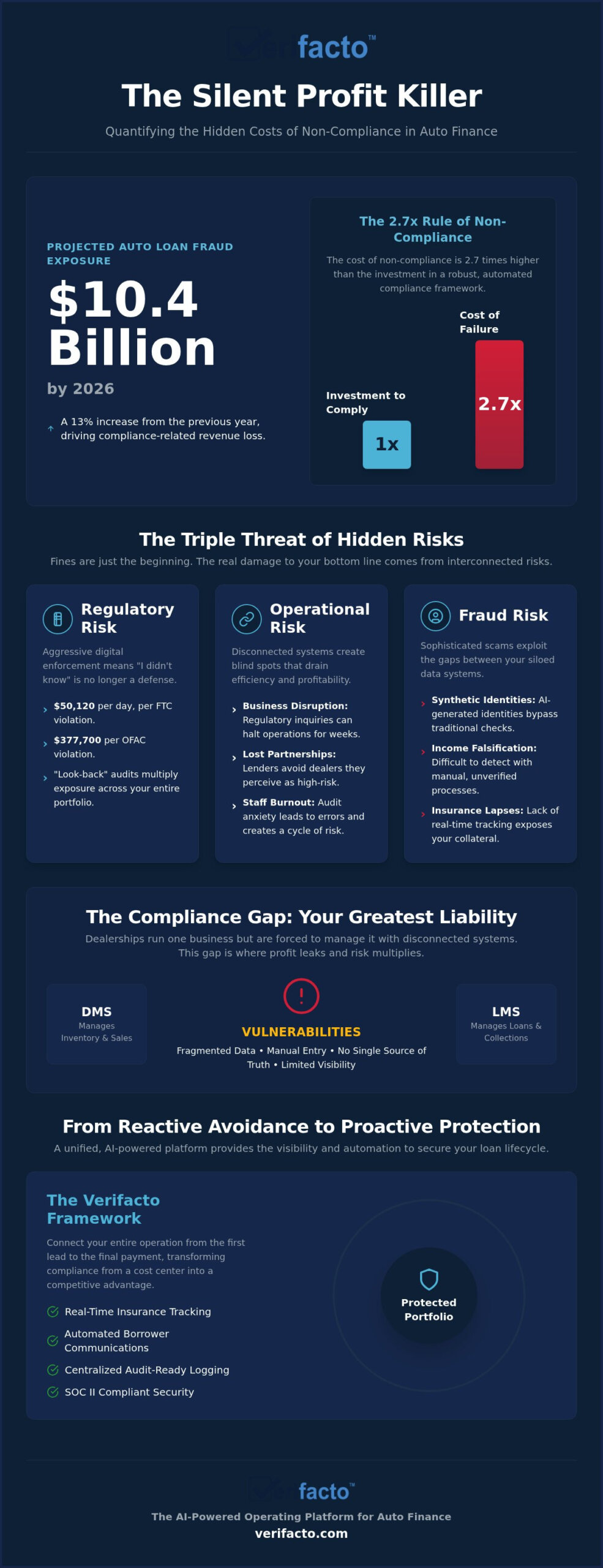
Industry analysis suggests that the cost of non-compliance is 2.7 times higher than the investment required to maintain a robust, automated framework. We call this the 2.7x Rule. It’s a mathematical necessity for margin protection. For every dollar you “save” by skipping advanced verification or manual tracking, you’re likely to lose nearly three dollars in litigation, recovery, and labor costs. Beyond the balance sheet, there’s a psychological cost. Staff who operate in a constant state of audit anxiety are less efficient and more prone to errors, creating a cycle of risk that manual systems can’t break.
Direct vs. Indirect Costs of a Compliance Failure
Direct costs are the easiest to quantify but often the most devastating. As of January 2026, the FTC can impose civil penalties of up to $50,120 per violation, per day for non-compliance with the Safeguards Rule. If you’re flagged for an OFAC violation, penalties can reach $377,700 per instance. These are “hard” costs that hit your bottom line immediately.
- Business Disruption: A single regulatory inquiry can halt operations for weeks while staff pull paper files.
- Lender Relationships: Indirect costs include the loss of floorplan partners who view non-compliant dealers as high-risk liabilities.
- Tail Risk: A bad audit often triggers “look-back” periods, where regulators scrutinize your entire portfolio for the past several years, multiplying your exposure.
The 2026 Regulatory Landscape for Lenders
The regulatory environment has shifted toward aggressive digital enforcement. The FTC and CFPB now use automated tools to scan digital records for inconsistencies in consumer protection laws compliance. Claims of “I didn’t know” are no longer valid defenses when modern platforms are designed to provide real-time visibility. Dealerships operate one business but are often forced to manage it through disconnected systems, which is exactly where regulators look for gaps. Point Predictive estimates that total exposure to auto loan fraud will reach $10.4 billion in 2026, a 13% increase from the previous year, which serves as a primary driver of compliance-related revenue loss.
Verifacto brings the operation, data and AI together in one platform to eliminate these gaps. By unifying the lifecycle from the first lead to the final payment, the platform helps you identify risks before they become penalties. Book a demonstration to explore how the platform fits your business and protects your portfolio from the silent profit killers of 2026.
Beyond the Fine Print: The Triple Threat of Regulatory, Operational, and Fraud Risks
While regulatory fines grab the headlines, the day-to-day cost of non-compliance in auto finance often stems from quieter, more persistent leaks. These leaks occur at the intersection of fraud, operational inefficiency, and asset exposure. Dealerships operate one business but are often forced to manage it through disconnected systems, which creates blind spots. When identity verification, insurance tracking, and record-keeping live in separate silos, these risks don’t just exist; they multiply.
Poor record-keeping is the fastest way to become a target for consumer lawsuits. Without an audit-ready log of every borrower communication and document, you’re essentially defenseless against claims of unfair practices. Centralizing these records in a SOC II compliant environment isn’t just about security. It’s about building a fortress around your business logic and protecting your portfolio from the litigation trap.
The $9.2 Billion Fraud Problem
Fraud isn’t just about stolen credit cards anymore. Synthetic identity fraud, where criminals blend real and fake data to create entirely new credit profiles, is a primary driver of early-stage defaults. Point Predictive reports that auto loan fraud exposure is projected to hit $10.4 billion in 2026, with 69% of all fraud originating from the applicant. If identity verification is an afterthought during origination, you’re inviting these losses into your portfolio. Verifacto’s unified platform reduces the window of opportunity for fraudulent applications by embedding verification into the initial workflow. This connectivity allows you to leverage AI agents that support human judgment, helping your team spot falsified income or synthetic profiles before the vehicle leaves the lot.
Insurance Lapses: The Hidden Portfolio Drain
An uncollateralized asset is a charge-off waiting to happen. Manual insurance tracking is notoriously slow, often leaving lenders with a 30-day visibility gap. In 2026, a 30-day delay in notification is unacceptable. Every day a vehicle is on the road without coverage, your capital is at risk. Manual force-placing is labor-intensive and prone to error, which only increases operational friction.
- Real-Time Tracking: Automated systems identify lapses immediately, not weeks later.
- CPI Solutions: Automated Collateral Protection Insurance ensures assets remain protected without adding to staff workload.
- Risk-Based Outreach: Linking insurance status directly to your communication strategy allows your team to prioritize high-risk accounts.
Transitioning from manual follow-ups to automated borrower communication preserves your staff’s time for complex tasks. By unifying these disconnected vendor systems, you can help protect the bottom line from the erosion caused by insurance lapses and uncollateralized charge-offs.
The Compliance Gap: Why Disconnected Systems Are Your Greatest Liability
Dealerships operate one business but are often forced to manage it through disconnected systems. This fragmentation is the primary driver of the cost of non-compliance in auto finance. When your DMS doesn’t talk to your LMS, you create a “Silo Effect” where data entry errors become inevitable. These aren’t just minor mistakes; they are audit red flags that suggest a lack of control over your operations. Regulators look for these gaps as evidence of systemic failure, making a “Frankenstein” tech stack one of your largest liabilities.
Paying for multiple vendors that don’t communicate results in “swivel-chair” operations where staff must manually sync data. The labor hours lost to this manual work are significant, but the real danger is the margin of error. A single missed insurance notification or a mismatched payment record can lead to a regulatory lapse that costs thousands in fines. Verifacto’s philosophy focuses on unifying the operation, data, and AI in one platform to close these gaps and ensure that a lead in the front office remains a consistent record through the final payment.
Duplicate Data Entry and the Margin of Error
Manual data syncing is a silent margin killer. When your team spends hours each week re-entering information across disconnected systems, they aren’t just being inefficient. They are increasing the likelihood of regulatory failures. Verifacto is designed to automate these workflows, supporting human judgment with embedded AI tools like the Analytics Agent. This ensures that borrower communication and payment history remain consistent across the entire loan lifecycle, providing greater visibility and reducing the risk of human error.
Audit-Ready Logs: The Difference Between a Fine and a Pass
In 2026, regulators expect more than just a folder of papers. They look for a chronological, unalterable record of every interaction. Manual spreadsheets fail the “audit-ready” test because they are easily edited and lack a verifiable trail. Failing to maintain these logs significantly increases the cost of non-compliance in auto finance by leaving you vulnerable during unpredictable audits.
Vendor lock-in is another major risk. If you can’t easily export your own data for an audit or internal analysis, you’re at the mercy of your software provider. Verifacto ensures dealer control, making it easy to access and export data for analytics or regulatory reviews. To ensure your portfolio is protected from these hidden risks, you can consult The 2026 Auto Finance Compliance Management Checklist. This unified approach provides the security and reliability needed to navigate high-stakes environments safely.
Audit-Proofing Your Portfolio: A Strategic Framework for Modern Lenders
Moving beyond a reactive avoidance approach requires a structural shift in how you handle data. The cost of non-compliance in auto finance is mitigated when compliance is no longer an extra step but the foundation of your operations. Centralizing inventory, CRM, and origination into a single cloud-hosted environment creates a “Guardian” effect over your portfolio. This unified structure ensures that every piece of data is accessible, exportable, and ready for scrutiny at a moment’s notice, effectively eliminating the risk of vendor lock-in.
Establishing a compliance-first culture doesn’t happen through manual checklists or staff meetings. It happens through embedded tools that make the right action the easiest action. By utilizing AI Operational Assistants to handle routine notifications and task scheduling, you remove the burden of compliance from your team’s daily workload. This allows your staff to focus on high-value decision-making while the platform maintains the audit-ready logs required to navigate 2026’s regulatory environment.
Step 1: Automate the Verification Lifecycle
Manual insurance verification is a bottleneck that leaves your capital exposed. Moving from phone calls to automated insurance tracking for car loans ensures that you have real-time visibility into your collateral. Using AI Sales Agents at the point of origination ensures that all required compliance documents are gathered and verified before the vehicle leaves the lot. This real-time monitoring protects the asset from day one, closing the gap where most “compliance-related revenue loss” occurs.
Step 2: Leverage AI for Predictive Oversight
Proactive risk management is the only way to protect margins in a high-risk market. The Analytics Agent is designed to spot subtle patterns of delinquency or insurance instability that manual spreadsheets often miss. This embedded AI supports human judgment by flagging high-risk accounts for immediate review, allowing your team to intervene before a lapse becomes a charge-off. Transitioning from reactive collections to predictive oversight ensures that your portfolio remains stable even as market conditions shift.
Modernizing your framework is about more than just avoiding fines; it’s about building a more profitable, resilient operation. Verifacto brings the operation, data and AI together in one platform to help you secure your customer and loan lifecycle. Book a demonstration to explore how the platform fits your business and provides the visibility you need to stay ahead of regulatory changes.
Protecting the Bottom Line: How Verifacto’s Unified Platform Mitigates Risk
Verifacto functions as a sophisticated guardian for your dealership, providing the visibility and control that manual systems lack. By positioning itself as an AI-powered operating platform, it connects the entire customer and loan lifecycle from the first lead to the final payment. This unification is the most effective way to lower the cost of non-compliance in auto finance, as it removes the data silos where risks typically hide. Failing to unify these systems is what drives up the total cost over time. With SOC II compliance and bank-level encryption, your sensitive borrower data is safeguarded against breaches that could otherwise lead to catastrophic legal and financial consequences.
Streamlining your operation through one platform doesn’t just improve security; it directly impacts your bottom line. Automated borrower communication and integrated payment processing reduce the hundreds of operational hours typically spent on manual collections and data entry. When your systems are connected, your team can manage larger portfolios with greater precision. This ensures that no regulatory requirement or insurance lapse falls through the cracks, allowing your staff to focus on growth rather than damage control.
Operational Efficiency as a Compliance Shield
The Verifacto AI Operating Platform is designed to reduce the need for constant manual oversight by embedding compliance into every workflow. A key component of this efficiency is the LoanApp mobile application. It puts essential compliance and payment tools directly into the borrower’s pocket, encouraging higher engagement and faster documentation updates. For example, if a borrower’s insurance policy expires, the platform detects the lapse in real-time. It then triggers an automated notification through the LoanApp. If the borrower doesn’t provide updated coverage, the system can facilitate CPI placement in minutes, ensuring the asset is never uncollateralized.
The Business Value of Reliability
Maintaining compliance in a 24/7 lending environment requires a platform that is as dependable as your business logic. Verifacto provides 99.99% uptime, ensuring that your audit-ready logs and communication channels are always accessible. This reliability extends to seamless accounting integration, which keeps your books as audit-ready as your loan files. By automating the flow of financial data, you reduce the risk of reconciliation errors that often trigger regulatory scrutiny. Ultimately, compliance shouldn’t be viewed as a burden or a cost. It’s the strategic foundation that allows your dealership to scale with confidence, protecting your margins while fostering long-term growth.
See how Verifacto connects your operation from the first lead to the final payment. Book a demonstration to explore how the platform fits your business.
Future-Proofing Your Portfolio for Sustainable Growth
The 2026 auto finance market demands a level of precision that manual processes simply cannot deliver. The real cost of non-compliance in auto finance manifests through silent revenue leaks, sophisticated fraud, and the operational friction of disconnected systems. Relying on an “avoidance approach” leaves your dealership vulnerable to unpredictable audits and asset erosion. By unifying your data, operation, and AI agents into a single platform, you transform compliance from a hurdle into a framework for consistent margin protection.
Verifacto is designed to act as your reliable guardian, providing SOC II compliant protection and bank-level security for your borrower data. With a 99.99% uptime guarantee and embedded AI-powered operational efficiency, the platform ensures your records stay audit-ready without adding to your headcount. You can finally move from reactive damage control to proactive risk management that supports your long-term business goals.
Book a demonstration to explore how Verifacto connects your operation from the first lead to the final payment. We are ready to help you secure your customer lifecycle and build a more resilient, profitable future for your dealership.
Frequently Asked Questions
What is the average cost of non-compliance for an auto dealer?
The average cost is estimated to be 2.7 times higher than the investment required to maintain a robust compliance framework. In 2026, this includes direct daily fines of up to $50,120 for FTC Safeguards Rule violations and indirect costs like lost lender relationships. When you factor in the $10.4 billion industry exposure to fraud, the financial impact of a single failure can be devastating to your margins.
How does automated insurance tracking reduce compliance risk?
Automated tracking provides real-time visibility into collateral status, which eliminates the dangerous 30-day blind spot common in manual systems. It ensures every vehicle in your portfolio maintains required coverage, preventing uncollateralized charge-offs and meeting lender requirements. This system creates a verifiable, unalterable audit trail of all insurance-related communications, proving your dealership’s due diligence to regulators.
What are the most common regulatory fines for BHPH dealers?
The most frequent penalties stem from violations of the FTC Safeguards Rule, the Red Flags Rule, and OFAC regulations. For example, the FTC can seek civil penalties of up to $2,500 per violation for failures related to identity theft prevention. The cost of non-compliance in auto finance grows exponentially when these fines are compounded by mandatory 20-year consent decrees and expensive third-party security audits.
Can AI really help with auto finance compliance without replacing my staff?
Yes, AI is designed to function as an embedded tool that supports human judgment by automating high-volume, repetitive workflows. For instance, the Analytics Agent identifies patterns of delinquency while the Sales Agent ensures all compliance documents are gathered at origination. This allows your team to focus on complex decision-making and customer service rather than manual data entry or tracking down missing insurance binders.
What is the difference between manual and automated CPI management?
Manual CPI management relies on labor-intensive phone calls and spreadsheets, which often leads to delays and human error. Automated CPI solutions use real-time data to detect insurance lapses and facilitate coverage placement in minutes. This speed is critical for protecting your capital and ensuring that the cost of non-compliance in auto finance doesn’t escalate through uncollateralized asset losses.
How does a unified DMS/LMS platform improve audit readiness?
A unified platform creates a single source of truth by connecting the entire loan lifecycle from the first lead to the final payment. This integration ensures that every interaction, document, and payment is recorded in a chronological log that regulators can easily verify. When an audit occurs, you can export comprehensive, accurate data immediately instead of searching through disconnected systems or paper files.
What are the risks of using disconnected software for loan management?
Disconnected systems force “swivel-chair” operations where data must be manually synced, which significantly increases the margin for error. This fragmentation leads to missed insurance notifications, duplicate data entry, and audit red flags. It also contributes to revenue leakage by hiding patterns of fraud or delinquency that an integrated operating platform would identify through unified data analysis.
How does SOC II compliance protect my dealership’s data?
SOC II compliance ensures your platform meets rigorous bank-level security standards for data privacy, processing integrity, and protection. It provides a framework for encryption and access controls that safeguard sensitive borrower information from cyber threats. This level of security is vital for maintaining consumer trust and avoiding the massive penalties associated with data mismanagement under the Gramm-Leach-Bliley Act.