
Did you know that 73% of borrowers will abandon a loan application if the process feels outdated or takes too long? In a market where 60-month new car loan rates average 7.04%, you can’t afford to lose qualified leads to friction or slow manual workflows. Many auto lenders still struggle with legacy silos where their dealer management and finance systems don’t talk to each other. Transitioning to a modern cloud based loan management system isn’t just about moving data; it’s about transforming your portfolio into a proactive risk-mitigation engine that protects your collateral in real time.
You likely feel the weight of manual insurance verification and the pressure of new compliance hurdles, such as the IRS interest reporting deadline on January 31, 2026. It’s frustrating when technical debt leads to high default rates or poor borrower communication. This guide promises to show you how to modernize your operations, mitigate risk, and scale your portfolio with confidence. We’ll explore how to implement a cloud-based framework that unifies sales and finance, automates collections, and provides the real-time visibility you need to stay ahead of shifting state regulations like California’s CARS Act.
Key Takeaways
- Shift from static legacy databases to dynamic cloud environments to streamline operations and adapt to the 2026 economic landscape.
- Discover how a cloud based loan management system centralizes servicing and uses automated triggers to minimize manual collection errors.
- Replace expensive legacy hardware with a predictable SaaS model that offers a modern, intuitive interface for your team.
- Use our 5-step implementation framework to audit your portfolio data and establish seamless automated workflows.
- Eliminate the gap between sales and finance by integrating your LMS and DMS for real-time collateral protection and insurance tracking.
The Evolution of Auto Finance: Why Cloud-Based Loan Management is Essential in 2026
The auto finance industry has reached a definitive tipping point. For decades, lenders relied on static legacy databases that functioned like digital filing cabinets. They were isolated, slow, and reactive. In 2026, the market demands a different approach. With average auto loan interest rates sitting at 7.04% for a 60-month new car loan, the margin for error has vanished. A cloud based loan management system isn’t a luxury; it’s the core infrastructure required to survive a high-rate environment. You need data that moves as fast as the market does.
The economic climate of 2026 requires a “do more with less” mentality. Lenders are adopting leaner, automated operations to offset the rising cost of capital. Manual data entry is now the primary threat to your profitability and legal standing. With the IRS interest reporting deadline of January 31, 2026, fast approaching, errors in manual logs can lead to severe penalties. Real-time accessibility is the new operational standard. You need the ability to monitor your entire portfolio from any device. This visibility allows you to react to market shifts instantly, rather than waiting for a weekly report that’s already obsolete.
The Death of On-Premise Software
Maintaining local servers is a liability you can’t afford. Physical data loss, localized security breaches, and hardware failures are constant risks for on-premise setups. Beyond the immediate risk, the “cheap” legacy system you’ve used for years carries heavy hidden costs. Every minute of downtime and every missed software update costs you in lost originations and inefficient servicing. Switching to the cloud ensures that modern technology for auto finance companies remains at your fingertips. You get automatic updates, enterprise-grade security, and a system that evolves with the industry without requiring a dedicated IT department.
Meeting the 2026 Borrower Expectations
Borrowers in 2026 have zero patience for friction. If your process feels like it belongs in 2010, they’ll walk away. Research shows that 73% of borrowers will abandon a loan application if it feels outdated or takes too long. They expect digital-first communication, specifically text-based updates and mobile-ready portals. A cloud based loan management system allows you to meet these expectations by offering instant loan modifications and payoffs. When borrowers can access their payment history in real-time through a secure portal, it builds the trust necessary to reduce defaults and improve long-term retention. This transparency isn’t just a courtesy; it’s a strategic tool for portfolio stability.
Core Pillars of a Modern Cloud-Based Loan Management System
A legacy system records history. A cloud based loan management system creates the future. It acts as the central nervous system for your auto finance operation, moving beyond simple accounting to offer a proactive approach to portfolio health. To scale safely in 2026, your infrastructure must rest on four specific pillars: centralized servicing, automated collections, actionable reporting, and integrated risk management. When these elements work together, you eliminate the operational gaps that lead to defaults and compliance risks.
Centralized servicing is the first pillar. It manages every stage of the loan lifecycle from the moment of funding to the final payoff. This unified approach eliminates the need for multiple platforms that don’t communicate. Automated collections follow closely. By setting pre-defined triggers and notifications, you reduce the human error that leads to missed payments. When you automate borrower communication through your LMS, your team spends less time on the phone and more time on high-value tasks. This shift is essential as state-level enforcement increases under laws like New York’s FAIR Business Practices Act, which demands higher transparency and accuracy in borrower interactions.
Comprehensive reporting transforms raw data into business intelligence. In 2026, you need to see portfolio performance in real-time to adjust to market shifts. This visibility allows you to identify trends in delinquency before they become systemic issues. For a deeper look at how rising delinquency rates are reshaping lender strategy, the complete framework for auto loan default management provides critical context for building a proactive response. Finally, risk management must be an active part of your workflow, not an afterthought. Protecting your collateral requires a system that monitors every asset’s status every day.
Automated Loan Servicing and Payment Processing
Friction kills profitability. Implementing integrated payment solutions for dealers allows you to accept multi-channel payments, including ACH, credit cards, and online portals, without manual reconciliation. The system handles complex interest calculations and amortization schedules automatically. This level of automation ensures your operations stay lean while maintaining compliance with federal standards, even as interest rates fluctuate. It’s about making it as easy as possible for the borrower to pay while keeping your records perfect.
Collateral Protection and Insurance Tracking
Most general fintech tools ignore the specific needs of auto lenders. In 2026, real-time insurance monitoring is a non-negotiable feature for protecting your assets. If a borrower’s policy lapses, an advanced cloud based loan management system triggers an automated CPI placement process. This mechanism ensures every vehicle in your portfolio remains covered, significantly reducing charge-offs. Protecting your collateral shouldn’t be a manual chore; it should be a built-in safeguard. If you’re ready to secure your portfolio, exploring how Verifacto’s unified platform automates these critical workflows is a logical next step.
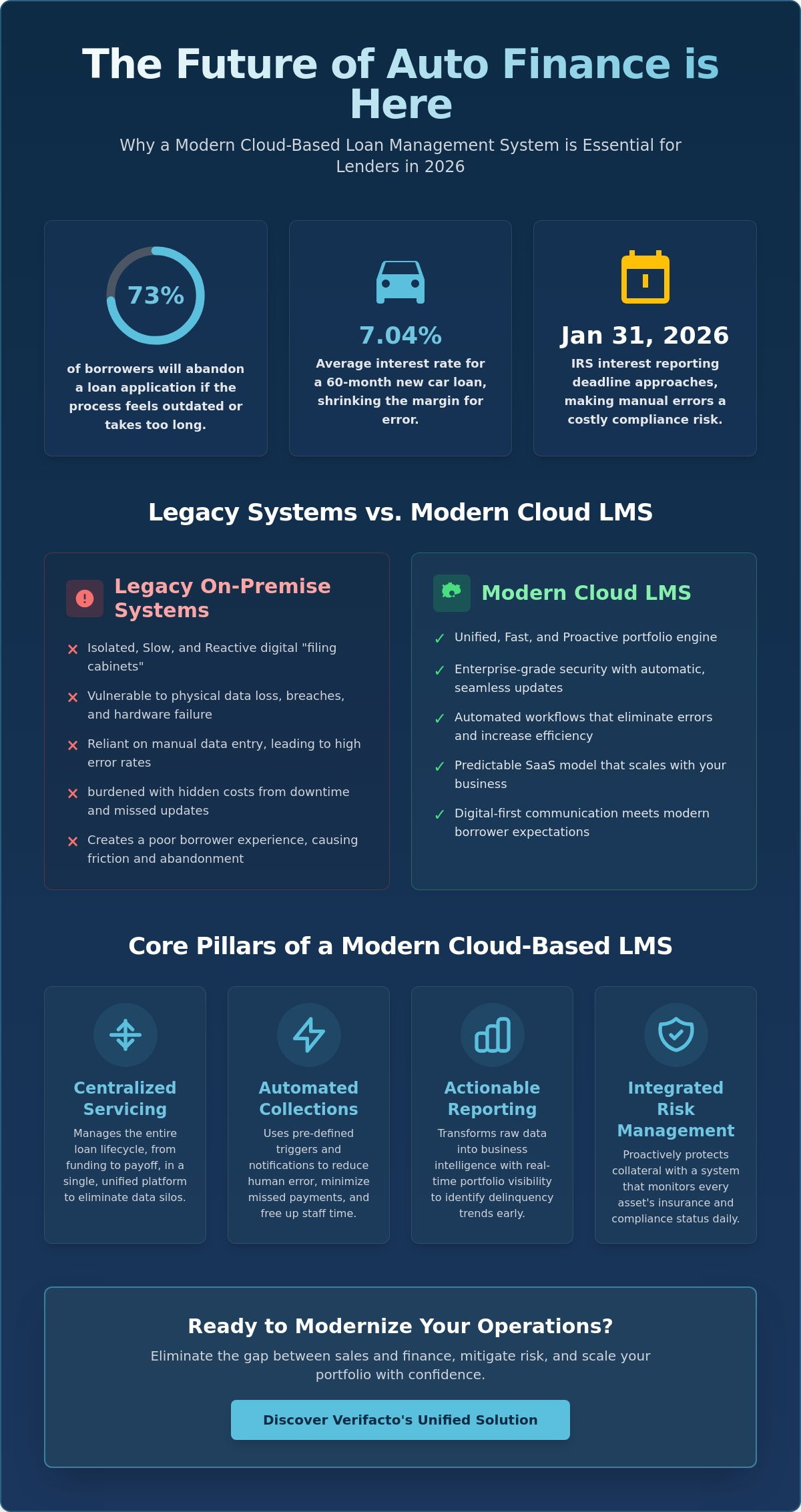
Legacy vs. Cloud LMS: Overcoming the Barriers to Modernization
Sticking with a legacy system often feels safer than making a jump, but that safety is an illusion. Many auto lenders hesitate to upgrade because of the “complexity myth.” They assume a cloud based loan management system requires a complete overhaul of their staff’s technical skills. The truth is the opposite. Modern cloud UIs are designed with the user in mind, making them far more intuitive than the clunky, menu-heavy software of the past. When your team can find what they need in two clicks instead of ten, your entire operation moves faster.
Financial predictability is another major advantage. Legacy systems demand significant upfront capital for hardware and local server maintenance. These costs are often coupled with expensive, infrequent updates. A SaaS subscription model replaces these spikes with a predictable monthly cost. This shift allows you to allocate capital toward growth rather than keeping the lights on in a server room. Security also takes a massive leap forward. While local servers are vulnerable to physical theft or localized breaches, cloud providers utilize military-grade encryption and redundant backups that most small-to-mid-sized lenders couldn’t afford to build on their own.
The most significant leap in efficiency comes from the integration advantage. Connecting your LMS with your what is dms platform eliminates the silo between sales and finance. Data flows seamlessly from the initial deal to the final payment, ensuring accuracy across the board. For lenders looking to take this further, streamlining auto finance operations with DMS provides a practical integration checklist to bridge the gap between your sales and servicing departments in 2026.
Addressing the Transition Anxiety
Fear of data loss or downtime often keeps lenders stuck. Modern providers have refined the data migration process, handling the heavy lifting so your records remain intact. Training your team doesn’t have to be a months-long ordeal. Intuitive cloud systems often reduce onboarding time by 50% compared to legacy setups. You can maintain business continuity by phasing in the switch, ensuring your collections and servicing never skip a beat during the transition.
The ROI of Cloud-Based Automation
Automation provides a measurable return on investment by improving collection efficiency auto loans. You don’t need to add headcount to scale your portfolio when a cloud based loan management system handles the repetitive tasks. Quantify the time your staff currently spends on manual insurance verification and borrower follow-ups. By automating these touchpoints, you reclaim hundreds of hours each month. This efficiency allows you to focus on strategic growth and high-risk accounts while the system maintains the steady pulse of your daily operations.
How to Implement a Cloud-Based LMS: A 5-Step Transition Guide
Transitioning to a cloud based loan management system is a strategic maneuver that demands a methodical roadmap. You aren’t just switching software; you’re upgrading your entire operational engine to meet the demands of the 2026 market. To ensure a seamless shift without disrupting your daily collections or borrower relationships, follow this structured five-step implementation guide.
- Step 1: Audit your current portfolio data. Identify “dirty data” such as incomplete borrower profiles, outdated contact information, or missing insurance records. Cleaning this data at the source prevents legacy errors from migrating into your new environment.
- Step 2: Define your automated workflow triggers. Determine exactly when and how the system should react to borrower behavior. Establish specific rules for late payment notices, grace period reminders, and payoff confirmations.
- Step 3: Integrate insurance tracking and CPI protocols. Build collateral protection into the core of your workflow. This ensures that insurance monitoring and automated CPI placement are active from the moment the first loan is migrated.
- Step 4: Execute a phased data migration. Avoid the “big bang” approach that risks significant downtime. Migrate your data in controlled segments, testing each batch for accuracy before moving the next portion of your portfolio.
- Step 5: Launch automated borrower communication. Activate your communication sequences and monitor performance in real time. Use the system’s analytics to refine your messaging and improve response rates immediately.
Phase 1: Preparation and Data Auditing
Mapping your existing loan structures to a modern cloud architecture is the most critical part of the preparation phase. You must ensure that every interest calculation and amortization schedule matches your existing legal agreements perfectly. Set clear KPIs during this stage. Whether your goal is to reduce delinquency by a specific percentage or cut manual verification time in half, having these benchmarks allows you to measure the success of your implementation immediately after launch. This preparation prevents the technical debt that often plagues lenders who rush the migration process.
Phase 2: Configuration and Launch
During the configuration phase, customize your borrower portal to reflect your brand’s professional identity. This isn’t just about aesthetics; it’s about building borrower confidence and encouraging self-service. Test your collection sequences and payment reminders in a sandbox environment before they go live to ensure the timing and tone are correct. Finally, establish strict user permissions and compliance audit trails. This ensures that every action taken within the system is logged, providing the security and transparency required for 2026 regulatory standards. If you’re ready to leave legacy limitations behind, schedule a demo of Verifacto’s unified LMS to see these steps in action.
Verifacto: The Unified LMS and DMS Solution for High-Performance Lenders
Many lenders struggle with fragmented data because their sales and finance departments speak different languages. Verifacto solves this problem by providing a unified ecosystem where the DMS and LMS work in perfect harmony. This isn’t just about convenience; it’s about operational integrity. When you implement a cloud based loan management system that’s natively connected to your dealership management software, you eliminate the manual handoffs that invite error and delay. You gain a streamlined path from the moment a deal is inked to the day the final payment is processed.
Our platform is built to handle the high-stakes requirements of modern auto finance. We offer built-in payment processing that simplifies the transition from “due” to “paid,” significantly reducing the friction that often leads to late payments. By automating borrower communication through text and mobile-ready portals, you engage customers on the channels they actually use. This proactive approach keeps your portfolio healthy and your team focused on growth rather than chasing down documentation or manual signatures.
A Single Source of Truth for Auto Dealers
The data gap between the sales floor and the finance office is where profitability often vanishes. Verifacto DMS and LMS work together to create a single source of truth for every vehicle and every borrower in your portfolio. This unified platform reduces operational friction by ensuring that data entered during the sales process is immediately available for servicing. In subprime auto finance, where timing and accuracy are critical, this level of integration is a game-changer. Lenders using this approach achieve 2026-level efficiency by automating mundane tasks and focusing their human capital on complex decision-making.
Proactive Risk Mitigation with Integrated CPI
Protecting your collateral shouldn’t require a full-time staff member to manually check insurance policies. Verifacto’s insurance tracking is a core component of the platform, not a disconnected add-on. The system monitors every asset in your portfolio and detects lapses in coverage in real time. When a policy drops, the transition to collateral protection is seamless and automated. This integrated CPI solution ensures your assets are never exposed, protecting your bottom line while maintaining strict compliance with state and federal standards. If you’re ready to modernize your operations and secure your future, Experience the Verifacto Cloud LMS Platform Today.
Secure Your Competitive Edge in the 2026 Auto Finance Market
The 2026 auto finance landscape rewards lenders who prioritize speed and precision. You’ve seen how legacy silos create unnecessary risk; it’s time to replace those manual bottlenecks with a modern cloud based loan management system that works as hard as you do. By unifying your DMS and LMS, you ensure that every deal is protected from the first signature to the final payoff. This transition isn’t just a technical upgrade. It’s a strategic shift that moves your business from a reactive stance to a position of absolute control.
Modernizing your infrastructure is the most effective way to reclaim your time and secure your collateral. Verifacto provides the specific tools you need to stay ahead of state-level enforcement and shifting interest rates. Through integrated real-time insurance tracking, automated borrower communication tools, and built-in payment processing, you maximize efficiency while minimizing charge-offs. You don’t have to navigate these operational complexities alone. Streamline Your Portfolio with Verifacto’s Cloud LMS. You have the guide and the roadmap. Take the decisive step today toward a more secure, automated, and profitable operation.
Frequently Asked Questions
What is a cloud-based loan management system?
A cloud based loan management system is a digital platform hosted on secure remote servers that centralizes loan servicing, collections, and reporting. Unlike legacy software, it allows lenders to manage their portfolios from any device with an internet connection. This accessibility ensures that your team can monitor accounts and update records in real time without being tethered to a physical office server. It provides a scalable foundation for modern operations.
How does a cloud LMS improve auto loan collections?
It improves collections by automating borrower touchpoints and reducing human error. You can set specific triggers to send text messages or emails the moment a payment is missed. This immediate, multi-channel approach increases the likelihood of recovery by keeping your brand in front of the borrower. It also ensures that your collection efforts remain consistent and perfectly documented for compliance purposes.
Is my data safe in a cloud-based loan management system?
Yes, modern cloud systems utilize enterprise-grade encryption and redundant backups that far exceed the security of local on-premise servers. These platforms are designed to protect sensitive borrower information from both physical loss and cyber threats. By using a cloud based loan management system, you benefit from continuous security updates that address new vulnerabilities as they emerge. It’s a much more reliable way to handle sensitive financial data.
Can I integrate my existing DMS with a new cloud LMS?
Most modern systems are built with open APIs that allow for seamless integration with your current dealership management software. This connectivity ensures that data flows directly from the sales floor to the finance office without manual re-entry. When your systems are unified, you eliminate the data silos that often lead to accounting errors and operational friction. It creates a single source of truth for your entire business.
How long does it take to transition from legacy software to the cloud?
The transition period typically ranges from a few weeks to a couple of months depending on the size of your portfolio. A phased migration approach is the most effective way to ensure zero downtime during the switch. This involves auditing your existing data, mapping it to the new architecture, and moving accounts in controlled batches to maintain business continuity. Proper preparation is the key to a fast and successful launch.
Does a cloud LMS help with auto finance compliance?
It helps by creating automated audit trails and ensuring that all borrower communications are logged. With shifting regulations like the CARS Act and the FAIR Business Practices Act, having a system that automatically updates to reflect legal changes is vital. It reduces the risk of manual errors that could lead to costly penalties or litigation. The system acts as a digital guardian for your regulatory standing.
What features are most important for independent car dealers in an LMS?
Independent dealers should prioritize built-in payment processing, automated borrower communication, and integrated insurance tracking. These features allow a smaller team to manage a growing portfolio without adding headcount. Real-time visibility into portfolio performance is also essential for making informed decisions about risk and capital allocation in a fluctuating market. You need tools that maximize efficiency and protect your margins.
How does automated insurance tracking work within the system?
The system monitors borrower insurance policies and flags any lapses or cancellations in real time. If a policy falls out of compliance, the system triggers a sequence of notifications to the borrower. If the issue isn’t resolved, it can automate the CPI placement process to ensure your collateral remains protected without requiring manual intervention from your staff. This proactive approach significantly reduces the risk of uninsured losses.