
Auto loan fraud reached a record $10.4 billion in 2026, yet many lenders continue to defend their portfolios using manual spreadsheets and disconnected vendor systems. You likely recognize the frustration of revenue leakage and the constant risk of insurance lapses that slip through the cracks of a fragmented workflow. It’s a common struggle; dealerships often operate one business but are forced to manage it through tools that don’t talk to each other. This article explores how embedded AI in auto loan management transforms these manual hurdles into a unified, high-efficiency operating platform.
We’ll show you how to move beyond basic software to a system where AI agents support human judgment and automate the heavy lifting of loan servicing. You’ll discover how connecting your data from the first lead to the final payment provides real-time risk visibility and improves collection efficiency. This approach doesn’t just replace manual tasks. It’s designed to give you total control over your operation while driving higher closing rates through intelligent automation and a clearer view of your financial performance.
Key Takeaways
- Identify the hidden financial costs of managing a single dealership operation through multiple disconnected software vendors.
- Understand how AI in auto loan management acts as the connective tissue to unify your data from the initial lead to the final payment.
- Explore how specialized AI agents, including the Sales and Analytics Agents, support human judgment by automating follow-ups and delivering real-time insights.
- Learn to mitigate portfolio risk by linking collateral protection with automated, real-time insurance tracking.
- Discover how to evaluate your current tech stack for operational silos and streamline accounting through seamless platform integrations.
The Financial Impact of Fragmented Data in Auto Lending
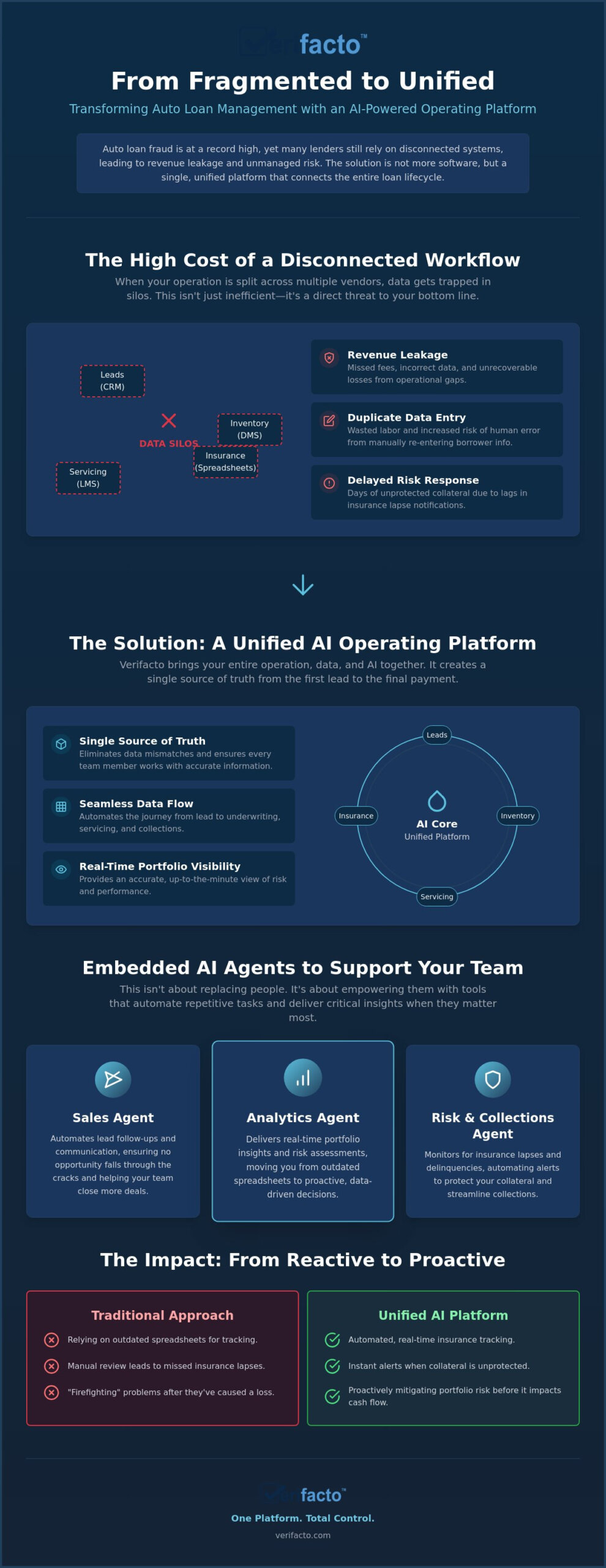
Dealerships operate one business but are often forced to manage it through disconnected systems. When inventory is in one tool, leads are in another, and loan servicing is in a third, you lose the holistic view of your portfolio. This fragmentation isn’t just an operational headache; it’s a direct drain on your bottom line. True AI in auto loan management isn’t a standalone novelty or a simple chatbot. It’s embedded intelligence designed to unify the entire lending lifecycle, turning a series of manual tasks into a single, high-efficiency operating platform.
Managing a portfolio through five or more disconnected software vendors creates “data silos” that lead to revenue leakage. Every time a team member manually moves data from a CRM to a DMS, your risk of human error increases. A mistyped VIN, a missed insurance expiration, or a delayed payment notification can result in thousands of dollars in unrecoverable losses. By shifting from reactive management to proactive visibility, you stop chasing fires and start preventing them before they impact your cash flow.
Recognizing the Symptoms of Disconnected Systems
Duplicate data entry is the most obvious sign of a broken workflow. If your staff enters borrower information into multiple modules, you’re paying for redundant labor while increasing the chance of critical data mismatches. Other symptoms include:
- Delayed responses: If a borrower’s insurance lapses on Monday, but your tracking system doesn’t alert you until Friday, you’ve spent four days with zero collateral protection.
- Manual tracking: Relying on spreadsheets to monitor delinquencies means your data is already outdated by the time you review it.
- Reporting gaps: Without a unified dashboard, performing a real-time risk assessment becomes nearly impossible.
Why Traditional Software Fails Modern Lenders
Legacy systems act as static databases rather than active operational partners. They store information, but they don’t help you act on it. These tools often trap your data, making it difficult to export for a detailed credit analysis or deep portfolio analytics. This “vendor lock-in” forces you to work for the software, rather than the software working for you.
Traditional software fails to provide a seamless bridge between the initial lead and the final payment. This creates blind spots in the borrower’s lifecycle where communication breaks down and risk increases. Verifacto brings the operation, data, and AI together in one platform to eliminate these gaps. This modern approach to AI in auto loan management provides the advanced operational tools necessary to maintain control over your data while automating the workflows that typically cause revenue leakage.
How AI Unifies the Lending Lifecycle from Lead to Payment
Dealerships operate one business but are often forced to manage it through disconnected systems. Verifacto brings the operation, data and AI together in one platform. This connectivity is the foundation of effective AI in auto loan management. Instead of treating sales and collections as separate islands, embedded intelligence creates a continuous data loop. This ensures that every team member, from the showroom floor to the collections office, works from a single source of truth for every vehicle and borrower. By unifying these stages, you eliminate the “information lag” that typically leads to missed opportunities or unmanaged risks.
Cloud-hosted architecture supports this unification by providing “anytime, anywhere” operational access. Whether your team is at a desk or working remotely, they have real-time visibility into the entire portfolio. This eliminates the friction associated with legacy on-premise servers and ensures that data captured during the sales process remains accurate and accessible throughout the life of the loan. It’s about creating a modernized environment where data flows seamlessly between departments without manual intervention.
Streamlining Origination and Underwriting
The transition from a lead in your dealership CRM to an active loan in your LMS is a critical point of failure for many lenders. Manual data entry at this stage is slow and creates a significant liability for human error. AI in auto loan management is designed to automate this data flow, reducing mistakes in contract generation and compliance documentation. By using integrated data, you can make more informed lending decisions backed by historical performance rather than guesswork. This automation also helps dealerships navigate complex discussions around AI and fair lending compliance, ensuring that decision-making processes remain consistent and data-driven.
Enhancing the Borrower Experience via LoanApp
Modern borrowers expect a digital-first experience that mirrors their interactions with major financial institutions. LoanApp provides this transparency, allowing borrowers to track their payments, view balances, and receive automated reminders directly on their mobile devices. This connectivity reduces the volume of inbound support calls, as borrowers can find answers to basic questions within the app interface. It shifts the relationship from a transactional one to a partnership based on clear communication.
Providing a seamless payment experience is essential for improving consistency. When the payment process is built directly into the operating platform, it removes friction for the borrower and the lender alike. If you want to see how this connectivity can transform your daily workflow, you can explore our AI-powered solutions to see how the platform fits your business. This integrated approach ensures that your team spends less time on administrative tasks and more time on high-value operations.
Deploying Specialized AI Agents for Sales and Operations
Dealerships often struggle with lead attrition because response times lag behind consumer expectations. In 2026, waiting an hour to reply to a lead is an hour too long. AI in auto loan management provides specialized agents that act as a force multiplier for your existing staff. These tools handle the high-volume, repetitive interactions that typically bog down your sales and operations teams. By automating the “grunt work,” you allow your employees to focus on the high-value tasks that require human judgment and relationship building.
The core value of these agents lies in their ability to work within your connected data. They don’t operate in a vacuum; they use real-time information from your inventory and borrower records to provide accurate, helpful responses. This supports a more efficient workflow where tasks move from initiation to completion without getting stuck in a manual queue. It is a shift from managing software to managing an automated operation.
The Sales Agent: Driving Revenue Through Automation
Your sales team cannot be online 24/7, but your leads are. The Sales Agent provides an immediate response to inquiries from various digital marketplaces, ensuring your dealership is the first to engage. It nurtures prospects through intelligent follow-up sequences, answering basic questions and moving them toward a scheduled appointment. This happens without requiring a single minute of manual effort from your staff. You can learn how the AI Sales Agent automates your lead engagement to increase your closing rates and capture more revenue from your existing lead sources.
The Analytics Agent: Turning Data into Strategy
Transitioning from reactive to proactive management requires more than just a static spreadsheet. The Analytics Agent delivers real-time dashboards that identify trends in delinquency before they turn into charge-offs. By analyzing connected data across your entire portfolio, it provides predictive insights that help you intervene early. This level of visibility allows you to explore Verifacto’s AI capabilities for lenders and turn raw data into a clear operational strategy that protects your investment.
Routine administrative work, like setting up payment reminders or scheduling account reviews, often falls through the cracks during busy periods. The Operational Assistant handles these tasks automatically. It ensures that every borrower receives timely communication, which supports better payment consistency and reduces the administrative burden on your office staff. These agents are designed to support your team, not replace them. By handling the routine, they empower your staff to step in when a situation requires a personal touch or a complex decision.
Mitigating Portfolio Risk with AI-Driven Insurance Tracking
A lapse in insurance is a lapse in collateral protection. For any lender, an uninsured vehicle represents a total loss risk if an accident occurs. Traditional tracking methods often rely on manual audits or physical mail notifications from carriers, which frequently arrive too late to prevent a financial hit. AI in auto loan management addresses this vulnerability by providing continuous, automated monitoring that is designed to detect insurance lapses the moment they occur. By unifying insurance data with your loan records, Verifacto brings the operation, data and AI together in one platform to close the gaps that lead to revenue leakage.
Embedding insurance tracking into your daily workflow eliminates the need for staff to manually audit thousands of active loan files. The system serves as a proactive guardian, cross-referencing borrower data with real-time insurance carrier databases. This provides greater visibility into your portfolio’s health and ensures that your assets are protected without increasing the administrative burden on your team. It shifts the focus from chasing paperwork to maintaining a secure, high-efficiency operation.
Real-Time Monitoring vs. Periodic Audits
Point-in-time insurance verification creates a false sense of security. A borrower may have active coverage at the time of contract signing, only to cancel the policy or miss a payment shortly after leaving the lot. Periodic audits might not catch these changes for weeks or months, leaving a dangerous “uninsured gap” in your portfolio. Automated tracking is designed to monitor these changes continuously, allowing you to act before a loss occurs. For lenders looking to safeguard their investments more effectively, it is helpful to understand What is Collateral Protection Insurance (CPI)? A 2026 Lender’s Guide.
Automated Borrower Communication for Compliance
When a lapse is identified, the platform can help trigger automated notifications to the borrower. These reminders, sent via text or email, prompt the borrower to provide updated proof of coverage immediately. This automated sequence is consistent and maintains audit-ready logs, which is essential for meeting state regulatory requirements. It ensures that every borrower receives timely notice while protecting the lender’s right to secure the collateral. To ensure your broader operations are aligned with current standards, you can review The 2026 Auto Finance Compliance Management Checklist.
Automating the placement of Collateral Protection Insurance (CPI) serves as the final safety net for your portfolio. If a borrower fails to provide proof of coverage within the required timeframe, the platform can help initiate the CPI process to safeguard the asset. This level of automation ensures that no vehicle remains unprotected due to administrative oversight. If you are ready to see how these protective tools can stabilize your portfolio, book a demonstration to explore how the platform fits your business.
Transitioning to an AI-Powered Operating Platform
Dealerships operate one business but are often forced to manage it through disconnected systems. If you’re paying for five different software subscriptions that don’t talk to each other, you’re likely dealing with duplicate vendor costs and fragmented data. Moving to AI in auto loan management isn’t about a total overhaul of your staff’s daily routine. It’s about evaluating your current tech stack for silos and replacing them with a unified environment where data flows freely. By consolidating these tools, you reduce operational friction and gain a clearer view of your financial performance.
If you are looking to apply this philosophy of unified efficiency to your broader professional ecosystem, you can visit LifeOS™ by Venturis 13 to discover a category-defining AI infrastructure for business and life.
A modern operating platform must integrate seamlessly with your existing accounting tools. For most dealerships, this means a direct connection to QuickBooks. This integration ensures that your loan servicing data matches your financial records without the need for manual reconciliations. Utilizing a banking API like Wealthreader can further enhance this connectivity by automating the flow of financial data. You should also prioritize platforms that guarantee data control. Choosing a system that allows for easy data export ensures you aren’t trapped by vendor lock-in and can perform your own deep-dive analytics whenever necessary.
Integrating Payments and Collections
Fragmented payment systems often lead to reconciliation errors and delayed cash flow. A unified platform provides built-in payment processing for ACH, credit cards, and recurring payments directly within the loan management workflow. When these payments are connected to automated reminders, you can help reduce late payments and improve consistency. This connectivity ensures that the moment a payment is processed, the borrower’s balance and your accounting records update in real time. To see how this fits into a broader strategy, you can read more about What is Auto Loan Management Software? The 2026 Guide.
Securing Your Future with SOC II Compliance
In 2026, protecting sensitive borrower data is a non-negotiable requirement for auto finance executives. Bank-level encryption and SOC II compliance provide the security framework necessary to operate in a high-stakes environment. These standards ensure that your data is handled with the highest level of care while maintaining a 99.99% system uptime guarantee. Reliability is the backbone of any successful operation; your team needs to know the platform will be available whenever they need to close a deal or manage a collection.
Modernizing your operation doesn’t have to happen overnight. You can implement AI agents incrementally, starting with lead follow-up or insurance tracking, to support your existing workflows. This gradual transition allows your team to adapt to new tools while immediately benefiting from increased efficiency. If you are ready to eliminate duplicate data entry and secure your portfolio, book a demonstration to explore how the platform fits your business. See how Verifacto connects your operation from the first lead to the final payment.
Modernizing Your Portfolio for a High-Efficiency Future
Dealerships operate one business but are often forced to manage it through disconnected systems. We have explored how AI in auto loan management serves as the connective tissue that eliminates revenue leakage and provides real-time risk visibility. By unifying your data from the first lead to the final payment, you move from reactive troubleshooting to a proactive, high-efficiency operation. This shift ensures your team works from a single source of truth, reducing human error and collateral risk across the entire loan lifecycle.
Transitioning to an integrated platform allows your team to focus on high-value tasks while specialized agents handle routine follow-ups and insurance monitoring. Verifacto is SOC II compliant and provides a 99.99% uptime guarantee, offering the stability that high-stakes environments require. Trusted by independent dealers nationally, our platform is designed to provide greater visibility and stability for your loan portfolio. You don’t have to navigate these complexities alone; the right tools can help you maintain control and drive better financial performance. The path to a more secure and profitable operation starts with bringing your data together.
See how Verifacto connects your operation from the first lead to the final payment
Frequently Asked Questions
How does AI actually improve auto loan collection efficiency?
AI improves collection efficiency by automating routine borrower communications and identifying high-risk accounts before they go delinquent. By analyzing payment patterns and insurance status in real time, the platform helps your team prioritize accounts that need immediate attention. This proactive approach allows your staff to focus on complex cases while the system handles consistent, automated follow-ups through integrated communication tools.
Will AI agents replace my dealership’s sales or collections staff?
No, AI is designed to support human judgment rather than replace your dealership’s staff. These tools act as a force multiplier by handling repetitive tasks like lead nurturing and payment reminders. By automating these workflows, your sales and collections teams can focus on high-value activities that require personal interaction, negotiation, and strategic decision-making to close more deals and recover more payments.
Can AI help with insurance verification and CPI management?
Yes, the platform provides real-time insurance tracking that is designed to detect coverage lapses the moment they occur. If a borrower’s policy expires or is cancelled, the system can help trigger automated notifications and, if necessary, initiate the placement of Collateral Protection Insurance (CPI). This continuous monitoring protects your collateral without requiring manual file audits or constant phone calls to insurance carriers by your team.
Does Verifacto’s AI platform integrate with QuickBooks?
Yes, Verifacto’s platform features seamless integration with accounting tools like QuickBooks. This connection ensures that your loan servicing data and financial records stay synchronized without the need for manual data entry or duplicate efforts. By unifying your accounting and operational data, you reduce the risk of human error and gain a clearer, more accurate view of your dealership’s overall financial performance.
What is the difference between a standard DMS and an AI-powered operating platform?
A standard DMS often acts as a static database where data is stored in disconnected silos; an AI-powered operating platform unifies the entire lending lifecycle. Verifacto connects inventory, sales, and collections through shared data and embedded intelligence. This “one platform” philosophy eliminates the need for multiple disconnected software vendors and provides real-time visibility across your entire operation from the first lead to the final payment.
How does the LoanApp mobile application assist in loan management?
LoanApp assists in loan management by providing borrowers with a transparent, mobile-first experience for tracking payments and viewing balances. It reduces the administrative burden on your staff by answering basic borrower questions through the app interface. This direct line of communication helps improve payment consistency and provides a modern experience that mirrors current consumer expectations, leading to a more professional relationship with your customers.
Is my dealer data secure on a cloud-based AI platform?
Your data is highly secure on our cloud-hosted platform, which maintains SOC II compliance and utilizes bank-level encryption. We prioritize data protection to ensure that sensitive borrower information is safeguarded at all times. Additionally, the system provides a 99.99% uptime guarantee, ensuring that your operational data is always accessible and reliable when your team needs to make critical business decisions.
Can AI help reduce charge-offs in a BHPH portfolio?
AI in auto loan management can help reduce charge-offs by providing predictive insights through the Analytics Agent. By identifying trends in delinquency and insurance lapses early, the platform allows you to intervene before an account becomes unrecoverable. This proactive risk management provides the visibility needed to maintain a healthy BHPH portfolio and protect your dealership’s long-term revenue from preventable losses.