
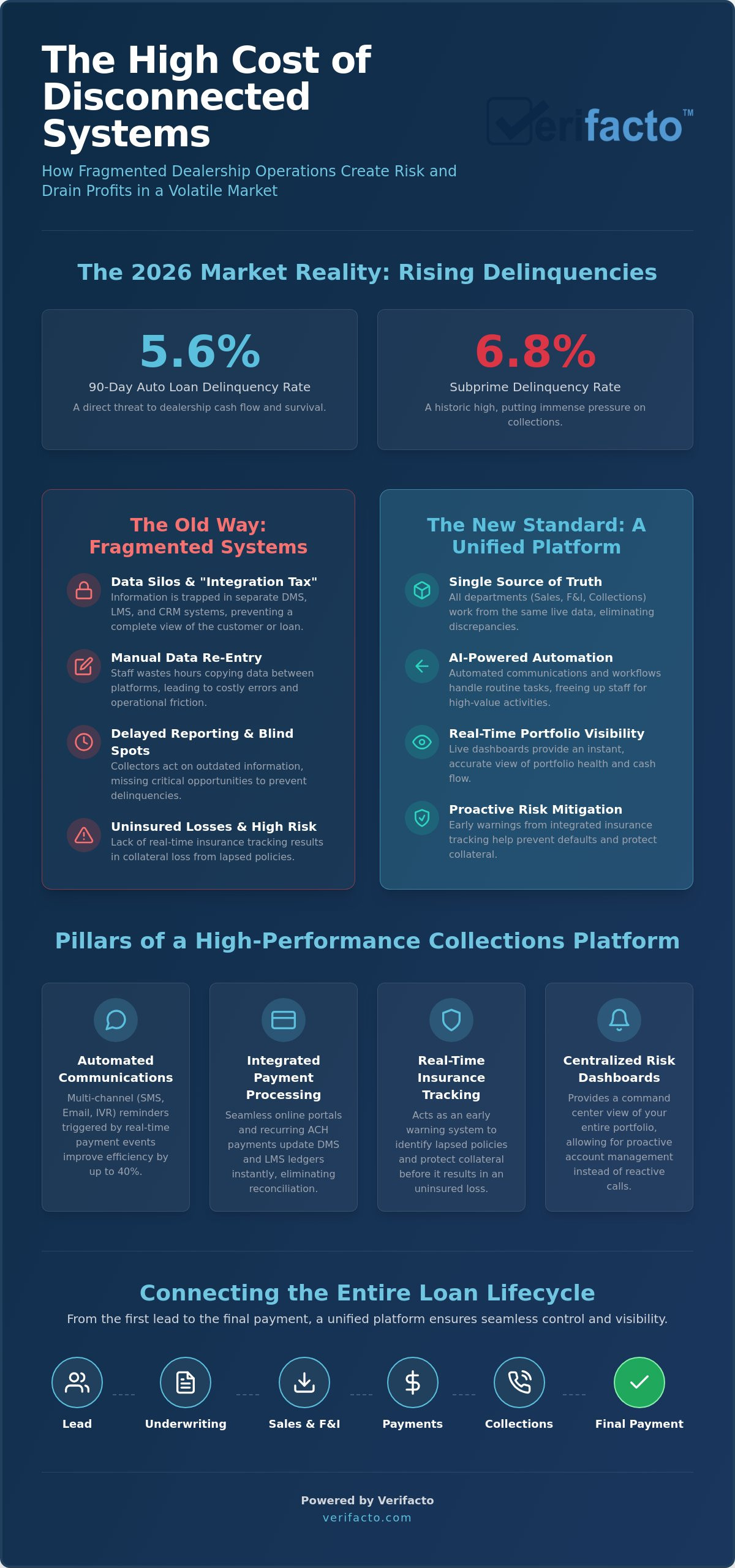
With 90-day auto loan delinquency rates climbing to 5.6% in early 2026, the gap between your sales desk and your collection department is no longer just an administrative headache; it’s a direct threat to your dealership’s survival. You likely feel the pressure of managing a portfolio where subprime delinquencies have reached a historic 6.8%, yet your team is still stuck manually entering data between disconnected systems. Relying on a legacy DMS with integrated collections for used car dealers that doesn’t actually talk to your payment processor or insurance tracker is a recipe for uninsured losses and wasted labor.
We understand that maintaining control over your cash flow requires more than just reactive phone calls. This guide will show you how integrating collections directly into your operating platform eliminates manual entry errors, prevents collateral loss from lapsed insurance, and secures your bottom line. You’ll discover how a unified approach provides a single source of truth for every payment, automated reminders that drive borrower action, and the real-time visibility you need to navigate a volatile 2026 market with total confidence.
Key Takeaways
- Moving from siloed software to a unified DMS and LMS architecture eliminates the “integration tax” and manual data errors that drain dealership profit.
- Implementing a DMS with integrated collections for used car dealers allows for automated borrower communications triggered by real-time payment milestones.
- Real-time insurance tracking serves as an early warning system, helping you identify potential defaults before they result in an uninsured loss.
- Built-in payment processing ensures every transaction updates your inventory and loan ledger simultaneously, providing a single source of truth for your cash flow.
- Transitioning to a unified operating platform connects the entire loan lifecycle, from the initial lead through to the final payment.
Why Integrated Collections are the Core of Modern Used Car DMS
Managing a used car dealership in 2026 requires a fundamental shift in how you view your software. For decades, the industry focused on “moving metal,” treating the sales desk as the primary engine of profit. But with 90-day delinquency rates hitting 5.6% and subprime defaults rising, your ability to collect is now just as important as your ability to sell. True integration means moving beyond a standard Dealership Management System (DMS) that simply tracks inventory. It requires a unified software architecture where your DMS and LMS share real-time data on every borrower and every vehicle.
A DMS with integrated collections for used car dealers ensures that your sales and collection teams operate from a single source of truth. When a payment is made, the ledger updates instantly across the entire platform. This eliminates the “profit leaks” caused by manual data re-entry and the delayed reporting that plagues siloed systems. When your data lives in separate buckets, your staff spends more time reconciling spreadsheets than they do managing risk. In a high-interest environment, these delays are expensive and dangerous to your stability.
The High Cost of Siloed Dealer Management
Every minute your team spends switching between a CRM, an inventory tool, and a separate collection platform is a minute they aren’t closing deals or securing collateral. Data latency often leads to missed collection opportunities. If your collector doesn’t know a payment failed until three days later, the borrower has already moved on to other financial priorities. The integration gap is the #1 cause of operational friction for used car dealers, creating a blind spot that leads to higher delinquency and preventable losses.
Moving Beyond Basic Inventory: The Focus on Cash Flow
Success in 2026 is measured by the velocity of capital. You cannot afford to have your cash tied up in non-performing assets while you wait for manual reports to tell you which accounts are at risk. Integrated collections provide immediate visibility into the health of your entire portfolio, allowing you to transition from reactive chasing to proactive account management. You aren’t just selling cars; you’re managing a financial portfolio that requires constant, real-time oversight. By connecting the entire loan lifecycle, you gain the control necessary to protect your dealership’s cash flow and scale your operations without adding unnecessary headcount.
Key Features of a DMS Built for High-Performance Collections
A modern DMS with integrated collections for used car dealers must do more than just record a sale. It acts as the command center for your entire operation. By housing inventory, sales, and collection data under one roof, you eliminate the fragmented workflows that lead to missed payments. High-performance collections in 2026 depend on four pillars: automated outreach, integrated payments, real-time risk dashboards, and centralized document management. These tools work together to ensure that no account falls through the cracks due to administrative oversight.
Automated Borrower Communication and Real-Time Alerts
Manual outreach is a relic of the past. If your staff spends their morning making 50 individual phone calls for five-day-late payments, they’re wasting valuable time. Automated borrower communication tools use multi-channel notifications, including SMS, email, and IVR, to engage customers exactly when a trigger is met. You can set custom triggers for the end of a grace period or the moment a late fee is assessed. This proactive approach is designed to help dealers improve collection efficiency. Some operational models suggest that automating early-stage outreach can improve efficiency by up to 40% by reducing the need for human intervention on routine reminders.
Seamless Payment Processing Integration
Friction is the enemy of cash flow. When a borrower has to call in or mail a check, the likelihood of a missed payment increases. Utilizing Integrated Payment Solutions for Dealers allows you to offer online portals and recurring ACH capabilities. Because the payment processing is built into the platform, the DMS and LMS ledgers update simultaneously. You don’t need to spend hours at the end of the month reconciling bank statements against your software. This real-time synchronization provides an immediate view of your portfolio’s health, ensuring your delinquency reports are always accurate and actionable.
Accuracy in documentation is also a critical safeguard. Centralizing your retail installment contracts and insurance binders within the platform helps you stay aligned with regulatory requirements like the FTC’s Used Car Rule. When all disclosures and contracts are tied directly to the loan record, responding to audits or verifying coverage becomes a matter of seconds rather than a search through filing cabinets. This level of organization transforms a standard dealership into a high-performance finance operation. To see how these tools work in a live environment, you can explore how our platform connects your operation from lead to payment.
The Role of Real-Time Insurance Tracking in Collection Efficiency
Uninsured collateral represents the single greatest threat to your dealership’s bottom line in 2026. A total loss on a vehicle without active coverage isn’t just a missed payment; it’s a 100% write-off of your asset. To protect your portfolio, a DMS with integrated collections for used car dealers must treat insurance monitoring as a core collection function rather than a secondary administrative task. When insurance tracking is embedded into your operating platform, it acts as an early warning system that identifies high-risk accounts before they actually default on their loan payments.
Insurance status is often the first indicator of financial distress for a borrower. If a customer can’t afford their monthly premium, the car note is usually the next obligation to fail. By monitoring policy status in real-time, your collection team can reach out the moment a lapse occurs, addressing the root cause of the risk before it escalates into a delinquency. This operational synergy allows you to maintain the “reliable guardian” persona, protecting both your interest and the borrower’s ability to stay on the road.
Preventing Uninsured Losses Before They Happen
The transition from a standard insurance policy to lender-placed coverage should be seamless. Understanding What is Collateral Protection Insurance (CPI) and its role in risk mitigation is vital for any dealer holding their own paper. Real-time monitoring identifies “high-risk” accounts by flagging cancellations or non-renewals instantly. Instead of waiting for a paper notice in the mail, your system triggers an automated alert, allowing for immediate intervention. This proactive stance ensures you aren’t discovering a lapse only after a wreck has already occurred.
Integrating CPI Solutions into the Payment Workflow
Efficiency gains happen when you automate the administrative burden of tracking thousands of individual policies. By integrating CPI solutions directly into the payment workflow, you can automate the billing of premiums through your DMS payment portal. This ensures that the cost of protecting the collateral is factored into the borrower’s regular payment cycle without requiring manual ledger adjustments.
Maintaining compliance is also simplified when your platform handles the disclosures and notifications required by the FTC’s Used Car Rule and state-specific insurance regulations. When an insurance lapse is detected, the platform can automatically initiate the CPI placement process, send the necessary borrower notifications, and update the LoanApp with the new payment amount. This level of automation reduces the chance of human error and ensures that your dealership remains protected and compliant at all times.
Evaluating Your Options: Integrated vs. Fragmented Software Stacks
The “Integration Tax” is a silent killer of dealership profitability. It’s the cumulative cost of paying for five or six different software subscriptions that don’t talk to each other. When you use a separate CRM, a standalone inventory tool, and a third-party collection plugin, you aren’t just paying multiple vendors; you’re paying your staff to act as the bridge between those systems. Manually moving data from a sales contract into a collection ledger is a low-value task that introduces high-stakes errors. In the 2026 market, a DMS with integrated collections for used car dealers is the only way to eliminate this operational friction and reclaim your team’s time.
Fragmented stacks also create massive security and compliance risks. Every time data is exported to a spreadsheet or synced via a loose API, you increase the chance of a data breach or a record-keeping violation. A unified platform ensures that sensitive borrower information stays within a secured environment, with every action tracked in a permanent audit trail. This isn’t just about convenience; it’s about building a “reliable guardian” for your portfolio that protects you from both financial loss and regulatory scrutiny.
The Hidden Risks of Third-Party LMS Plugins
Many dealers attempt to save money by bolting a third-party LMS plugin onto a legacy DMS. These API connections are notorious failure points. A “sync error” might seem like a minor glitch until it results in a borrower being charged an incorrect late fee or, worse, a wrongful repossession trigger. These technical gaps make it nearly impossible to maintain a clean record for Auto Finance Compliance Management. A native integration, where the DMS and LMS share the same database, is the only way to ensure that what the collector sees matches exactly what the sales manager promised at the desk.
Scalability and Compliance in 2026
Multi-lot operations face unique challenges when using fragmented systems. Managing ten different logins and ten different sets of reports per location makes it impossible to get a clear view of your total portfolio risk. Cloud-native platforms solve this by providing a single source of truth that is accessible from any lot. This scalability allows you to increase your loan volume without adding administrative headcount, as the system handles the heavy lifting of payment processing and borrower notifications automatically.
Automated audit trails are also essential for defending your dealership against regulatory audits. When every communication, payment, and insurance update is timestamped and linked to the loan record, you can prove compliance in seconds. This level of organization is what separates modern, high-growth dealerships from those struggling with legacy bottlenecks. If you’re ready to stop paying the integration tax, you can see how a unified platform connects your operation from the first lead to the final payment.
Modernizing Your Dealership with Verifacto’s Unified Platform
Adopting a DMS with integrated collections for used car dealers is no longer a luxury; it’s a requirement for navigating a 2026 market defined by high delinquency and tighter margins. Verifacto is designed to replace the friction of fragmented software with an AI-powered operating platform that connects the entire loan lifecycle. By unifying underwriting, payments, collections, and insurance tracking, you move away from being a reactive bill collector and become a proactive portfolio manager. This no-nonsense approach ensures that every decision your team makes is backed by real-time data, not delayed reports or manual spreadsheet entries.
The core advantage of this unified architecture is the “reliable guardian” effect it has on your dealership. When your insurance tracking and CPI engine are built directly into your workflow, you stop guessing about collateral risk. You gain the ability to see exactly which accounts are losing coverage and can automate the transition to lender-placed insurance before a loss occurs. This level of protection helps reduce charge-offs and stabilizes your cash flow, allowing you to focus on growth rather than constant crisis management.
Streamlining the BHPH Lifecycle
From the first lead at the desking stage to the final payment, Verifacto tracks every touchpoint in one interface. Your team can utilize the LoanApp to maintain a constant connection with borrowers, providing them with a modern way to manage their payments while giving you a direct channel for automated reminders. Leveraging Auto Loan Management Software that actually communicates with your sales data allows your collectors to be both assertive and helpful. They don’t have to ask the borrower for information the system already knows; they can focus on securing the payment and maintaining the customer relationship.
Getting Started with Verifacto DMS and LMS
Modernizing your operations doesn’t have to be a disruptive event. The first step is to audit your current software stack for efficiency gaps, specifically looking for where data is being manually re-entered or where insurance tracking is falling through the cracks. Our team is designed to assist with migrating your data to Verifacto’s secure cloud platform, ensuring that your historical records are preserved while your new, unified workflow is established.
By consolidating your vendors and eliminating the “integration tax,” you simplify your billing and your daily operations simultaneously. You’ll gain a single source of truth that empowers your staff and protects your assets. If you’re ready to see how a connected platform can transform your dealership’s financial performance, we invite you to schedule a demo of the Verifacto DMS today and see how we connect your operation from lead to final payment.
Secure Your Dealership’s Future with Unified Technology
Transitioning to a DMS with integrated collections for used car dealers is no longer just an operational choice; it’s a strategic necessity. By unifying your sales and collection data on a single cloud-based platform, you eliminate the dangerous blind spots that lead to missed payments and uninsured collateral. Real-time CIMS™ insurance tracking serves as your early warning system, while an automated borrower communication suite scales your outreach without increasing your administrative headcount.
Stop paying the “integration tax” and start managing your portfolio with the precision it deserves. Our AI-powered operating platform is designed to help you maintain control over the entire loan lifecycle from the first lead to the final payment. Optimize Your Collections with Verifacto DMS today. With the right technology acting as your reliable guardian, you can navigate market volatility with confidence and secure your dealership’s long-term cash flow.
Frequently Asked Questions
What is the difference between a DMS and an LMS for used car dealers?
A Dealership Management System (DMS) focuses on inventory, desking, and the point of sale, while a Loan Management System (LMS) manages the journey of the loan until the final payment. For many, these are separate tools, but a DMS with integrated collections for used car dealers combines these functions into one database. This eliminates the need to manually sync data between sales and collection teams, providing a single source of truth for the entire operation.
How does integrated payment processing reduce dealership overhead?
Integrated payment processing removes the need for manual reconciliation between bank statements and your software. When a borrower pays through the LoanApp or an online portal, the DMS and LMS ledgers update at the same time. This reduces administrative labor hours and prevents the accounting errors that occur when staff must re-enter payment data across multiple platforms.
Can I track borrower insurance in real-time within my DMS?
Yes, you can monitor insurance status directly within the platform using real-time insurance tracking (CIMS™). The system is designed to flag policy cancellations or non-renewals the moment they happen. This allows your team to intervene immediately or initiate automated CPI placement, ensuring your collateral is never left unprotected.
What are the compliance benefits of an integrated collection system?
Integrated systems provide a permanent, automated audit trail for every borrower interaction and payment. This level of organization helps you stay aligned with the FTC’s Used Car Rule and state-specific finance regulations. By automating late fee assessments and disclosures, you reduce the risk of human error that often leads to costly compliance violations.
How does automated borrower communication impact recovery rates?
Automated borrower communication improves recovery rates by ensuring consistent outreach at critical trigger points. Instead of waiting for a collector to find time for a phone call, the system sends SMS or email notifications the moment a grace period ends. This proactive approach helps resolve early-stage delinquencies before they escalate into high-risk defaults.
Is a cloud-based DMS secure for sensitive borrower financial data?
A cloud-based platform offers a more secure environment than legacy desktop systems that rely on local servers or manual backups. Data is encrypted and stored in a centralized location with controlled access. This protects sensitive borrower financial data while providing dealership owners with real-time visibility into their portfolio performance from any location.
How long does it take to transition from a legacy DMS to Verifacto?
The transition process is designed to be streamlined, though the exact timeline depends on the complexity of your current data. Our team assists with migrating your historical records to the Verifacto cloud platform to ensure a no-nonsense transition. Most dealers begin by auditing their current software for efficiency gaps before moving their active loans into the new system.
Does Verifacto support multi-lot dealership operations?
Verifacto fully supports multi-lot operations by providing a single source of truth for all locations. Managers can access real-time reports for individual lots or view the health of the entire portfolio from a single dashboard. This scalability allows you to grow your operation without needing to manage separate, disconnected software subscriptions for each location.