
What if the most significant risk to your loan portfolio isn’t a borrower missing a payment, but the manual spreadsheet you’re using to track their insurance? For many auto finance executives, the reality of revenue leakage from total loss vehicles with lapsed coverage is a constant source of professional anxiety. You likely want to know how to implement a cpi program for auto lenders that eliminates the need for chasing insurance binders or fixing data entry errors caused by disconnected systems. It’s a frustrating, high-overhead cycle that leaves your collateral vulnerable and your team exhausted.
We understand that you need a more reliable way to protect your assets without adding to your staff’s workload. This guide provides the exact steps to transform these manual hurdles into a seamless, automated workflow. You’ll learn how to move from reactive tracking to a proactive, high-yield program that secures your portfolio in real-time. We’ll explore how an AI-powered operating platform unifies your data, utilizes the LoanApp for borrower communication, and maintains the audit-ready compliance logs required by state and federal regulators.
Key Takeaways
- Eliminate revenue leakage by replacing manual spreadsheets with a real-time tracking system that alerts you the moment coverage lapses.
- Discover how to implement a cpi program for auto lenders by defining clear lapse triggers and automating the notification cycle.
- Move beyond disconnected DMS and LMS tools by utilizing a unified operating platform that connects the entire loan lifecycle.
- Leverage the AI Sales Agent and LoanApp to ensure insurance is verified at the point of sale and remains active throughout the loan term.
- Reduce financial risk with audit-ready compliance logs and automated workflows designed to secure your collateral against uninsured losses.
The Financial Risk of Disconnected Insurance Tracking
Dealerships operate one business but are often forced to manage it through disconnected systems. This fragmentation creates a dangerous visibility gap between your loan management software and the actual insurance status of your collateral. When your data lives in silos, you’re effectively flying blind. Lenders often rely on Collateral Protection Insurance to mitigate the risk of uninsured collateral, but the effectiveness of that protection depends entirely on the speed of your data. A manual tracking process creates a significant time lag. If a borrower cancels their policy today, a manual system might not alert you for 30, 60, or even 90 days. During that window, your asset is completely vulnerable.
Revenue leakage is the inevitable result of this delay. Consider the math of a typical portfolio. A single uninsured total loss can easily wipe out the net profit of ten performing loans. When you’re considering how to implement a cpi program for auto lenders, you aren’t just looking for a software feature. You’re looking for a way to stop the bleeding. Beyond the immediate financial loss, modern lenders in 2026 face increasing pressure from state and federal regulators. High-stakes environments require “audit-ready” compliance logs that prove you’ve followed proper notification cycles. Without automated, time-stamped records, your business is exposed to both physical asset risk and significant regulatory liability.
The Hidden Costs of Manual Verification
Manual insurance verification is a massive drain on operational efficiency. Think about the hourly cost of your staff calling insurance agents to verify coverage or chasing down paper binders. If an employee earns $25 per hour and spends just 10 hours a week on these tasks, you’re spending $13,000 annually on a process that is prone to human error. Manual data entry across DMS and LMS modules leads to typos and missed lapses that put your capital at risk. Traditional batch reporting is no longer sufficient for high-risk portfolios. Waiting for a monthly report to tell you about a lapse that happened three weeks ago is a recipe for disaster.
Bridging the Gap Between Data and Protection
Verifacto brings the operation, data, and AI together in one platform to eliminate these silos. By using a unified operating platform, you gain real-time visibility into insurance status changes across your entire portfolio. This connectivity starts at the very beginning of the loan. For example, the AI Sales Agent is designed to ensure insurance is verified and documented before the customer even leaves the lot. This proactive approach drastically reduces the risk profile of every loan you originate. The unprotected interval is the period between an insurance policy’s expiration and the lender’s notification of the lapse, during which the asset is completely exposed to financial loss. Closing this interval is the primary goal for any lender focused on long-term stability and growth. Knowing how to implement a cpi program for auto lenders correctly means ensuring your technology can bridge this gap instantly.
Designing Your CPI Program Strategy
Successful implementation begins with a clear objective. You must decide if your primary goal is risk mitigation or establishing a secondary revenue stream. While some lenders view CPI as a profit center, the most sustainable programs prioritize collateral protection and borrower retention. You need to define your “Lapse Trigger” with precision. Is it a notification of cancellation from the carrier, or the exact moment a policy expires without a renewal on file? Establishing these triggers early ensures your automated workflows act with surgical accuracy. When you are determining how to implement a cpi program for auto lenders, these strategic decisions form the foundation of your operational success.
Integrating the premium structure into your existing payment processing is equally critical. If the CPI premium isn’t seamlessly added to the borrower’s ledger, you create more manual work for your accounting team. This is why a unified operating platform is superior to disconnected tools. Verifacto connects these dots, ensuring that when a policy is placed, the financial data flows directly into your LMS without duplicate entry. This level of integration prevents the data errors that often lead to borrower disputes and financial discrepancies.
Establishing Compliance and Disclosure Standards
Compliance isn’t a one-time setup; it’s an ongoing requirement. Your loan agreements must contain clear language regarding collateral protection and the lender’s right to place insurance. You also need to stay informed about evolving standards, such as CFPB guidance on CPI practices, which warns against charging for unnecessary coverage or placing insurance after a vehicle has been repossessed. Verifacto is designed to provide greater visibility into these regulatory requirements across different states, though we don’t offer legal advice. This transparency helps you maintain “audit-ready” status without the guesswork.
The Borrower Notification Lifecycle
The borrower notification lifecycle is where many programs fail. A rigid 30, 60, or 90 day cycle is the traditional standard, but modern lenders often use accelerated variants to close the “unprotected interval” and reduce exposure. The goal is to encourage the borrower to provide their own insurance first. Using multi-channel communication, such as SMS, email, and the LoanApp, increases the likelihood of a response. When a borrower receives a push notification directly on their phone, they can upload their new proof of coverage in seconds. This reduces friction and keeps the relationship positive. If you want to see how these automated communications fit into your specific operation, book a demonstration to explore the platform’s capabilities.
Technology Requirements for Modern CPI Implementation
Legacy software often functions as a collection of disconnected patches that force your team into manual workarounds. To achieve true operational efficiency, your technology must be built on a cloud-hosted architecture. This foundation allows for “anytime, anywhere” insurance management, which is essential for distributed teams or multi-location dealerships. When you are researching how to implement a cpi program for auto lenders, the ability to access real-time data is the most critical differentiator. Moving beyond monthly batch reports to instant lapse alerts means you can react the moment a policy is cancelled, not weeks later when the risk has already compounded.
Integration is the second pillar of a modern tech stack. Your insurance tracking shouldn’t exist in a vacuum; it must sync directly with your accounting and LMS modules. This connectivity ensures that every lapse alert, premium addition, and payment update is reflected across your entire operation instantly. Security standards are equally non-negotiable. In 2026, protecting borrower data requires SOC II compliance and bank-level encryption. These aren’t just features; they’re the mandatory safeguards that protect your business from the catastrophic financial and reputational damage of a data breach.
Embedded AI vs. Standalone Software
Standalone software often requires a human to trigger every audit, which inevitably leads to missed lapses. An AI Operational Assistant is designed to identify these lapses faster and more accurately than any manual audit. By constantly monitoring connected data, AI can flag inconsistencies that a human eye might overlook. Additionally, an AI Analytics Agent provides greater visibility by predicting which borrowers are likely to lapse based on historical patterns. These AI agents support human judgment rather than replacing it, allowing your staff to focus on high-value tasks while the platform automates the repetitive workflows.
Unified Platform Advantages
Dealerships operate one business but are often forced to manage it through disconnected systems. Verifacto brings the operation, data, and AI together in one platform to eliminate duplicate data entry between your DMS and CPI modules. This unification ensures that when a payment is processed, the CPI premium is handled seamlessly without manual intervention. We also prioritize dealer control by ensuring data exportability. You should never be subject to vendor lock-in; your portfolio analytics should be easily accessible for your own internal reporting. This transparent approach to data management is a core part of how to implement a cpi program for auto lenders that actually scales with your business.
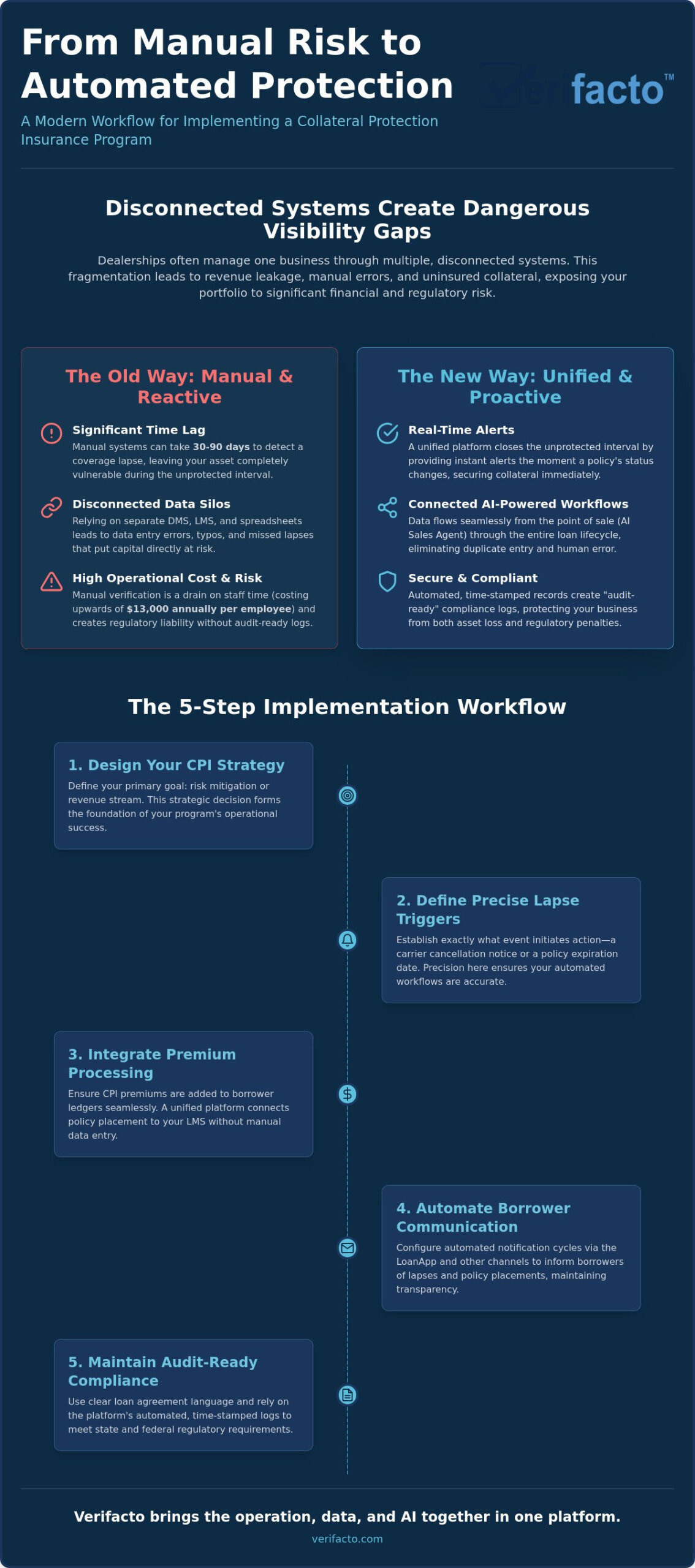
The 5-Step Implementation Workflow
Transitioning from manual insurance tracking to an automated system requires a methodical approach to ensure data integrity and operational continuity. Dealerships operate one business but are often forced to manage it through disconnected systems; this workflow is designed to bridge those gaps. By following a structured path, you can eliminate the “unprotected interval” and secure your capital without disrupting your daily operations. Knowing how to implement a cpi program for auto lenders effectively means focusing on the transition from legacy data to a live, AI-supported environment.
- Step 1: Portfolio Audit and Data Clean-up. Establish a baseline by identifying which loans have active, verified coverage and which are currently exposed.
- Step 2: Integration of the Operating Platform. Connect your loan data and accounting tools to the unified platform to ensure a single source of truth.
- Step 3: Configuration of Automated Notification Triggers. Define the specific criteria for lapses and set the multi-channel communication sequences.
- Step 4: Borrower Onboarding and Education. Introduce borrowers to the LoanApp to provide transparency and a simple way for them to manage their insurance status.
- Step 5: Launching the Automated Cycle. Activate the placement and cancellation engine to begin real-time portfolio protection.
Phase 1: The Integration Audit
Success starts with clean data. Stale insurance data refers to records that haven’t been verified within the last 30 days or contain policy numbers that no longer match the carrier’s active database. Accuracy at this stage prevents false positives that frustrate borrowers. You must verify VIN accuracy and borrower contact information before going live to ensure notifications reach the right person. This phase also involves ensuring a seamless sync with QuickBooks or your specific accounting software to handle premium additions automatically. If you’re ready to modernize your workflow, book a demonstration to explore how the platform fits your business.
Phase 2: Automating the Placement Cycle
Once the baseline is set, the system takes over the heavy lifting. When a lapse is detected, the platform manages the communication cycle through the LoanApp, SMS, and email. If a borrower obtains their own coverage, they can simply upload a photo of their proof of insurance directly through the app. The system is designed to recognize valid private insurance and trigger an automated cancellation of the CPI policy. This includes managing the refund of unearned premiums, which keeps your program compliant and borrower-friendly. Automating this cycle reduces the manual overhead spent chasing binders and allows your team to focus on loan performance rather than paperwork. This is the most efficient way to understand how to implement a cpi program for auto lenders while maintaining a positive customer relationship.
Optimizing ROI with Verifacto’s AI-Powered Platform
ROI in an insurance tracking program is often measured by premium volume, but the true value lies in operational savings and asset protection. Verifacto connects the entire customer and loan lifecycle, ensuring that your data remains fluid from the first lead to the final payment. By unifying disconnected vendor systems, you eliminate the friction that typically leads to revenue leakage. When you consider how to implement a cpi program for auto lenders, you’re really choosing a strategy for long-term financial performance. This approach transforms insurance from a back-office burden into a strategic advantage.
The AI Sales Agent plays a critical role by ensuring insurance is verified at the point of sale. This prevents “day one” lapses that often occur when manual verification processes are rushed or bypassed during busy periods. Beyond the initial sale, monitoring insurance behavior provides a unique window into borrower risk. A borrower who allows their insurance to lapse is frequently a leading indicator for a future payment default. By identifying these high-risk accounts early, your collections team can intervene proactively, improving overall portfolio stability.
Scaling Operations Without Adding Headcount
Scaling your business shouldn’t require a proportional increase in staff. With automated CPI workflows, one employee can effectively manage a portfolio twice as large as they could using manual spreadsheets. This efficiency comes from eliminating the need to chase insurance binders or manually update accounting ledgers. Verifacto’s 99.99% uptime guarantee ensures that your risk monitoring remains continuous, even when your office is closed. By removing the operational hurdles of fragmented data, you allow your team to focus on growth rather than administrative maintenance.
Future-Proofing Your Auto Finance Business
Adapting to 2026 market trends requires a platform that offers both cloud-based flexibility and AI-driven insights. Modern lenders must maintain control over their data to make informed strategic decisions. We prioritize this by ensuring your data is easily exportable, protecting you from vendor lock-in and allowing for custom analytics. Implementing a robust CPI program is the first step toward a fully optimized and protected portfolio. It’s about building a foundation of security that supports your business as it evolves. If you’re ready to see how a unified platform can modernize your operation, book a demonstration to explore how the platform fits your business.
Securing Your Portfolio with Automated Precision
Managing a modern loan portfolio requires moving beyond the operational friction of disconnected systems. By shifting from manual insurance tracking to a unified operating platform, you eliminate the dangerous time lags that lead to revenue leakage. You’ve seen the strategic framework and the technical requirements necessary to protect your capital. Knowing how to implement a cpi program for auto lenders isn’t just about risk mitigation; it’s about building a scalable business that leverages real-time data to maintain stability.
Verifacto provides the security and reliability you need to operate with confidence. With SOC II compliance, bank-level data protection, and a 99.99% uptime guarantee, your risk monitoring never stops. Our AI-powered insurance tracking is designed to support your human judgment while automating the repetitive workflows that drain your staff’s energy. It’s time to replace the anxiety of uninsured collateral with the certainty of an automated, audit-ready system.
See how Verifacto connects your operation from the first lead to the final payment and start future-proofing your business today. We’re here to help you navigate these operational shifts and ensure your portfolio remains protected and profitable.
Frequently Asked Questions
What is the primary benefit of a CPI program for auto lenders?
The primary benefit is the immediate reduction of financial risk by ensuring every asset in your portfolio is covered against physical damage or total loss. When you know how to implement a cpi program for auto lenders, you eliminate the unprotected interval where a vehicle has no insurance but remains on your books. This protection preserves your capital and ensures that a single accident—or even minor physical wear like a cracked windshield—doesn’t wipe out the profit from multiple performing loans; for those managing fleets in Florida, you can check out Pinnacle Auto Glass for expert repair services.
How does Collateral Protection Insurance differ from standard auto insurance?
CPI specifically protects the lender’s financial interest in the collateral, whereas standard auto insurance typically includes liability coverage for the borrower. While standard policies cover the driver’s legal responsibilities, CPI is designed to cover the vehicle’s actual cash value if it’s damaged while uninsured. It’s a specialized tool for lenders to maintain portfolio security when a borrower fails to keep their own private policy active and documented.
Is it legal to force-place insurance on a borrower’s vehicle?
Force-placing insurance is legal provided the right is clearly established in the original loan agreement signed by the borrower. Lenders must follow specific notification cycles and disclosure requirements to remain compliant with state and federal regulations. Verifacto is designed to provide greater visibility into these requirements, helping you maintain audit-ready records that prove you provided the borrower with ample opportunity to obtain their own coverage before placement.
How long does it take to implement an automated CPI program?
A typical implementation timeline ranges from two to four weeks, depending on the complexity of your current data and existing software integrations. This period includes the initial portfolio audit, data clean-up, and the synchronization of your LMS with the unified operating platform. Once the automated notification triggers are configured and your team is trained on the LoanApp interface, the system can begin real-time monitoring of your entire portfolio immediately.
Can I integrate CPI tracking with my existing accounting software?
Yes, our platform is designed to sync directly with major accounting tools like QuickBooks to automate premium billing and ledger updates. This integration eliminates the need for manual data entry between your insurance tracking module and your financial records. When a CPI policy is placed or cancelled, the corresponding financial adjustments flow seamlessly into your LMS, ensuring your borrower balances and company financials remain accurate without manual intervention.
What happens to the CPI premium if the borrower provides their own insurance?
The CPI policy is cancelled immediately, and any unearned premium is credited back to the borrower’s loan balance. This automated process ensures your program remains borrower-friendly and compliant with fair lending practices. By using the LoanApp, borrowers can upload their proof of coverage instantly, which triggers the system to verify the new policy and process the pro-rated refund without requiring manual calculations from your staff.
Do I need special staff to manage an automated CPI program?
You don’t need additional staff; in fact, an automated system usually allows your existing team to manage a much larger portfolio with less effort. The AI Operational Assistant handles the repetitive tasks of monitoring lapses and sending notifications, which reduces the manual overhead typically associated with insurance tracking. Your team shifts from being collectors of paperwork to managers of exceptions, focusing only on high-priority accounts flagged by the platform.
How does real-time insurance tracking improve loan portfolio performance?
Real-time tracking improves performance by providing instant visibility into coverage changes, allowing you to react before a loss occurs. When you understand how to implement a cpi program for auto lenders that uses live data, you drastically reduce your exposure to uninsured total losses. This proactive approach also identifies high-risk borrower behaviors early, which can serve as a leading indicator for potential payment defaults and allow for earlier collection intervention.