
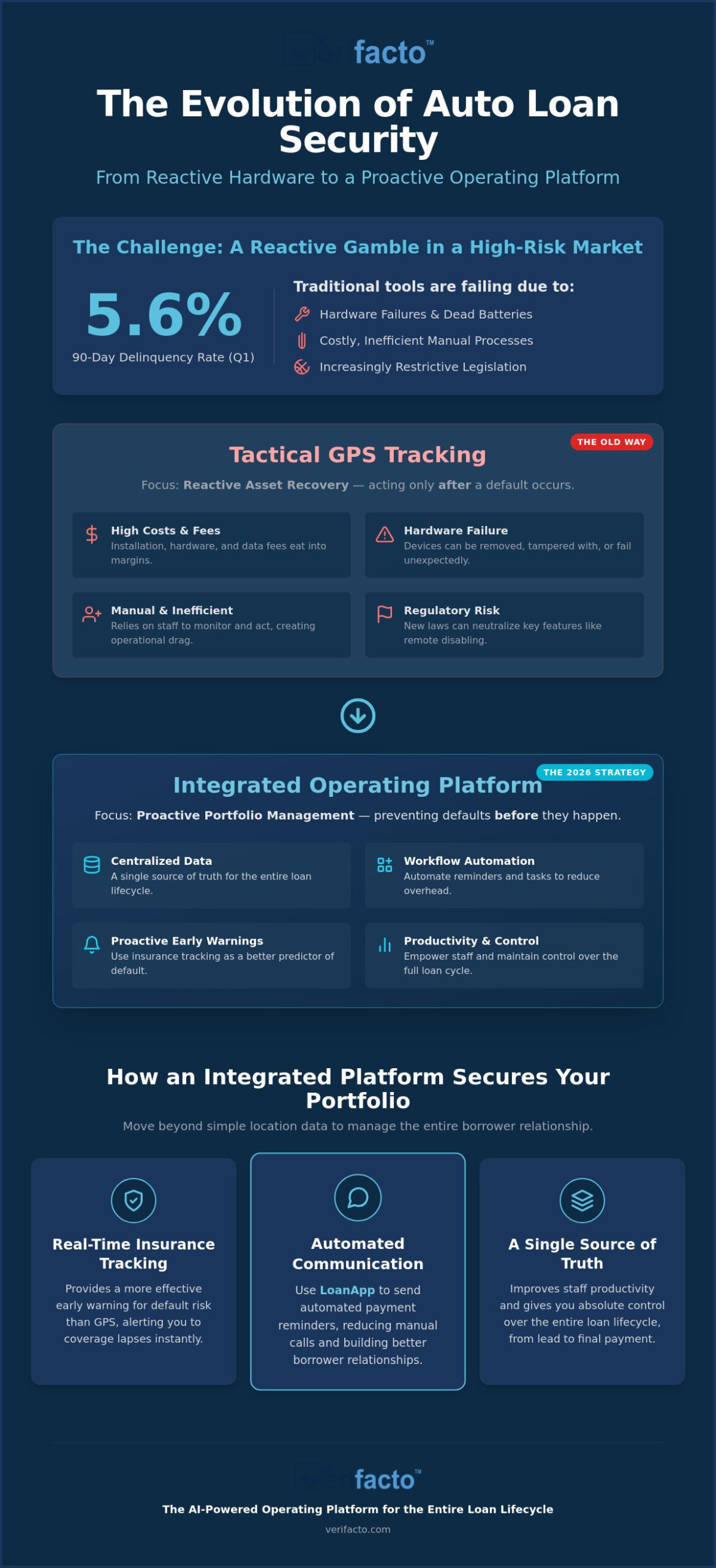
The GPS tracker you just hardwired into a subprime unit might feel like security, but in 2026, relying on hardware alone is a reactive gamble. With 90-day delinquency rates hitting 5.6 percent in the first quarter of this year, traditional auto loan default risk management strategies are struggling to keep pace. You know the cycle: hardware fails, batteries die, and new legislation across various states is increasingly restricting the use of remote disabling devices. It’s a costly, manual process that often leaves your portfolio exposed at the exact moment you need protection most.
We understand that protecting your investment shouldn’t feel like a constant battle against equipment malfunctions and endless insurance follow-up calls. This guide reveals why forward-thinking lenders are moving beyond hardware-dependent tracking toward integrated loan management and real-time insurance verification to secure their portfolios. You’ll discover how Verifacto’s AI-powered operating platform connects the entire loan lifecycle through tools like LoanApp, helping you lower delinquency rates and eliminate the operational overhead that eats into your margins.
Key Takeaways
- Shift from reactive asset recovery to proactive portfolio management by moving beyond tactical hardware toward a strategic operating platform.
- Discover why real-time insurance tracking provides a more effective early warning system for auto loan default risk management than simple GPS coordinates.
- Reduce operational overhead by replacing manual staff tasks with automated borrower communications and integrated payment processing through LoanApp.
- Eliminate the friction, high installation costs, and hardware failure rates associated with traditional GPS tracking devices.
- Centralize your data into a single source of truth to improve staff productivity and maintain absolute control over the entire loan lifecycle.
Loan Management Software vs. GPS Tracking: Defining the 2026 Choice
Many lenders view risk through the lens of recovery. If a borrower stops paying, you find the car. This reactive mindset is the biggest hurdle to scaling a profitable portfolio in 2026. While GPS tracking has served as a traditional safety net, it’s a tactical tool that only activates after a default has occurred. Modern auto loan default risk management requires a shift from recovery to prevention. You need to manage the borrower relationship, not just the asset location.
The choice today isn’t about which hardware to install, but how to leverage data to predict outcomes. Applying foundational risk management principles to your dealership means identifying potential defaults before they happen. An integrated operating platform provides the visibility needed to intervene early, whereas GPS hardware simply waits for the “skip” to occur. Hardware fails. Data doesn’t.
What is Auto Loan Management Software (LMS)?
An LMS is a strategic operating platform designed to connect every stage of the loan lifecycle. Instead of jumping between disconnected spreadsheets and legacy on-premise servers, cloud-based systems centralize payment processing, borrower communication, and document storage in one secure environment. This connectivity is the backbone of auto loan management software for modern lenders who want to eliminate operational silos.
By integrating functions like insurance tracking and automated communication through LoanApp, lenders can maintain a constant pulse on the loan’s health. This approach offers a clear business benefit: an all-in-one view of the borrower that allows your team to focus on collections rather than administrative data entry. When your software handles the “busy work,” your staff can focus on high-value risk mitigation.
The Traditional Role of GPS in Auto Finance
For decades, GPS tracking and starter-interrupt technology were the primary defenses for subprime lenders. These devices provided real-time location data, offering a sense of security for high-risk collateral. However, the 2026 landscape has changed the math on hardware. Rising monthly data fees and the high cost of professional installation have turned these “safety nets” into significant operational burdens.
Regulatory shifts are also making hardware-only strategies riskier. For example, Colorado’s HB 26-1261 now restricts the use of remote disabling devices, effectively neutralizing a key feature of many GPS units. Relying solely on hardware ignores the digital-first reality of 2026. If your auto loan default risk management plan depends on a device that can be removed, tampered with, or legislated out of utility, your portfolio remains vulnerable.
The Strategic Power of Integrated Loan Management Systems
Scaling an independent dealership requires more than just selling cars; it requires a bulletproof back-office strategy that minimizes human error. When your systems are fragmented, your staff spends more time chasing data than collecting payments. An integrated operating platform transforms your operation by creating a single source of truth for every borrower profile. This connectivity is essential for effective auto loan default risk management, as it allows you to see the full journey of the loan from the first lead to the final payment without switching between disconnected tabs.
Integrating your LMS with a robust DMS is the key to a seamless front-to-back office experience. Understanding what is dms and how it feeds into your broader risk strategy is vital for scaling. When these systems talk to each other, data flows naturally from the sales desk to the collections department. This reduces manual entry errors and ensures that no borrower falls through the cracks during the transition from origination to servicing. You can explore how AI-driven connectivity bridges these operational gaps.
Workflow Automation and Borrower Communication
Automating the “busy work” of reminders and follow-ups increases staff productivity immediately. Instead of manual calls, use LoanApp to send automated text and email reminders based on real-time data. This consistent communication reduces delinquency without the need for additional headcount. It also helps you stay aligned with evolving standards for consumer protection in auto loans, ensuring your outreach is professional, documented, and compliant. This approach builds a better borrower relationship compared to the high-friction, “recovery-first” mentality of GPS hardware.
Built-in Payment Processing and Cash Flow
Cash flow is the lifeblood of your portfolio, and any friction in the payment process increases your risk. Third-party payment processors often introduce delays that can derail a borrower’s payment habit. By leveraging integrated payment solutions for dealers, you eliminate these barriers. Real-time tracking allows you to see exactly when a payment is made or missed, giving you the agility to respond instantly. Convenient borrower payment portals help reduce charge-offs by making it easier for customers to stay current on their obligations.
- Eliminate manual data entry by connecting sales and collections data.
- Reduce missed payments through automated, multi-channel reminders.
- Improve liquidity with real-time payment processing and reporting.
- Empower borrowers with self-service tools via LoanApp.
GPS Tracking: Tactical Asset Recovery or Operational Burden?
If you’re still relying on GPS hardware as your primary defense, you’re playing a reactive game that often costs more than it saves. High upfront hardware acquisition costs are only the beginning. When you factor in professional installation labor and recurring monthly data fees, the financial weight on your portfolio becomes significant. More importantly, relying on asset recovery means you’ve already accepted a total loss of the profitable borrower relationship. True auto loan default risk management focuses on keeping the customer in the car and the payments flowing, not just finding the collateral after the deal has soured.
This philosophy of prioritizing the borrower’s relationship with their asset is a hallmark of modern specialty lenders who focus on financial stability over simple recovery. To see an example of how this model is applied to vehicle and property-secured loans, click here.
Borrowers are also becoming more sophisticated. The “cat and mouse” game of finding and disabling tracking units has moved from niche forums to mainstream social media. A simple internet search provides dozens of ways to bypass or jam traditional GPS signals. If your security rests on a physical device that can be removed in minutes, your “safety net” is largely an illusion. Transitioning to a software-driven strategy eliminates this physical vulnerability while focusing on the data that actually predicts a default.
Hardware Failure and Maintenance Realities
Hardware isn’t infallible. GPS units fail, batteries die, and cellular connections drop in remote areas. Every time a device goes dark, your staff enters a logistical nightmare of service calls and troubleshooting. These failures often create false positives in your monitoring system, leading to unnecessary collection efforts or strained borrower relationships. When calculating your true ROI, you must look past the device price tag. Account for the hours your team spends managing non-functioning hardware instead of managing active accounts. In 2026, labor is too expensive to waste on hardware maintenance.
The 2026 Legal and Compliance Landscape
The regulatory environment has made hardware-centric strategies increasingly dangerous. A recent Federal Reserve analysis on auto delinquencies highlights the mounting pressure on subprime borrowers, yet state-level privacy laws are simultaneously restricting how lenders can use tracking data. Using faulty GPS data to trigger a repossession opens your dealership to massive litigation risks and statutory damages.
Staying ahead requires a robust auto finance compliance management framework that prioritizes data integrity over hardware coordinates. If your risk strategy is tied to a physical device, you’re one legislative update away from an operational standstill. Modern operating platforms help you navigate these shifts by focusing on behavioral data and insurance status, which are far more reliable and legally defensible indicators of risk.
- Replace expensive hardware maintenance with scalable software oversight.
- Avoid the litigation risks associated with wrongful repossession and faulty GPS data.
- Focus staff energy on borrower engagement rather than device troubleshooting.
- Stay compliant with evolving state-level restrictions on starter-interrupt devices.
Beyond Coordinates: Why Insurance Tracking Outperforms GPS
A vehicle’s coordinates tell you where it’s parked, but they say nothing about the financial health of the borrower. In 2026, the most effective auto loan default risk management starts with monitoring insurance status. An insurance lapse is frequently the first indicator of financial distress, often occurring weeks before the first payment is actually missed. While GPS hardware waits for a “skip” to occur, insurance tracking provides a proactive window into the borrower’s ability to maintain the contract. If they can’t pay the premium, they likely won’t pay the note.
Relying solely on location data leaves a massive hole in your risk strategy. A car that is easily located but uninsured is a liability, not an asset. If that vehicle is involved in a collision, your collateral value can vanish in an instant. Software-driven tracking allows you to move away from reactive recovery and toward a model that prioritizes the financial integrity of the loan. You can see how AI-driven data identifies these patterns before they turn into charge-offs.
Automating Insurance Verification
Manual insurance verification is a productivity killer. Your staff shouldn’t spend hours on hold with agents or sorting through stacks of paper notices. Modern platforms provide real-time alerts the moment a policy is cancelled or changed. This automation prevents the “uninsured total loss” nightmare that GPS cannot stop. By the time a GPS unit tells you a car hasn’t moved, it might already be sitting in a salvage yard without a penny of coverage. Data-driven tracking ensures you’re protected before the accident happens.
CPI Solutions: The Ultimate Safety Net
When a borrower fails to maintain their own coverage, you need an immediate financial backstop. Collateral Protection Insurance (CPI) serves as this ultimate safety net. By integrating CPI into the monthly payment through your LMS, you ensure the lender’s interest is protected automatically. A guaranteed payout for a total loss is far superior to recovering a damaged, uninsured asset. Understanding what is collateral protection insurance allows you to build a risk strategy that prioritizes financial recovery over physical repossession.
- Identify financial distress early by monitoring insurance premium payments.
- Eliminate manual staff work with automated carrier notifications.
- Protect your portfolio from total loss with integrated CPI solutions.
- Maintain continuous coverage without the friction of hardware maintenance.
Protect your portfolio from the high cost of uninsured losses by exploring our real-time insurance tracking solutions today.
Modernizing Your Portfolio with Verifacto’s Integrated LMS & DMS
Transitioning from a hardware-heavy recovery model to a software-first management strategy is the most significant move you can make for your dealership’s long-term health. Verifacto provides a unified, AI-powered operating platform designed specifically for the complexities of auto finance. By connecting every function from origination to final payment, you eliminate the operational silos that lead to missed opportunities and increased risk. This connectivity is the foundation of modern auto loan default risk management, allowing you to focus on growth rather than hardware troubleshooting.
The Verifacto advantage lies in its ability to replace expensive, high-friction GPS hardware with intelligent data flows. You no longer need to wait for a physical device to report a location to know your portfolio is at risk. Instead, you gain a clear path toward improving collection efficiency auto loans through real-time insurance tracking and automated borrower engagement. This shift is essential for auto loan default risk management, as it reduces your total cost of ownership and creates a more stable, predictable revenue stream.
Seamless Cloud Integration
A secure, cloud-based platform ensures you can access your portfolio data from anywhere, at any time. This mobility is crucial for modern teams that need to respond quickly to changing borrower behaviors. Through LoanApp, your borrowers stay engaged with their accounts, receiving automated notifications and making payments through a streamlined interface. This level of connectivity reduces the administrative burden on your staff, allowing them to handle larger volumes without increasing headcount. You can explore how our AI-driven tools automate these critical communication paths.
Proactive Risk Management
Resilience in 2026 comes from data-driven insights. Verifacto’s insurance tracking creates a proactive shield around your collateral, identifying potential defaults before they manifest as missed payments. By using behavioral data and insurance status rather than just physical coordinates, you create a more sophisticated risk profile for every borrower. If you’re ready to modernize your operation and connect your entire loan lifecycle, contact us to schedule a Verifacto demo and see the platform in action.
Making the switch to a software-driven model doesn’t have to be a hurdle. We help you transition your existing data into a unified environment where underwriting, payments, collections, and insurance tracking work in harmony. It’s time to stop chasing assets and start managing a more profitable portfolio. Just as you secure your auto units, you may also want to explore Subscription-based Title and Lien Monitoring to protect your real estate assets from unauthorized changes. We invite you to see how the platform connects your entire operation from the first lead to the final payment.
The Future of Your Portfolio is Software-Driven
Relying on hardware to protect your assets is a legacy strategy that no longer fits the 2026 lending landscape. As explored throughout this guide, GPS units are reactive tools that often fail when you need them most. By shifting your focus to an integrated operating platform, you gain the ability to predict risk rather than just react to it. You move from a “recovery first” mindset to a “management first” approach that prioritizes borrower engagement and financial stability.
A resilient portfolio requires more than just coordinates. It demands cloud-based efficiency and SOC II compliant security to protect your sensitive data. Real-time insurance tracking serves as your most powerful early warning system, allowing you to intervene before a lapse turns into a total loss. Modernizing your auto loan default risk management strategy ensures you stay ahead of regulatory shifts and rising delinquency rates while reducing the operational friction of manual staff tasks.
It’s time to connect your entire customer and loan lifecycle into a single source of truth. Secure Your Portfolio with Verifacto’s Integrated LMS and see how a software-first model transforms your bottom line. We look forward to helping you build a more secure and profitable operation.
Frequently Asked Questions
Is loan management software a complete replacement for GPS tracking?
Modern loan management software acts as a strategic replacement by shifting your focus from asset recovery to borrower management. While GPS provides location data, an integrated platform manages the entire loan lifecycle and insurance status. This proactive approach is designed to prevent defaults before they happen, making physical tracking less relevant for many portfolios.
How much can a lender save by switching from GPS to insurance tracking?
Lenders reduce operational overhead significantly by eliminating upfront hardware costs, professional installation fees, and monthly data subscriptions. You also save on the labor costs associated with troubleshooting failed devices and managing service calls. Removing these physical expenses directly improves your portfolio’s total cost of ownership and bottom-line margins.
Does Verifacto’s software integrate with existing GPS providers if I want to use both?
The platform is designed to be flexible and can connect with various data sources to maintain a single source of truth for your operation. This connectivity allows you to centralize your auto loan default risk management data even if you aren’t ready to phase out hardware entirely. It ensures that all borrower information, including location data, is accessible in one secure environment.
What are the compliance risks of using GPS starter-interrupt devices in 2026?
Compliance risks have increased due to fragmented state regulations and stricter privacy laws regarding collateral tracking. For example, Colorado’s HB 26-1261 now prohibits the use of remote disabling devices for a debtor’s only vehicle. Relying on hardware data to trigger a repossession can lead to significant litigation risks if the device provides inaccurate information. Effective auto loan default risk management requires staying ahead of these legislative shifts.
How does real-time insurance tracking actually work within the LMS?
The system monitors carrier data automatically and generates instant alerts the moment a policy is cancelled, changed, or expires. This replaces the need for staff to make manual calls to insurance agents or process paper notices. By integrating this data directly into the loan journey, you can take immediate action to protect your collateral before an uninsured loss occurs.
Can an LMS really help improve my collection rates without a physical device?
Collection rates often improve when you reduce payment friction and maintain consistent borrower engagement. Using LoanApp to send automated reminders and providing integrated payment portals makes it easier for borrowers to stay current. Professional, software-driven communication is more effective at building long-term payment habits than the high-friction “recovery” mindset of physical tracking.
What happens if a borrower disables their GPS? How does the LMS help then?
If a physical device is neutralized, the LMS continues to manage the risk through behavioral data and insurance monitoring. Because the software connects the entire borrower relationship, you still have access to payment history, communication logs, and verified insurance status. This data-driven oversight ensures you aren’t left in the dark just because a piece of hardware was tampered with.
How long does it take to implement an integrated LMS and DMS platform?
Implementation time varies based on your portfolio size and data complexity, but cloud-based platforms are designed for a streamlined transition. Our team works to map your existing data into the new system to ensure a seamless “front-to-back” office experience. The goal is to get your operation running from lead to payment with minimal disruption to your daily business.