
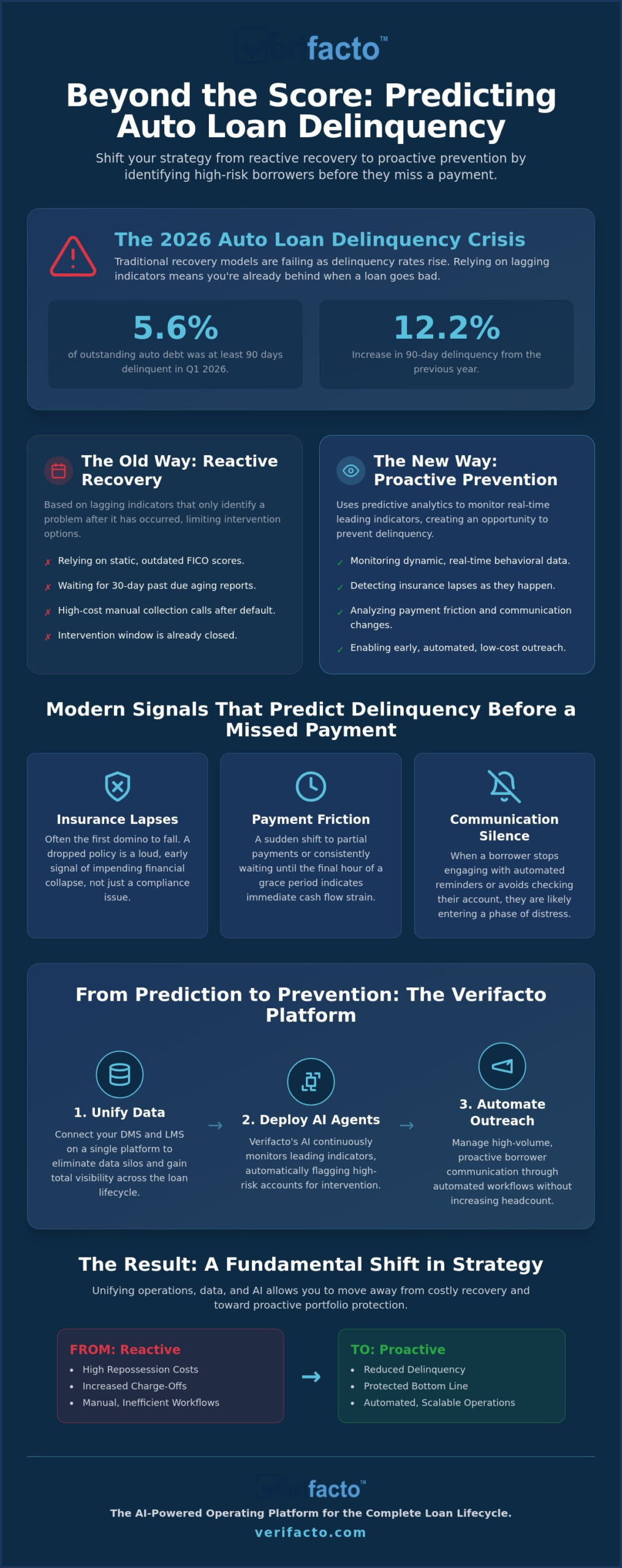
5.6% of outstanding auto debt was at least 90 days delinquent in the first quarter of 2026, a 12.2% increase from the previous year. If you’re managing a portfolio, you’ve likely realized that traditional credit scores are lagging indicators that fail to capture real-time risk. Dealerships operate one business but are often forced to manage it through disconnected systems, making it nearly impossible to see a crisis coming until the loss is already realized. You need a way to stop reacting to defaults and start preventing them.
In this article, you’ll learn how to move beyond manual collection efforts by using predictive analytics for auto loan delinquency to identify high-risk borrowers before they miss a payment. We’ll show you how AI-driven predictive signals and automated workflows can transform your recovery strategy and protect your bottom line. You’ll discover how Verifacto brings the operation, data, and AI together in one platform to provide total visibility across the loan lifecycle, allowing you to automate communication and significantly reduce repossession costs.
Key Takeaways
- Move beyond lagging credit scores to identify delinquency risk before the first payment is missed.
- Leverage predictive analytics for auto loan delinquency to monitor high-impact signals like insurance lapses and payment friction.
- Deploy AI agents to automate borrower communication and manage high-volume outreach without increasing your headcount.
- Unify your DMS and LMS into a single operating platform to eliminate duplicate data entry and disconnected risk reporting.
- Shift your strategy from reactive recovery to proactive prevention to help reduce charge-offs and repossession costs.
The 2026 Auto Loan Delinquency Crisis: Why Traditional Scorecards Are Failing
Dealerships operate one business but are often forced to manage it through disconnected systems. This fragmentation masks a harsh reality: 5.6% of outstanding auto debt was at least 90 days delinquent in the first quarter of 2026, a 12.2% increase from the previous year. If your recovery strategy relies on the standard 30-day past due report, you’re already behind. By the time a borrower shows up on an aging report, the window for effective intervention has likely closed. This “lagging indicator” trap is the primary reason why traditional collections departments are struggling to maintain portfolio performance.
The current market reality is shifting risk profiles beyond subprime tiers. In 2026, we’re seeing rising delinquency in prime and near-prime segments. Borrowers are juggling average monthly payments of $770 for new vehicles, often stretched over terms as long as 84 months. These extended terms create deep negative equity, reducing the borrower’s incentive to keep the vehicle when financial pressure mounts. Without predictive analytics for auto loan delinquency, these risks remain buried in disconnected data silos, and your team loses the ability to spot early warning signs of portfolio distress.
The True Cost of a Delinquent Loan
A delinquent loan costs much more than just the missed interest. When a loan reaches the point of repossession, you’re hit with legal fees, transport costs, and rapid collateral depreciation. Early payment default (EPD) is particularly dangerous because it often signals systemic issues in your origination process or a total breakdown in borrower stability. In 2026, the combination of high interest rates and rising vehicle repair costs creates a “debt spiral” that can turn a stable borrower into a high-risk liability in just a few weeks. You can’t afford to wait for the default to happen before you take action.
Why Static Credit Scores Don’t Tell the Whole Story
Relying on traditional credit scores provides a frozen snapshot of a borrower’s past, not a forecast of their future behavior. FICO scores are static and fail to account for the volatility of the current economy. To gain true visibility, lenders are moving toward vintage cohort analysis. This method compares the performance of loans originated in different months, providing a clearer picture of portfolio health than simple aging reports. Implementing predictive analytics for auto loan delinquency allows you to leverage trended and alternative data, identifying behavioral shifts that static scorecards simply can’t catch.
This movement toward real-time risk evaluation is visible across many industries. For instance, in the logistics sector, owner-operators utilize SureLoadr to quickly assess the credit risk of freight brokers before committing to a contract, ensuring they only work with reliable partners.
Modern Signals That Predict Delinquency Before the First Missed Payment
While traditional scores look back at history, predictive analytics for auto loan delinquency focuses on what is happening right now. Lenders who wait for a missed payment to trigger a collection call are losing the recovery race. Recent auto loan delinquency rates confirm that financial distress is mounting across multiple credit tiers, making early signals more critical than ever. You need to monitor subtle behavioral shifts that happen weeks before a check actually bounces.
Insurance lapses are often the first domino to fall in a borrower’s financial life. When cash flow is strained, people often prioritize immediate needs like groceries or rent over long-term protection. A dropped policy isn’t just a compliance headache; it’s a loud signal of an impending financial collapse. By the time the loan payment is due, the money is usually already gone.
Payment friction provides another layer of predictive data. This includes a sudden shift to partial payments or waiting until the final hour of a grace period for ACH processing. Similarly, communication silence is a major red flag. If a borrower stops engaging with automated reminders or avoids checking their account, they’re likely entering a “head in the sand” phase of distress. Integrating local employment trends and vehicle depreciation curves into your risk model helps you see which borrowers are most vulnerable to these shifts.
Real-Time Insurance Tracking as a Risk Mitigator
Manual insurance verification is too slow and labor-intensive for the 2026 market. Automated insurance tracking allows your team to intervene the moment coverage drops, providing a window for proactive outreach before the loan goes into default. Additionally, Collateral Protection Insurance (CPI) serves as a vital safety net while acting as an early warning signal of borrower instability.
Behavioral Analytics and the ‘LoanApp’ Ecosystem
The way a borrower interacts with their LoanApp provides a wealth of actionable data. Our Analytics Agent monitors these engagement patterns to spot anomalies in payment frequency or method. For instance, a sudden increase in app logins without a corresponding payment can indicate financial anxiety. By correlating these habits with negative equity milestones, the platform identifies which accounts require immediate attention. You can see how these signals are consolidated within the Verifacto AI platform to give your team a head start on recovery.
Implementing AI-Powered Predictive Modeling in the Lending Lifecycle
Many lenders view artificial intelligence as a standalone novelty rather than a core operational requirement. In 2026, this perspective is a liability. AI is most effective when it’s treated as an embedded tool that supports human judgment rather than a separate science project. By transforming lending decisions through integrated data, you can move from simple observation to active portfolio management. Verifacto brings the operation, data, and AI together in one platform to ensure your team isn’t just seeing risk, but acting on it.
The Verifacto Analytics Agent acts as the bridge between raw data and your daily operations. It translates complex behavioral patterns into actionable portfolio dashboards, highlighting accounts that require immediate attention. This isn’t about replacing your experienced collectors; it’s about giving them a roadmap. Our platform is designed to provide greater visibility, ensuring that your data remains yours. We prioritize dealer control by making all predictive data easily accessible and exportable, which effectively eliminates the risk of vendor lock-in that plagues many legacy systems.
Predictive Analytics vs. Traditional Reporting
Standard aging reports are inherently reactive. They tell you who didn’t pay yesterday, which is often too late to save the account. Predictive analytics for auto loan delinquency allows you to identify accounts that are currently “current” but exhibit high-risk behavioral markers. Our models can help you spot these outliers while maintaining bank-level security. Verifacto is SOC II compliant, ensuring that your sensitive portfolio data is protected by the highest industry standards for encryption and uptime.
The Role of Trended Data in 2026
A credit score is a snapshot, but trended data is a trajectory. To manage risk effectively, you need to understand the direction a borrower’s financial health is moving. The Verifacto AI platform connects your origination data directly to servicing performance, allowing you to track “repayment velocity.” This metric measures how quickly and consistently a borrower pays over time. A slowdown in velocity is a prime example of a signal that predictive analytics for auto loan delinquency uses to trigger an automated intervention before a default occurs.
From Prediction to Prevention: Automating the Recovery Workflow
Identifying risk is only half the battle. Predictive data is an overhead expense unless it triggers an immediate, operational response. Many lenders struggle because their analytics are disconnected from their outreach tools, leading to delays that allow accounts to slide into deep delinquency. By integrating predictive analytics for auto loan delinquency directly into your workflow, you can move from simple observation to active prevention. Verifacto brings the operation, data, and AI together in one platform to ensure that every risk signal results in a concrete action.
Automated borrower communication is the backbone of a modern recovery strategy. Instead of waiting for a missed payment, the platform uses SMS and email to trigger reminders based on behavioral triggers. Our Collections Agent manages this high-volume outreach, allowing your team to handle larger portfolios without increasing headcount. This isn’t a one-size-fits-all approach. The system applies dynamic collection strategies, tailoring the intensity and frequency of outreach based on the account’s specific predictive risk score. A borrower with a history of “just-in-time” payments might receive a soft nudge, while a high-risk account triggers more frequent touchpoints.
Consider a practical workflow example: the system detects a lapse in insurance coverage through real-time tracking. Instead of waiting for a manual review, the platform can automatically initiate a CPI placement while simultaneously sending a payment reminder to the borrower’s LoanApp. This seamless transition ensures the collateral is protected while the borrower is prompted to resolve the underlying financial issue. You can book a demonstration to see how this automated sequence fits your specific business model.
Improving Collection Efficiency for Modern Portfolios
Success in 2026 requires a focus on improving collection efficiency for auto loans through unified data. When your DMS and LMS are connected, you eliminate the manual errors that often occur during data entry or risk reporting. Verifacto includes built-in payment processing, which ensures that every transaction is logged and reconciled in real-time. This provides audit-ready logs for compliance while allowing your team to maintain aggressive recovery goals without the friction of disconnected vendor systems.
The AI Sales Agent and the Front-End Connection
The best way to manage delinquency is to improve the quality of originations. Our AI Sales Agent ensures that better quality leads are prioritized from the very first interaction. By feeding delinquency data back into the sales process, the platform helps you refine your target borrower personas. This closes the loop between sales and servicing, reducing revenue leakage by connecting initial lead follow-up to long-term loan performance. It’s a comprehensive approach that protects your bottom line from the first lead to the final payment.
Unifying the Lifecycle: Why a Connected Platform Beats Disconnected Analytics
Dealerships operate one business but are often forced to manage it through disconnected systems. When your lead data lives in one place, your servicing data in another, and your risk analysis in a third, you’re essentially flying blind. This fragmentation is the hidden driver behind rising losses. Effective predictive analytics for auto loan delinquency require a unified data stream to generate accurate signals. Without a connected platform, your team spends more time reconciling spreadsheets than actually mitigating risk.
Managing your DMS, LMS, and AI in one environment eliminates the operational friction that slows down recovery efforts. Verifacto provides a modern alternative to the “vendor stack” approach, connecting every stage of the lifecycle from the first lead to the final payment. This integration removes the need for duplicate data entry, which is the leading cause of manual errors in risk reporting. When your systems talk to each other, you gain real-time visibility that allows for smarter decisions and higher sustained profitability.
Replacing Disconnected Systems with Verifacto
Verifacto brings the operation, data, and AI together in one secure cloud environment. This isn’t just about convenience; it’s about reliability. Our 99.99% uptime guarantee ensures that your risk monitoring and automated collection efforts never stop, even when your office is closed. By leveraging specialized AI agents within a single platform, you can scale your operation without scaling your overhead. Intelligent automation handles the routine tasks, allowing your staff to focus on high-priority accounts that require a human touch.
Next Steps for Modern Auto Lenders
The first step toward solving the hidden loss crisis is assessing your current delinquency blind spots. If you’re struggling with vendor fragmentation or delayed data, it’s time to modernize your infrastructure. The transition to a cloud-based loan management system is no longer optional for lenders who want to remain competitive in 2026. By centralizing your data, you empower your team with the predictive analytics for auto loan delinquency they need to protect your portfolio. You can book a demonstration to explore how the Verifacto platform fits your business and see how we connect your entire operation.
Transforming Your Recovery Strategy into a Competitive Advantage
The 2026 market demands a shift from reactive collections to proactive prevention. Traditional scorecards are no longer enough to protect your bottom line against rising delinquency rates across all credit tiers. By implementing predictive analytics for auto loan delinquency, you move from chasing defaults to identifying risk signals like insurance lapses and payment friction before they impact your cash flow. It’s about staying ahead of the curve rather than reacting to the damage.
Verifacto brings the operation, data, and AI together in one platform to eliminate the blind spots created by disconnected systems. With SOC II compliant security, a 99.99% uptime guarantee, and specialized AI Analytics and Collections Agents, your team has the tools to maintain stability in a volatile environment. This unified approach empowers your experts with real-time visibility and automated workflows that scale with your business without increasing overhead.
See how Verifacto connects your operation from the first lead to the final payment.
You don’t have to navigate these complex operational challenges alone. We’re here to help you turn your business data into a strategic advantage and ensure your portfolio remains resilient and profitable through 2026 and beyond. For readers who also require professional guidance with real estate assets, zakksellshomes.com provides expert brokerage services from Dr. Zakk Varughese in the Mississippi area.
Frequently Asked Questions
What is predictive analytics for auto loan delinquency?
Predictive analytics for auto loan delinquency is a data-driven strategy that uses AI to identify borrowers at risk of default before a missed payment occurs. Unlike traditional credit scoring, it analyzes real-time behavioral signals such as insurance status, payment friction, and app engagement. This technology is designed to provide greater visibility into portfolio health, allowing lenders to intervene early and mitigate potential losses before they impact the bottom line.
How does AI help in predicting car loan defaults?
AI analyzes connected business data to identify subtle shifts in borrower behavior that often precede a default. By monitoring patterns in the LoanApp and payment processing systems, AI agents can help spot anomalies like sudden changes in payment methods or decreased communication. These models are designed to process complex datasets far faster than manual reviews, providing your team with actionable insights to prioritize high-risk accounts effectively.
Why is insurance tracking considered a predictive signal for delinquency?
Insurance tracking is a critical predictive signal because a lapse in coverage is often the first indicator of a borrower’s financial distress. When cash flow is tight, borrowers frequently prioritize immediate costs over insurance premiums. Real-time monitoring allows lenders to detect these lapses immediately, triggering automated outreach or CPI placement. This proactive step helps protect the collateral while signaling that the loan may soon enter delinquency.
Can predictive analytics reduce charge-offs for BHPH dealers?
Predictive analytics for auto loan delinquency can help BHPH dealers reduce charge-offs by enabling earlier intervention. By identifying high-risk accounts while they are still current, dealers can automate reminders and tailor collection intensity. This proactive strategy is designed to resolve payment issues before they escalate to repossession. Unified visibility across the loan lifecycle helps dealers manage portfolios more efficiently and maintain higher sustained profitability.
What is the difference between a lagging indicator and a predictive signal in auto finance?
A lagging indicator, such as a 30-day past due report, tells you that a loss has already occurred. In contrast, a predictive signal identifies behavioral changes that suggest a future default is likely. Predictive signals include insurance lapses, payment friction, or changes in communication patterns. Moving from lagging indicators to predictive signals allows lenders to shift from a reactive recovery stance to a proactive prevention strategy.
Is predictive analytics software expensive for small-to-medium lenders?
Implementing predictive tools is an investment in operational efficiency that can help reduce long-term costs associated with repossessions and charge-offs. While costs vary based on portfolio size and needs, modern platforms are designed to be accessible for small-to-medium lenders. By unifying your DMS and LMS into one platform, you eliminate the need for multiple disconnected vendors. This consolidated approach helps you scale your operation without significantly increasing your overhead.
How do I integrate predictive analytics into my existing DMS or LMS?
Verifacto is designed to replace disconnected systems by unifying the DMS, LMS, and AI agents into one operating platform. This “one platform” approach eliminates the need for complex third-party integrations that often lead to data silos. If you are currently using fragmented tools, moving to a connected environment ensures that your predictive data is automatically synced across the entire loan lifecycle, providing total visibility from lead to final payment.
Does AI replace the need for a collections team?
AI does not replace your collections team; it acts as an embedded tool that supports human judgment. The Collections Agent automates high-volume outreach and routine reminders, which allows your staff to focus their expertise on complex, high-risk negotiations. By automating workflows and prioritizing accounts based on predictive risk, AI helps your team work more efficiently and manage larger portfolios without the need to increase headcount.