
Can your portfolio survive a 5.60% delinquency rate when a significant portion of those vehicles are driving without active coverage? Dealerships and finance companies often manage their operations through disconnected systems, leaving them blind to insurance lapses until a total loss occurs. It’s a frustrating reality where manual verification simply can’t keep pace with rapid portfolio growth. You likely recognize that relying on outdated spreadsheets or fragmented vendor data creates unnecessary revenue leakage. Implementing modern lender placed insurance software is no longer just an operational upgrade; it’s a necessary shield for your collateral in 2026.
In this article, you’ll discover how top-performing lenders are replacing labor-intensive tracking with AI-driven automation to eliminate coverage gaps and protect their bottom line. We’ll explore how unifying your data through an integrated platform ensures compliance and streamlines the CPI placement process. From real-time monitoring to automated borrower communication via LoanApp, you’ll see exactly how a connected system turns risk management from a high-cost administrative burden into a streamlined, strategic advantage.
Key Takeaways
- Learn how unifying disconnected systems into a single platform can help eliminate the blind spots that lead to revenue leakage from uninsured losses.
- Discover how AI agents provide real-time monitoring across your entire portfolio, allowing for immediate detection of insurance lapses without increasing headcount.
- Understand how modern lender placed insurance software automates the transition from coverage detection to borrower notification via the LoanApp mobile application.
- Explore the importance of bank-level data protection and SOC II compliance in maintaining a secure, audit-ready insurance tracking environment.
- Identify the practical steps to move from reactive manual verification to a proactive, automated workflow that safeguards your collateral and improves financial performance.
The Operational Cost of Disconnected Insurance Tracking
Dealerships operate one business but are often forced to manage it through disconnected systems. This fragmentation is where revenue leakage begins. When your loan data lives in one place and your insurance tracking lives in another, you create a visibility gap that puts your entire portfolio at risk. Lender placed insurance software is designed to solve this by monitoring borrower coverage continuously and automating the placement of Collateral Protection Insurance (CPI) when a policy cancels or expires. Without this automation, your team is stuck in a reactive cycle that costs time and money.
Managing insurance through manual entry or third-party portals that don’t sync with your primary records leads to “disconnected data.” You might have a borrower who paid their loan but let their insurance lapse three weeks ago. If your systems don’t talk to each other, you won’t know until it’s too late. Verifacto views insurance tracking not as a standalone task, but as an embedded function of your auto loan management software. Operational efficiency comes from having one source of truth for the entire loan lifecycle.
Why Manual Verification Fails Modern Lenders
Staff members shouldn’t spend their afternoons calling insurance agents or filing paper binders. This process is incredibly time-intensive and scales poorly as your portfolio grows. The biggest threat is “the gap.” This is the window of time between a borrower’s insurance lapse and the moment your staff identifies the problem. If an accident occurs during this period, your collateral is unprotected. Manual verification is also prone to “false placement,” where a lender places CPI on a vehicle that actually has coverage. This creates unnecessary borrower friction and heavy administrative work to reverse the charges.
The Financial Impact of Unprotected Collateral
The numbers in early 2026 show auto loan delinquency rates reaching 5.60%. When a delinquent borrower also lacks insurance, the risk of a total loss becomes a financial emergency. A single uninsured total loss in a subprime portfolio can negate the interest income from dozens of other loans. Automated tracking provides greater visibility into these risks before they become losses. High-performing lenders treat lender placed insurance software as an investment in stability rather than a simple operational expense. It helps you maintain control over your assets without adding to your payroll costs; for readers who also manage residential assets or simply want to see how top-tier mortgage professionals maintain their standards, check out Morgan Financial.
Leveraging AI for Real-Time Insurance Monitoring
Monitoring a growing portfolio shouldn’t require a growing payroll. While traditional systems act as passive databases, modern lender placed insurance software utilizes AI agents to actively patrol your data. AI agents don’t blink. These agents monitor thousands of loans simultaneously, identifying policy cancellations or expirations the moment they occur. With the agentic AI insurance market projected to reach $7.26 billion in 2026, lenders are rapidly moving toward these intelligent operating models to maintain a competitive edge and eliminate the human fatigue that leads to missed lapses.
Verifacto integrates these capabilities through specific tools like the Analytics Agent and the AI Operational Assistant. These aren’t standalone novelties; they are embedded tools designed to provide clean, actionable data that supports human judgment. For a deeper look at the regulatory context, you can find Lender-placed insurance explained by state regulators. By unifying your data, AI at Verifacto ensures your team focuses on high-level decision making while the software handles the repetitive monitoring and data entry tasks.
Automated Detection and Borrower Outreach
Speed is everything when a lapse is detected. The system immediately triggers automated communication through multiple channels, including SMS, email, and the LoanApp mobile application. This multi-channel approach ensures the borrower receives the notice through their preferred medium, increasing the likelihood of a quick resolution. Automating these reminders significantly reduces the administrative burden on your collections team. It allows them to focus their energy on accounts that require personal intervention rather than chasing basic insurance renewals.
Predictive Analytics for Risk Mitigation
Beyond simple detection, the Analytics Agent identifies patterns that suggest a borrower is likely to let their coverage drop. This might include previous lapse history or specific shifts in payment behavior that correlate with insurance non-renewal. Real-time dashboards offer executives a clear view of portfolio health, making it easier to adjust strategies before risks escalate. Essentially, AI analytics can help lenders anticipate risk before it becomes a charge-off. If you want to see these tools in action, you can book a demonstration to explore how the platform fits your business.
Core Capabilities of an Integrated LPI Platform
Effective risk management requires more than a simple notification system. To truly protect a portfolio, lender placed insurance software must be part of a unified environment where data moves without friction. This starts with the deep connection between an integrated DMS and LMS. When your dealer management and loan servicing systems share a single database, the platform can verify insurance status against active loan records in real time. This eliminates the duplicate data entry that plagues disconnected operations and ensures that your collateral is never left exposed due to a synchronization error.
Security is just as critical as connectivity. Handling sensitive borrower information and insurance documents requires bank-level encryption and rigorous standards. Verifacto maintains SOC II compliance to ensure that your data, and your borrowers’ data, remains protected against modern cyber threats. This level of security is essential for lenders who need to meet the reporting requirements of the Cyber Incident Reporting for Critical Infrastructure Act taking effect in May 2026. By centralizing these functions, the platform acts as a reliable guardian for your entire operation.
Automated CPI Placement and Management
When a borrower fails to provide proof of insurance, the transition to force-placed coverage must be seamless. The software is designed to handle the entire lifecycle of a policy, from the initial lapse detection to the final premium billing. Automated workflows trigger the placement of coverage based on your specific business rules, ensuring that you remain compliant with the guidelines outlined by the NAIC on lender-placed insurance. This automation includes the ability to calculate and bill premiums directly through the system, reducing the manual workload on your accounting team. Maintaining detailed, audit-ready logs is a core component of a robust auto finance compliance management strategy, providing you with a clear paper trail for every action taken.
Accounting and Marketplace Integrations
A cloud-based platform provides the “anytime, anywhere” accessibility needed to manage a modern lending business. To prevent financial discrepancies, the system offers a direct sync with QuickBooks and other major accounting tools. This ensures that every insurance premium and payment is reflected accurately across your financial records without manual intervention. Verifacto prioritizes open data access, which reduces vendor lock-in and allows you to export your data for custom analytics. This transparency gives you total control over your information, enabling you to build a more resilient and scalable business model. If you’re ready to see how a unified platform can transform your workflow, you can book a demonstration to explore the platform’s full capabilities.
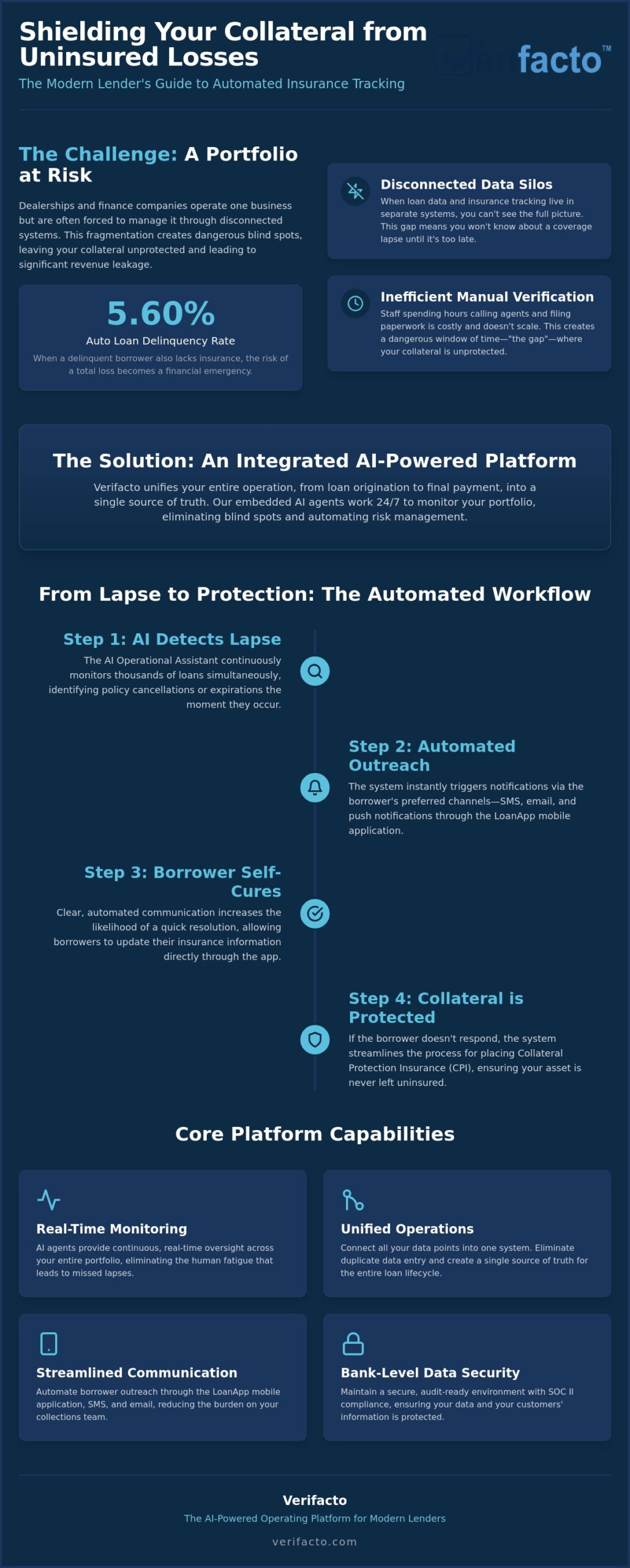
The Automated Workflow: From Lapse to Protection
A proactive risk management strategy requires a clear, repeatable process. When you implement lender placed insurance software, the transition from identifying a lapse to securing the collateral happens in minutes rather than days. This automated workflow removes the guesswork and ensures that every account is treated with the same level of scrutiny. It’s about moving from a reactive “catch-up” mode to a state of constant, automated readiness.
- Step 1: Detection. The system identifies a policy lapse or expiration immediately through real-time monitoring.
- Step 2: Outreach. Automated borrower communication is triggered via SMS and the LoanApp mobile application.
- Step 3: Escalation. The AI Operational Assistant creates a task for the lender if the borrower doesn’t respond within a set grace period.
- Step 4: Placement. The system facilitates automated CPI placement to ensure the collateral is never unprotected.
- Step 5: Billing. Premium costs are integrated into the loan balance and payment schedule within the LMS.
This sequence ensures that no vehicle remains uninsured longer than necessary. By integrating these steps directly into your daily operations, you eliminate the administrative bottlenecks that usually lead to revenue leakage. The platform handles the heavy lifting, allowing your team to step in only when human judgment is required.
Reducing Borrower Friction with LoanApp
Borrowers often find insurance verification to be a point of friction in their loan experience. LoanApp changes this dynamic by allowing borrowers to upload proof of insurance directly through their mobile device. This real-time verification helps you avoid “false placement” complaints that can damage customer relationships and lead to costly reversals. The AI Sales Agent can even assist in gathering initial insurance data during the origination phase, setting a standard for transparency from day one. By making it easy for the borrower to stay compliant, you reduce the need for forced placement altogether.
Maintaining Compliance and Audit Readiness
Regulatory oversight in auto finance is becoming increasingly complex. The software tracks every touchpoint, notification, and response, creating a comprehensive log for state-specific LPI notification periods. This level of detail provides greater visibility into your compliance status without the need for manual audits. Instead of hoping your staff followed the correct notification rules, the platform ensures those rules are baked into the workflow. If you’re ready to see how this workflow fits your business, book a demonstration to explore the platform’s full capabilities.
Unifying Your Operation with Verifacto
Dealerships operate one business but are often forced to manage it through disconnected systems. Verifacto brings the operation, data, and AI together in one platform. This unification is the key to stopping revenue leakage and improving overall financial performance. When your lender placed insurance software is an integrated part of your operating system rather than an outside add-on, you gain a level of control that manual processes can’t match. You no longer have to worry about the visibility gaps that occur when your loan data and insurance tracking live in different worlds.
Efficiency isn’t just about speed; it’s about reliability. Verifacto provides a 99.99% uptime guarantee, ensuring that your risk management tools are always available when you need to verify coverage or place a policy. This stability is crucial for independent dealers and finance companies that need to scale their operations without significantly increasing their administrative costs. By using a single source of truth, you eliminate the friction of toggling between vendors and re-entering data across multiple screens. The platform is designed to grow with you, providing the same level of sophisticated protection whether you’re managing one hundred loans or ten thousand.
Beyond operational risks, achieving long-term financial resilience often requires a holistic approach to liability management; for those exploring innovative ways to optimize their capital, Debt2Capital offers a tech-enabled platform that combines life insurance products with strategic debt elimination.
Beyond Insurance: A Complete Lending Lifecycle
The Verifacto mission goes beyond just tracking binders. We provide a comprehensive environment that includes inventory management, a robust dealership CRM, and loan servicing. This “One Platform” approach means that every piece of data, from the first lead gathered by the Sales Agent to the final payment processed through our integrated payment solutions, is connected. This connectivity ensures that insurance management isn’t a siloed task but a natural part of the loan lifecycle. When your payment processing and insurance tracking are in sync, you can manage premiums and cancellations with total accuracy.
Next Steps for Modern Lenders
The first step toward optimization is recognizing where your current systems are failing you. We encourage lenders to audit their existing manual processes for hidden revenue leakage, such as missed insurance lapses or the high cost of manual data entry. In the competitive environment of 2026, transitioning to AI-driven tracking is a necessary step for maintaining profitability and protecting your portfolio. AI agents like the Analytics Agent and Collections Agent are ready to help your team maintain control without the burnout of manual tracking.
Modern lender placed insurance software should support your team, not replace them. By providing clean data and automated workflows, Verifacto allows your staff to focus on higher-value tasks while the platform acts as the guardian of your collateral. If you’re ready to see how this unified approach can transform your business, book a demonstration to explore how the Verifacto platform fits your business.
Securing Your Portfolio with Integrated Automation
Operating a successful finance company in 2026 requires more than just reactive tracking. It demands a unified platform where data, operation, and AI work together to identify risks before they become total losses. By replacing manual verification with modern lender placed insurance software, you eliminate the visibility gaps that lead to revenue leakage. You also give your team the tools they need to maintain control without the burden of duplicate data entry or fragmented vendor portals.
Verifacto is built to act as the reliable guardian of your collateral. With SOC II compliance, bank-level data protection, and a 99.99% uptime guarantee, our AI-powered operating platform provides the professional security your business requires to scale safely. Whether it’s the Analytics Agent identifying risk patterns or the LoanApp streamlining borrower communication, every tool is designed to improve your financial performance and operational efficiency. It’s time to move away from disconnected systems and embrace a platform that supports your long term growth. We are here to help you navigate these operational challenges with confidence and precision.
See how Verifacto connects your operation from the first lead to the final payment.
Frequently Asked Questions
What is lender placed insurance (LPI) software?
LPI software is a specialized system that tracks borrower insurance coverage and automatically places collateral protection insurance (CPI) when a lapse is detected. It replaces manual binder verification, ensuring that the lender’s interest in the vehicle is protected at all times. By integrating with your loan management data, it provides real-time visibility into which vehicles are currently uninsured and automates the placement workflow.
How does automated insurance tracking reduce lender risk?
Automated tracking reduces risk by eliminating the “gap” between an insurance lapse and the lender’s discovery of that lapse. In early 2026, auto loan delinquency rates reached 5.60%, making it critical to identify uninsured collateral instantly. The software provides continuous monitoring, which helps prevent revenue leakage from total losses on uninsured vehicles that staff might have missed during manual audits or phone verification.
Can this software integrate with my current accounting tools like QuickBooks?
Yes, the Verifacto platform provides direct integration with QuickBooks and other major accounting tools. This connectivity ensures that insurance premiums, payments, and cancellations are automatically reflected in your financial records without duplicate data entry. It streamlines the reconciliation process, allowing your accounting team to maintain accurate books while managing a growing loan portfolio through a single, unified interface.
What happens if a borrower provides proof of insurance after CPI is placed?
The system is designed to handle policy cancellations and premium refunds automatically once proof of insurance is verified. Borrowers can upload their documents directly through the LoanApp mobile application for immediate review. Once the coverage is confirmed, the software can help calculate the earned premium and credit the borrower’s account for any unearned portion, reducing administrative friction and avoiding “false placement” complaints.
Is the Verifacto platform SOC II compliant?
Yes, Verifacto maintains SOC II compliance and utilizes bank-level encryption to protect sensitive borrower and portfolio data. This level of security is essential for meeting modern regulatory requirements, including the reporting mandate of the Cyber Incident Reporting for Critical Infrastructure Act taking effect in May 2026. We prioritize data security to ensure your operation remains audit-ready and protected against modern cyber threats at all times.
Does the software handle borrower communication automatically?
Yes, the platform triggers automated borrower communication via SMS, email, and app notifications the moment a lapse or expiration is detected. This multi-channel approach is managed by AI agents that provide reminders without requiring manual intervention from your staff. By automating these touchpoints, you ensure consistent outreach and improve the speed of insurance renewals across your entire portfolio without increasing your internal payroll costs.
Can I use this software for a BHPH dealership?
Absolutely, the platform is specifically designed to support the unique needs of Buy Here Pay Here (BHPH) dealerships and independent finance companies. As a unified AI-powered operating platform, it connects your DMS and LMS data with real-time lender placed insurance software. This integration helps BHPH dealers protect their high-risk collateral and improve financial performance by automating the entire CPI placement and billing workflow.
How does AI improve the insurance tracking process?
AI improves the process by acting as an embedded tool that monitors thousands of loans simultaneously without human fatigue. AI agents, such as the Analytics Agent, can identify patterns that suggest a borrower is likely to let their coverage lapse based on historical data. This proactive approach allows lenders to move from reactive recovery to predictive risk mitigation, providing greater visibility and supporting human judgment with clean data.